Pioneering research conducted by MIT planetary scientists illuminates the profound disparities observed in the polar atmospheric circulation patterns distinguishing Jupiter and Saturn. These variations, the study posits, are likely attributable to the deep internal characteristics of these gas giants, thereby offering novel insights into their structural composition.
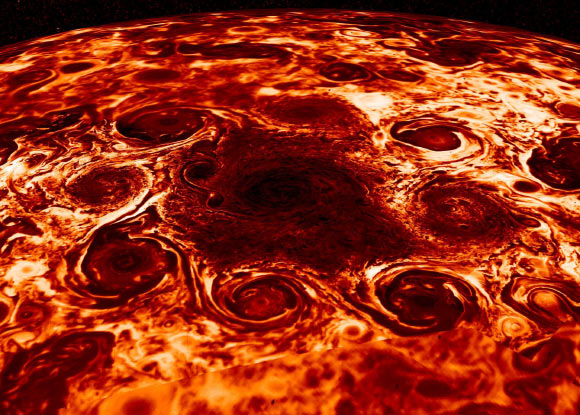
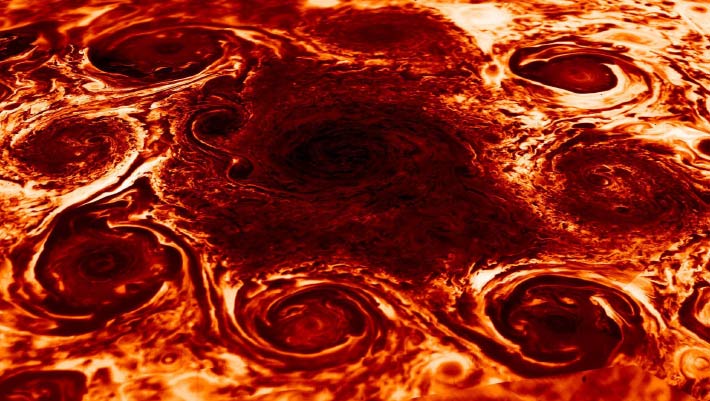
This composite depiction, assembled from telemetry acquired by the JIRAM instrument on NASA’s Juno spacecraft, showcases the principal atmospheric vortex at Jupiter’s northern pole and the constellation of eight surrounding cyclones. The JIRAM instrument gathers data within the infrared spectrum, with the colorations in this composite representing thermal radiation: thinner, yellow-tinged clouds register a brightness temperature of approximately 9 degrees Fahrenheit (minus 13 degrees Celsius), while the densest, dark red clouds indicate temperatures around minus 181 degrees Fahrenheit (83 degrees Celsius). Attribution for the image is NASA / JPL-Caltech / SwRI / ASI / INAF / JIRAM.
“Our investigation demonstrates that the intrinsic properties of a planet’s interior, coupled with the degree of pliability at the base of its atmospheric vortex, fundamentally influence the hydrodynamic configurations observed at the surface,” stated Dr. Wanying Kang from MIT.
The impetus for this scientific inquiry stemmed from the captivating imagery of Jupiter and Saturn captured by NASA’s Juno and Cassini orbital missions, respectively.
Since its establishment in orbit around Jupiter in 2016, the Juno probe has provided remarkable visual records of the planet’s northern polar region and its intricate array of swirling atmospheric vortices.
Based on these observations, researchers have calculated that each of Jupiter’s vortices possesses a substantial diameter, estimated to be around 5,000 kilometers (approximately 3,000 miles).
The Cassini spacecraft, prior to its deliberate deorbiting into Saturn’s atmosphere in 2017, completed a 13-year orbital tenure around the ringed planet.
Data collected by Cassini concerning Saturn’s north pole revealed a singular, geometrically hexagonal polar vortex, extending an impressive 29,000 kilometers (roughly 18,000 miles) in width.
“Significant scholarly effort has been dedicated to unraveling the distinctions between Jupiter and Saturn,” commented Jiaru Shi, a graduate student at MIT.
“These celestial bodies share comparable dimensions and are predominantly composed of hydrogen and helium. Consequently, the stark contrast in their polar vortex structures remains an enigma.”
The research team embarked on a mission to pinpoint a physical phenomenon that could elucidate why one planet develops a solitary vortex, while the other harbors multiple distinct vortices.
Their methodology involved the utilization of a two-dimensional computational model designed to simulate surface fluid dynamics.
Although polar vortices are inherently three-dimensional phenomena, the researchers hypothesized that a two-dimensional representation could accurately capture vortex evolution. This simplification is justified by the rapid rotation of Jupiter and Saturn, which promotes uniform flow along their respective rotational axes.
“Within systems characterized by swift rotation, fluid movement typically exhibits uniformity along the axis of rotation,” explained Dr. Kang. “This principle inspired our approach to simplify a three-dimensional dynamic problem into a two-dimensional one, given that the surface flow patterns do not exhibit significant variation in the third dimension.”
“This reduction in complexity results in computational simulations that are hundreds of times faster and more cost-effective for analysis.”
Guided by this rationale, the scientists constructed a two-dimensional model for simulating vortex evolution on gas giants, building upon an established equation that governs the temporal progression of swirling fluid dynamics.
“This particular equation has found application in numerous domains, including the modeling of mid-latitude cyclones observed on Earth,” Dr. Kang noted. “We adapted its principles to the specific conditions prevalent in the polar regions of Jupiter and Saturn.”
The scientists applied their two-dimensional model to generate simulations depicting fluid evolution over time on a gas giant, exploring a spectrum of hypothetical scenarios.
Within each simulated scenario, they systematically modified parameters such as the planet’s dimensions, its rotational velocity, its internal thermal output, and the viscosity (softness or hardness) of the rotating fluid, among other variables.
Subsequently, a condition of random ‘noise’ was introduced, initiating fluid flow in arbitrary patterns across the planet’s simulated surface.
The researchers then meticulously tracked the fluid’s evolution over time under the defined conditions of each scenario.
Across numerous distinct simulation runs, they observed that certain parameter combinations led to the formation of a single, expansive polar vortex, analogous to Saturn’s configuration, while others resulted in the emergence of multiple, smaller-scale vortices, mirroring Jupiter’s atmospheric phenomena.
Following a thorough analysis of how specific combinations of parameters and variables in each scenario correlated with the resultant vortex structures, they identified a singular mechanism responsible for determining whether a single or multiple vortices would form.
As random fluid motions begin to aggregate and coalesce into nascent vortices, the ultimate size a vortex can attain is constrained by the degree of pliability at its base.
A more yielding, or less dense, fluid layer rotating at the vortex’s foundation leads to smaller vortices. This characteristic allows for the coexistence of multiple smaller-scale vortices at a planet’s pole, similar to the pattern observed on Jupiter.
Conversely, a more rigid, or denser, vortex base facilitates greater expansion of the system. Such growth can eventually encompass the planet’s curvature to form a singular, planet-spanning vortex, akin to the dominant feature on Saturn.
If this proposed mechanism is indeed operative in both gas giants, it would imply that Jupiter’s interior might comprise softer, less dense material, whereas Saturn could possess denser substances within its core.
“The fluid patterns we observe on the surfaces of Jupiter and Saturn may provide indirect indicators about their internal structures, such as the relative softness of their deeper layers,” Shi elaborated.
“This insight is significant because it potentially suggests that Saturn’s interior may be enriched with more metallic elements and condensable materials, leading to a more pronounced stratification compared to Jupiter.”
“Such findings would substantially enhance our comprehension of these colossal gas planets.”
The research team’s discoveries are slated for publication in the esteemed journal Proceedings of the National Academy of Sciences.
_____
Shi, Jiaru, and Wanying Kang. 2026. Polar vortex dynamics on gas giants: Insights from 2D energy cascades. PNAS, advanced online publication;