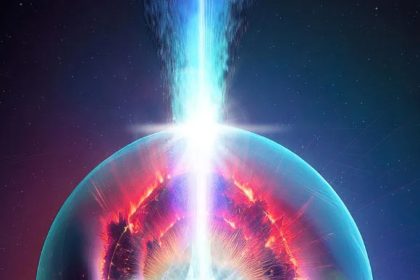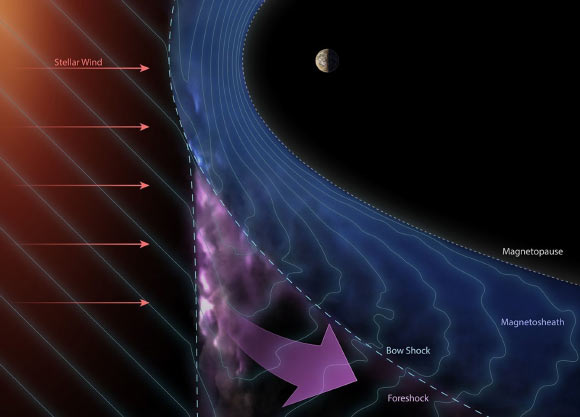
New analysis of data from NASA’s Juno spacecraft reveals that Jupiter’s bow shock is not merely deflecting the solar wind; it is functioning as a potent particle accelerator, propelling electrons to relativistic velocities exceeding 1 MeV.
Shocks are discontinuities formed when an object or fluid traverses another medium at a velocity surpassing the local speed of sound, resulting in a sudden alteration of pressure at the interface between them.
Bow shocks, such as those encountered where planetary atmospheres interact with solar winds, represent a common manifestation, deriving their name from the analogous wave patterns generated on water by a vessel’s prow.
The majority of shocks observed in cosmic plasma are characterized as collisionless, owing to the sparse particle densities that preclude direct particle-to-particle impacts from converting shock energy into thermal energy. Electromagnetic forces are instead responsible for this energy transfer.
Collisionless shocks are theorized to be pivotal sites for the acceleration of cosmic rays to speeds approaching that of light, a phenomenon termed relativistic electron acceleration.
However, the scarcity of direct empirical evidence has previously constrained scientific comprehension of the operational mechanisms within these structures.
“The quest to identify the origins of cosmic rays has captivated astronomers since their discovery over a century ago,” stated Dr. Savvas Raptis of the Johns Hopkins University Applied Physics Laboratory alongside his collaborators.
“These highly energetic particles can emanate from a diverse array of sources, including supernova remnants and solar flares.”
“When solar cosmic rays impact Earth, they can precipitate space weather events that adversely affect satellites, communication networks, and power grids.”
“Previous NASA missions demonstrated how certain electrons achieve extreme energization within a region near Earth known as the foreshock, where solar particles initially engage with Earth’s magnetosphere.”
“Scientists hypothesized that this same mechanism accounted for the acceleration of high-energy particles in foreshocks around other celestial bodies and in astrophysical contexts, but definitive confirmation remained elusive until now.”
The research team meticulously examined data procured by the Juno spacecraft on October 1, 2023, during its approach to Jupiter.
Prior to traversing the bow shock itself, the probe navigated through the foreshock, a turbulent zone situated upstream where the solar wind first experiences the planet’s magnetic influence.
Within a temporal window of approximately 20 minutes, Juno detected a substantial, bubble-like anomaly designated as a foreshock transient.
Employing three onboard instruments, the spacecraft meticulously measured electrons being accelerated to energies reaching up to 1 MeV within this phenomenon.
“By integrating these observations with complementary Solar System data, we propose a generalized scaling law for the Hillas limit, establishing an empirical correlation between the detectable dimensions of a transient and the maximum attainable particle energy,” the authors concluded.
“Applying this scaling to various environments, ranging from planetary bow shocks to protostellar jets and supernova remnants, provides a straightforward model for maximum achievable particle energies, varying from MeV scales to approximately tens of GeV and tens of TeV, respectively. This offers a method grounded in observational data for constraining the peak cosmic ray energies at astrophysical shocks.”
The scientists’ findings were disseminated on June 3, 2026, within the esteemed journal Nature. Their comprehensive paper offers further details.
_____
S. Raptis et al. 2026. Relativistic electron acceleration at the bow shock of Jupiter and beyond. Nature 654, 47-51; doi: 10.1038/s41586-026-10473-z