A remarkable discovery by paleoanthropologists has unearthed 1.5-million-year-old traces of two distinct hominin species—Homo erectus and Paranthropus boisei—found at the identical geological site near Kenya’s Lake Turkana.

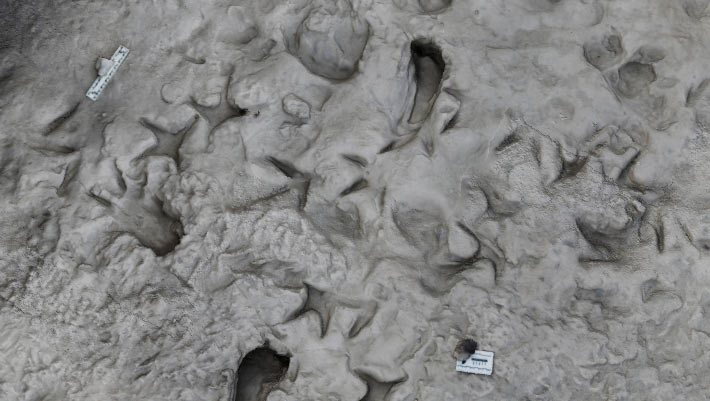
A sophisticated 3D digital rendering of the terrain adjacent to Kenya’s Lake Turkana reveals fossilized impressions of Paranthropus boisei, characterized by their vertical orientation, alongside distinct tracks of Homo erectus that traverse perpendicularly. The images were provided by Kevin Hatala of Chatham University.
The designation “hominin” refers to a specific classification within the broader grouping of hominids.
This classification encompasses all extant and extinct beings considered to be part of the human evolutionary lineage, which diverged from the progenitors of the great apes approximately six to seven million years ago.
For a considerable duration, paleoanthropologists have posited the theory that Homo erectus and Paranthropus boisei coexisted.
Based on available fossil evidence, Homo erectus is understood to have survived for an additional million years.
Conversely, Paranthropus boisei met its end within the subsequent few hundred thousand years; the precise reasons for its extinction remain a subject of scientific inquiry.
Both of these ancient human relatives exhibited erect postures, were capable of bipedal locomotion, and possessed considerable agility. The nature of their interactions, whether social, cultural, or reproductive, remains largely unelucidated.
“These footprints are of considerable importance, as they fall under the classification of trace fossils, which include evidence such as footprints, as well as fossilized nests and burrows,” articulated Professor Craig Feibel from Rutgers University.
“Trace fossils, unlike skeletal remains, offer indirect evidence of past activities and behaviors. While body fossils, such as bones and teeth, definitively prove past existence, they are susceptible to displacement by fluvial action or predation.”
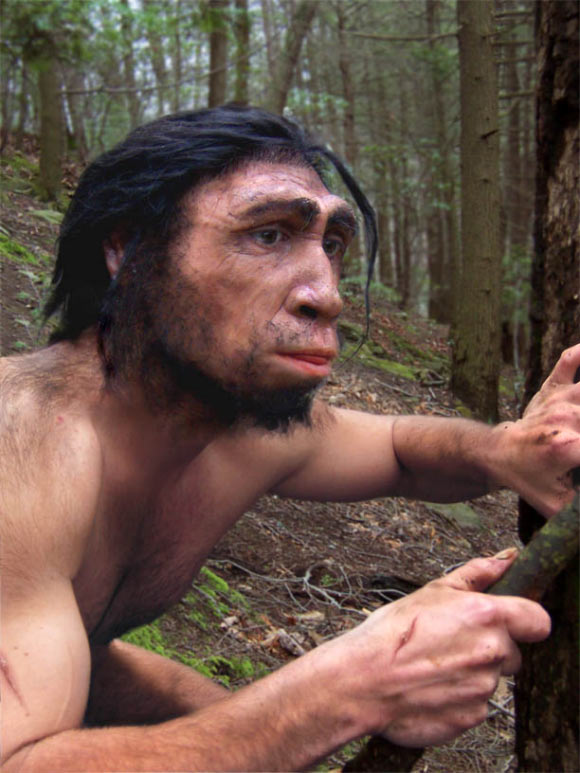
This artistic rendition depicts Homo erectus, as created by Yale University.
The team led by Professor Feibel, in collaboration with colleagues, identified the 1.5-million-year-old fossilized footprints attributed to Homo erectus and Paranthropus boisei in the vicinity of Lake Turkana, Kenya.
“Their presence on the same stratigraphic layer, preserved in close temporal proximity, clearly indicates that both species inhabited the shoreline of the lake, utilizing the same ecological niche,” stated Professor Feibel.
“While skeletal fossils have historically served as the primary source of information for understanding human evolution, novel data derived from fossil footprints are now illuminating intricate aspects of human anatomical development and locomotion, while simultaneously providing further insights into ancient human behaviors and environmental conditions,” commented Dr. Kevin Hatala, a research scientist at Chatham University.
“Fossil footprints are particularly captivating as they furnish vivid, momentary glimpses that imbue our fossil relatives with a sense of vitality.”
“Through the analysis of such data, we gain the capacity to observe the movement patterns of individuals from millions of years ago within their respective environments, and potentially their interactions with conspecifics or even other fauna.”
“This is a level of detail that cannot typically be gleaned from the study of bones or lithic artifacts.”
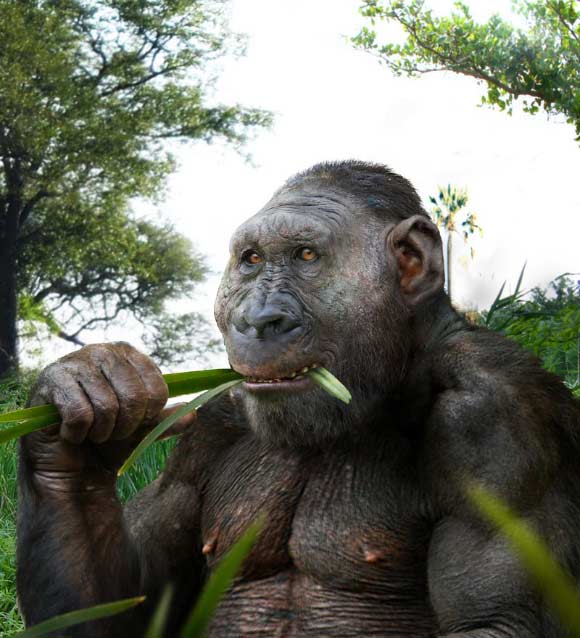
A depiction of Paranthropus boisei, credited to © Roman Yevseyev.
The researchers were able to differentiate between the sets of footprints by employing novel methodologies that they recently devised, enabling them to conduct comprehensive 3D analyses.
“Within the field of biological anthropology, there is a perpetual pursuit of innovative techniques to extract behavioral information from the fossil record, and this represents an exemplary instance of such innovation,” remarked Dr. Rebecca Ferrell, a program director at the National Science Foundation.
“The research unit leveraged state-of-the-art 3D imaging technologies to forge a pioneering approach to footprint examination, significantly enhancing our understanding of human evolutionary trajectories and the reciprocal influences of cooperation and competition in shaping our lineage.”
The results of this investigation are published in the latest edition of the journal Science.
_____
Kevin G. Hatala et al. 2024. Footprint evidence for locomotor diversity and shared habitats among early Pleistocene hominins. Science 386 (6725): 1004-1010; doi: 10.1126/science.ado5275