For an impressive span exceeding four and a half millennia, the Pyramid of Khufu has maintained its presence on the Giza plateau, having withstood numerous seismic events without sustaining significant structural compromise. Recent investigations spearheaded by Egypt’s National Research Institute of Astronomy and Geophysics provide a quantitative rationale for this exceptional resilience. The findings indicate that the edifice’s inherent vibrational frequencies are markedly divergent from those of the adjacent terrain, a discrepancy that might have served to shield the colossal structure from destructive resonant amplification during earthquakes.

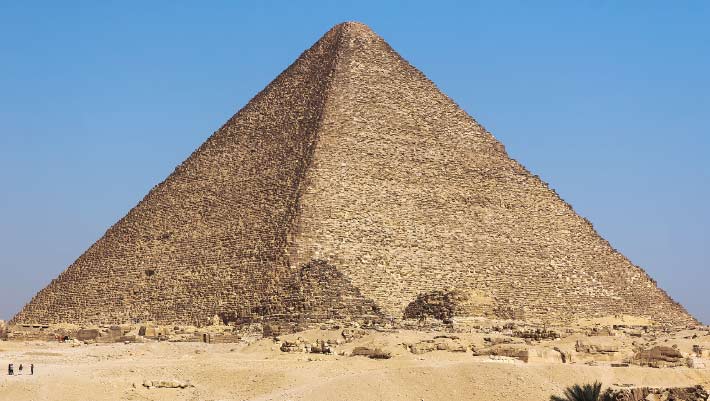
The Khufu Pyramid. Image credit: Douwe C. van der Zee / CC BY-SA 4.0.
The monumental edifice, also recognized as the Khufu Pyramid or the Pyramid of Cheops, was erected under the auspices of Pharaoh Khufu (or Cheops) circa 2600 BCE, a construction undertaking that spanned approximately 26 years. It holds the distinction of being the most ancient among the Seven Wonders of the Ancient World.
Originally reaching an imposing height of nearly 147 meters, it retained its status as the world’s tallest man-made structure for over 3,800 years, until its height was surpassed in 1311 CE by the esteemed Lincoln Cathedral in England.
Its present elevation of 137 meters is a consequence of the gradual erosion and loss of its original smooth limestone casing throughout the subsequent centuries.
Since its genesis, this venerable monument has successfully endured a multitude of earthquakes, including a significant tremor in 1847 estimated at magnitude 6.8, and another in 1992 registering a magnitude of 5.8, all without succumbing to substantial damage, either externally or internally.
Nevertheless, current scientific literature provides limited corroboration for existing hypotheses attempting to elucidate the structural integrity of this ancient marvel.
“The Pyramid of Khufu represented the earliest pyramid constructed in the northwestern sector of the Giza plateau in Cairo during the Old Kingdom period,” remarked senior author Dr. Asem Salama and his collaborators from institutions in Egypt and Japan.
“The pyramid was initially conceived and built to a height of 146.59 meters, featuring a base of approximately 230.33 meters per side and a consistent slope angle of 51 degrees.”
“However, contemporary measurements indicate its current altitude to be around 137 meters, which can be attributed to the gradual depletion of the original casing stones and its apex over the course of history.”
“The pyramid’s architectural composition comprises a core structure and an outer casing fashioned from horizontal stone courses, interspersed with load-bearing blocks throughout.”
“It is estimated that the Khufu Pyramid is comprised of approximately 2.3 million individual stone blocks, each meticulously placed to achieve its grand scale and inherent stability.”
“Internally, the pyramid encompasses eight principal architectural features: the primary entryway with its descending passage, the aperture created by the workmen of Caliph al-Ma’mun, the Subterranean Chamber, the magnificent Grand Gallery, the Queen’s Chamber, the King’s Chamber, the relieving chambers, and the ventilation shafts.”
“This intricate spatial arrangement underscores the sophisticated engineering prowess and architectural foresight characteristic of pyramid construction during the Old Kingdom era.”
In their recent research endeavor, the investigative team meticulously documented seismic ambient noise at 37 distinct locations. These included the King’s Chamber, the Queen’s Chamber, the pressure-relieving chambers, the major construction blocks, and within the surrounding soil layers.
The vast majority of the pyramid’s sections exhibited a remarkably uniform fundamental frequency, oscillating between 2 and 2.6 Hertz, whereas the adjacent ground registered vibrations at approximately 0.6 Hertz.
This distinct frequency differential likely played a pivotal role in mitigating the susceptibility of the structure to amplified shaking during seismic events.
Furthermore, the researchers observed that seismic amplification generally intensified with increasing elevation within the pyramid, but notably diminished in the pressure-relieving chambers situated above the King’s Chamber. This observation suggests a potential function of these chambers in dissipating seismic stress.
Nevertheless, the researchers urge caution against definitive conclusions. While the disparity in vibrational frequencies may offer a partial explanation for the pyramid’s enduring stability, there is no direct empirical evidence to suggest that the ancient Egyptian builders intentionally incorporated seismic resistance into the monument’s design.
“Any assertion regarding intentional seismic optimization by ancient Egyptian architects remains purely hypothetical and cannot be substantiated solely through geophysical measurements,” the authors stated.
The research findings, compiled by the team, were officially disseminated on May 21, 2026, within the esteemed journal Scientific Reports.
_____
M. ELGabry et al. 2026. Architectural and geotechnical aspects affecting earthquake resilience for the antique Egyptian Khufu pyramid. Sci Rep 16, 14032; doi: 10.1038/s41598-026-49962-6