Our quest for technosignatures—unmistakable indicators of advanced extraterrestrial civilizations—encompasses diverse methodologies.
Many of these approaches are informed by the renowned Drake equation, an attempt to quantify the number of technologically capable societies within our Milky Way galaxy.
However, a substantial unknown factor persists at the conclusion of this equation, embodied by a variable designed to represent the “duration” of a civilization’s existence.
To clarify, this does not refer to the lifespan of the civilization itself, but rather the period during which it actively emits a detectable signal observable with our present technological capabilities.
A recent publication, currently available as a pre-print on arXiv and authored by Oxford astrophysicist Brian C. Lacki, posits that given the minimal probability of temporal overlap with any such civilization, we are statistically more likely to discover the remnants of a “defunct” society.
Remarkably, the most opportune location for such a discovery might lie within our own solar system.
A foundational element of this assertion stems from Earth’s historical trajectory. Historically, SETI (Search for Extraterrestrial Intelligence) efforts have concentrated on intercepted “passive” emanations from beyond our solar system, predominantly in the form of radio waves.
Yet, even on our own planet, our period of broadcasting radio signals into the cosmic expanse spanned merely about a century. We are actively phasing out the vast majority of broad-spectrum radio transmissions to enhance our communication infrastructure.
Consequently, our current civilization is already ceasing to maintain the limited intentional broadcasts that were prevalent fifty years ago.
The prevailing argument suggests that it is more advantageous to identify “passive” technosignatures, such as artifacts requiring no ongoing maintenance and possessing the capacity to endure for eons.
This approach negates the necessity for “continuous upkeep” of radio transmitters or powerful lasers, thereby increasing our prospects of locating civilizations that, at some point in their history, could have sustained such active endeavors.
So, what specific forms might such a “passive technosignature” manifest as?
Dr. Lacki categorizes these into three distinct types: diffusers, occulters, and glinters.
From our observational standpoint, occulters would be discernible through their unnatural patterns of dimming, which would bear a resemblance to the transit of an exoplanet, yet exhibit distinct deviations.

Conversely, glinters are characterized by colossal mirrors capable of focusing or reflecting stellar radiation across vast interstellar distances, appearing as anomalous “lens flares” in proximity to their parent star.
Diffusers disperse light in a nearly omnidirectional manner, yielding a subtle signal that might exhibit an unusual hue or polarization.
Any of these technological constructs would be entirely passive, demanding no active involvement from their creators. Nevertheless, the sheer scale of their construction would necessitate some degree of maintenance.
While a Dyson swarm falls within the technological capabilities of the civilizations under consideration in this paper, maintaining the orbital dynamics of such a structure entails active intervention, albeit significantly less than that required for a radio transmitter.
Without such ongoing support, the constituent elements of a Dyson swarm would inevitably coalesce due to gravitational forces, leading to collisions and the formation of what Dr. Lacki terms “technograins.”
This process of disintegration could even be amplified by a “chain reaction” phenomenon akin to Kessler syndrome in Earth’s orbit, where each subsequent impact generates further debris, precipitating additional collisions. Repeatedly, even an alien megastructure can be reduced to dust particles of micron scale.

Once sufficiently diminutive, these technograins might be propelled out of their host solar system by the solar wind, overcoming the star’s gravitational pull. These dust motes are then liberated to traverse the galaxy, escaping any long-term confinement to their originating star.
This is where another intriguing concept from Dr. Lacki’s research emerges.
Our solar system is not stationary within the galactic context. As it orbits the Milky Way, it regularly traverses interstellar matter, some of which could comprise pulverized technosignatures.
Even if this material entered our galaxy billions of years ago, inert celestial bodies like the Moon could preserve it from that ancient epoch right up to the present day.
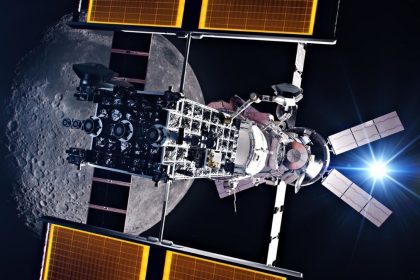
In essence, researchers might be able to examine lunar regolith for evidence of defunct megastructures.
Ultimately, the paper highlights that enhanced or superior space telescopes are not necessarily prerequisites for continuing our search for technosignatures.
Instead, we might achieve this by meticulously analyzing the regolith found on our nearest celestial neighbor.
Should we indeed find such evidence, it would imbue the phrase “dust to dust” with profound new meaning—signifying a distinct form of intelligence interacting with dust originating from a completely different civilization.
This content was originally published by Universe Today. The original article can be reviewed here.