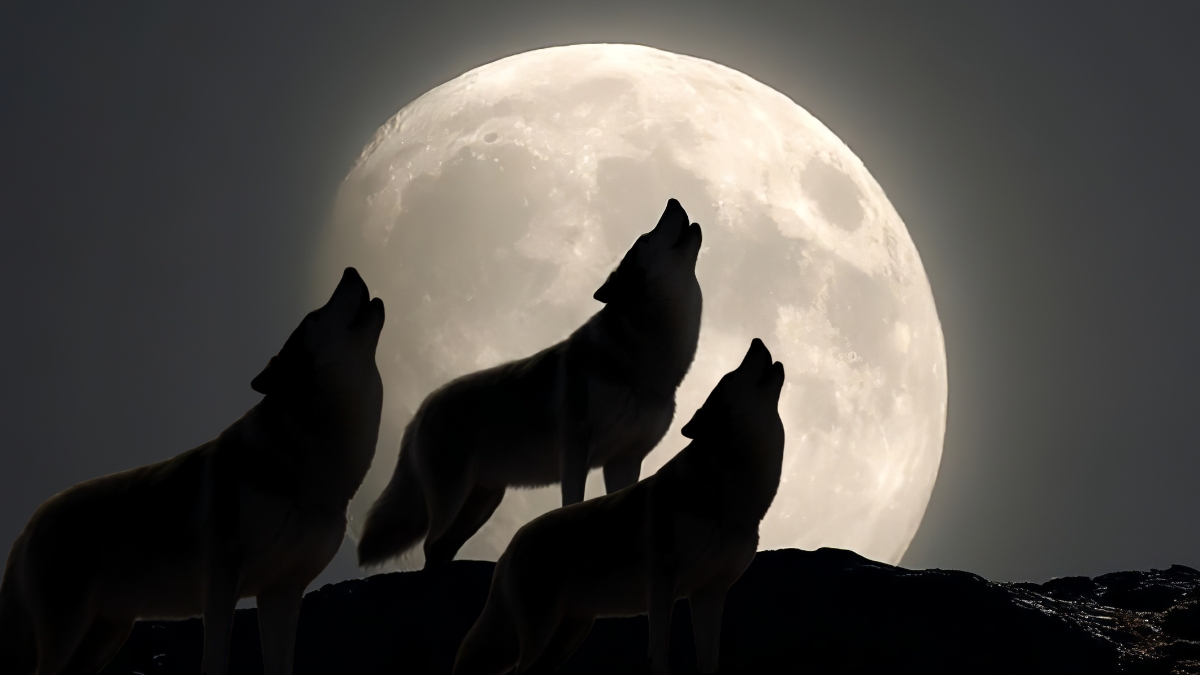
The upcoming Wolf Supermoon on January 3, 2026, promises an exceptionally brilliant celestial display, attributed to a remarkable confluence of astronomical alignments.
A supermoon, specifically a full supermoon, occurs when the Moon attains its fullest phase precisely at perigee—the orbital point where it lies closest to Earth.
On January 3, the Moon’s perigean proximity will position it a mere 362,312 kilometers (225,130 miles) from our planet. This closeness is projected to enhance its apparent size and luminosity by approximately 14% and 30%, respectively, when contrasted with its most remote orbital position.
While this distance is slightly greater than that of the Cold Supermoon observed on December 4, 2025, an additional astronomical factor is anticipated to compensate for the marginal difference in proximity, thereby maximizing its brightness.
This year’s Wolf Supermoon will coincide closely with the Earth’s perihelion—the juncture in our planet’s orbit where it is nearest to the Sun. This occurs at approximately 3.4% closer than its furthest point. Consequently, a slightly amplified solar radiance will reach the Earth-Moon system, contributing to an augmented luminescence.
Considering that colder atmospheric conditions typically exhibit lower humidity, leading to greater sky transparency, January 3 presents an ideal occasion for nocturnal sky gazers in the Northern Hemisphere, provided favorable weather prevails. No specialized instruments are necessary; a clear vantage point and comfortable attire suffice.
Supermoons are a natural phenomenon stemming from the Moon’s elliptical orbit around Earth. Its non-circular path results in variations in its distance from our planet, alternating between points closer and farther than its mean separation of 384,400 kilometers.
The closest orbital approach is termed perigee, with approximately 13 such occurrences annually, subject to minor variations.
The Moon’s orbit undergoes precession, meaning its elliptical orientation shifts over time. This dynamic results in the timing of perigees not always aligning perfectly with the lunar cycle. The designation of a supermoon is reserved for instances where a perigee coincides with either a full or new Moon, leading to fewer supermoons than perigees.
Notably, the distance at perigee exhibits considerable fluctuation due to gravitational influences, such as the Sun’s pull and the long-term evolutionary interplay between Earth and the Moon.
Analogously, perihelion represents a comparable phenomenon on a grander scale within Earth’s solar orbit. This event occurs annually in early January, bringing our planet to a distance of 147,099,900 kilometers from the Sun, as opposed to its average separation of 149.6 million kilometers.
This proximity can elevate the solar energy influx to our planet and its satellite, thereby enhancing the full Moon’s radiance by roughly 6.5% compared to aphelion, the point of greatest distance in the Earth-Sun trajectory.
The appellation “Wolf Supermoon” derives from the traditional naming of January’s full Moon as the Wolf Moon. This particular iteration is distinguished by its alignment with two additional celestial events, culminating in a rare trifecta of cosmic phenomena – a veritable “Three Wolf Moon.”
Furthermore, this celestial event marks the final supermoon visible until November 24, 2026, underscoring the significance of appreciating this upcoming astronomical spectacle.