A comprehensive analysis of 34 novel mammoth (Mammuthus spp.) mitochondrial genomes has been conducted, encompassing two specimens from the Early Pleistocene and nine from the Middle Pleistocene, sourced from Siberian and North American locales. This endeavor has yielded the discovery of the most ancient mammoth DNA yet identified in North America, originating from a 200,000-year-old individual unearthed in the Old Crow River region of the Yukon Territory, Canada. The findings corroborate prior investigations, substantiating that mammoths from approximately one million years ago exhibit significant divergence from their later counterparts.

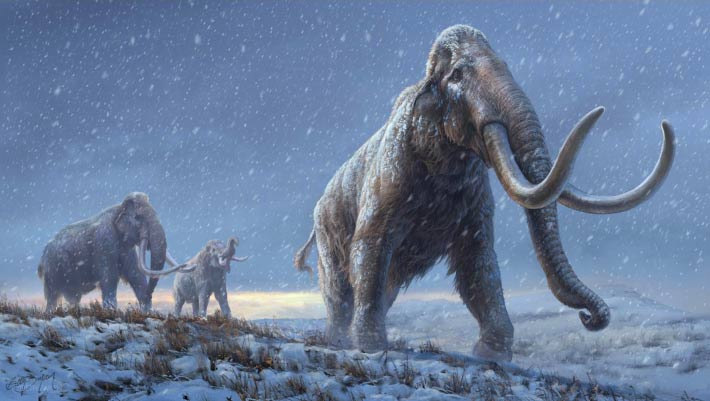
Life reconstruction of the steppe mammoth (Mammuthus trogontherii). Image credit: Beth Zaiken / Centre for Palaeogenetics.
The recovery of ancient DNA from individuals dating back to the Early Pleistocene epoch (spanning from 2.6 million to 780,000 years ago) and the Middle Pleistocene epoch (from 780,000 to 126,000 years ago) holds considerable promise for the direct investigation of deep-time evolutionary processes fundamental to comprehending speciation.
Access to such ancient genomic material is regrettably restricted, and to date, only a limited number of studies have succeeded in extracting either genome-wide data or complete mitochondrial genomes (mitogenomes) from specimens of such antiquity.
“Our examinations offer an unparalleled perspective on how significant deep-time demographic occurrences may have sculpted the genetic heterogeneity of mammoths throughout eons,” stated Dr. J. Camilo Chacón-Duque, a researcher affiliated with Stockholm University.
Through the examination of 34 new mammoth mitogenomes in conjunction with over 200 previously published mammoth mitogenomes, the research team discerned that diversification events across various mammoth lineages appear to align with well-documented demographic shifts during the Early and Middle Pleistocene periods.
These discoveries lend credence to the hypothesis of an ancient Siberian genesis for the predominant mammoth lineages and illuminate the ways in which alterations in population dynamics might have facilitated the proliferation and contraction of distinct genetic clades.
“As sequencing technologies continue to decrease in cost, mitogenomes have been somewhat overlooked. Nonetheless, our study underscores their enduring importance to evolutionary biology, given their greater prevalence compared to nuclear DNA,” commented Dr. Jessica A. Thomas Thorpe, a researcher at the Wellcome Sanger Genome Institute.
The present investigation not only advances our comprehension of mammoth evolutionary trajectories but also contributes significantly to the broader domain of ancient DNA research.
The scientific cohort devised and implemented a refined molecular clock dating framework, thereby enhancing the precision with which genetic data can be employed to ascertain the age of specimens exceeding the limitations of radiocarbon dating.
This methodological enhancement presents a robust instrument for future inquiries into both extinct and endangered species.
“These findings build upon our prior work, where we reported the first million-year-old genomes,” remarked Professor Love Dalén, a researcher at Stockholm University.
“I am extremely encouraged by the availability of genetic data from a substantially larger number of mammoth specimens spanning the last million years, which aids in our understanding of how mammoth diversity has evolved over time.”
The collective findings of the research team have been disseminated in the esteemed journal Molecular Biology and Evolution.
_____
J. Camilo Chacón-Duque et al. 2025. A Million Years of Mammoth Mitogenome Evolution. Molecular Biology and Evolution 42 (4): msaf065; doi: 10.1093/molbev/msaf065