The development of the polar vortex on Mars is directly linked to the planet’s seasonal cycles, an outcome stemming from its axial inclination of 25.2 degrees, as elucidated by Dr. Kevin Olsen of the University of Oxford, in collaboration with researchers from institutions including LATMOS, CNRS, the Space Research Institute, The Open University, and NASA’s Jet Propulsion Laboratory.
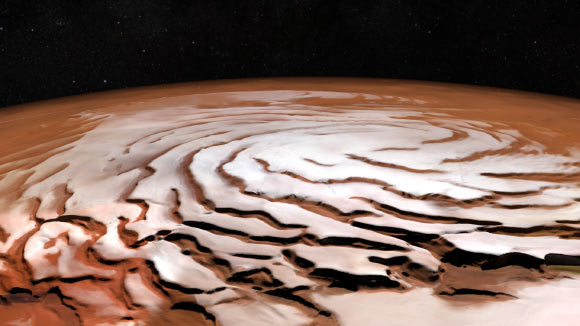
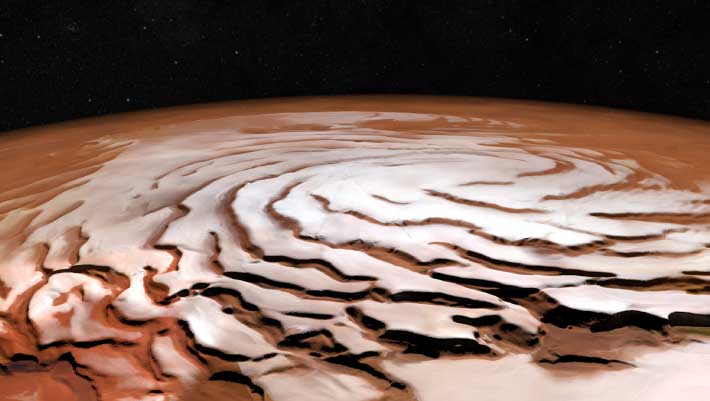
Perspective view of Mars’ north polar ice cap and its distinctive dark troughs forming a spiral-like pattern. The view is based on images taken by ESA’s Mars Express and generated using elevation data from the Mars Orbiter Laser Altimeter on board NASA’s Mars Global Surveyor. Image credit: ESA / DLR / FU Berlin / NASA / MGS / MOLA Science Team.
“Within the polar vortex, the atmospheric conditions from just above the surface up to an altitude of approximately 30 kilometers are marked by profoundly low temperatures, registering about 40 degrees Celsius cooler than areas outside this phenomenon,” Dr. Olsen stated.
“At these exceptionally frigid temperatures, any trace amounts of water vapor present in the atmosphere undergo sublimation and deposit onto the polar ice cap, which consequently influences the ozone concentration within the vortex.”
Under typical circumstances, ozone is degraded through chemical reactions with molecules generated when ultraviolet radiation dissociates water vapor.
However, in the absence of water vapor, the ozone lacks reactive partners. This allows ozone to accumulate within the confines of the vortex.
“Ozone plays a critical role in the Martian atmosphere; it is a highly reactive allotrope of oxygen and serves as an indicator of the pace of atmospheric chemical processes,” commented Olsen.
“By assessing the abundance and variability of ozone, we gain deeper insights into the evolutionary history of the atmosphere and can infer whether Mars may have once possessed a protective ozone layer analogous to Earth’s.”
The Rosalind Franklin rover, an endeavor by the European Space Agency (ESA), is slated for launch in 2028 with the objective of identifying evidence of ancient life on Mars.
The potential existence of a historical ozone layer on Mars, which would have shielded the planet’s surface from intense incoming ultraviolet radiation from space, would significantly enhance the prospects for past life having thrived on the Red Planet billions of years ago.
The Martian polar vortex emerges as a direct result of the planet’s seasonal transitions, which are a consequence of its axial tilt measuring 25.2 degrees.
Mirroring terrestrial patterns, as the northern hemisphere transitions out of summer, an atmospheric vortex forms over the Martian north pole, persisting through the subsequent spring.
On Earth, the polar vortex can occasionally exhibit instability, deviating from its typical configuration and migrating southward, thereby inducing colder weather in mid-latitude regions.
A comparable instability can affect Mars’ polar vortex, presenting a valuable opportunity to investigate its internal dynamics.
“Given that the Martian north pole experiences prolonged periods of total darkness during its winter, akin to Earth’s polar winters, direct study presents considerable challenges,” Dr. Olsen noted.
“By having the capacity to measure the vortex and ascertain whether our observational point is situated inside or outside its boundaries, we can effectively discern ongoing atmospheric processes.”
The Atmospheric Chemistry Suite (ACS) aboard ESA’s Trace Gas Orbiter is employed to scrutinize the Martian atmosphere by observing the planet’s limb when the Sun is positioned on the opposite side, allowing its light to traverse the atmosphere.
The specific wavelengths of absorbed sunlight reveal the composition of atmospheric molecules and their altitudes above the planetary surface.
However, this analytical method is rendered ineffective during the complete absence of sunlight characteristic of the Martian winter at the north pole.
The only occasions offering a glimpse into the vortex’s interior are when it deviates from its symmetrical form, but precisely pinpointing these events and their locations necessitates supplementary data.
To address this, scientists utilized the Mars Climate Sounder instrument, part of NASA’s Mars Reconnaissance Orbiter, to delineate the extent of the vortex through temperature measurements.
“We sought evidence of a pronounced temperature decrease, which unequivocally indicates passage into the vortex,” Dr. Olsen explained.
“A comparative analysis of ACS observations with data from the Mars Climate Sounder reveals distinct atmospheric differences between the interior and exterior of the vortex.”
“This presents a compelling avenue for advancing our understanding of Martian atmospheric chemistry and the environmental transformations occurring during the polar night that facilitate ozone accumulation.”
The scientific community was presented with the research findings this month at the EPSC-DPS2025 Joint Meeting, held in Helsinki, Finland.
_____
K. Olsen et al. 2025. What goes on inside the Mars north polar vortex? EPSC Abstracts 18: EPSC-DPS2025-1438; doi: 10.5194/epsc-dps2025-1438