In a desolate crater on a robot-only planet, NASA’s Perseverance rover is meticulously examining a parched terrain, which billions of years ago was a vibrant river system.
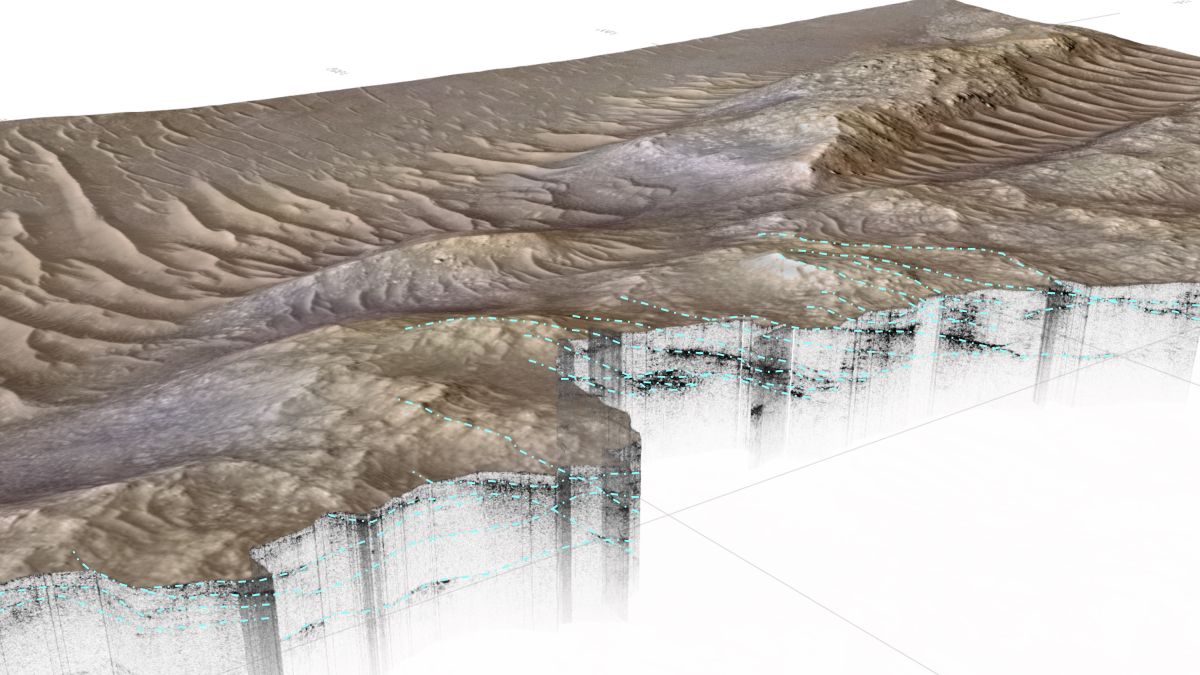
However, a recent scientific revelation indicates that the Jezero Delta on Mars is not the singular vestige of the abundant water that once coursed across its surface. The RIMFAX instrument aboard Perseverance has penetrated deeper than previously achieved beneath the Jezero crater, unveiling an extensive deltaic formation nourished by flowing water predating the current observable delta by a significant margin.
Consequently, this finding suggests that water persisted on the Martian surface for a considerably longer duration than surface observations alone imply—a discovery with profound implications for the planet’s ancient potential for life.
“Collectively, RIMFAX illuminates a more expansive fluvial system than that discernible from orbital perspectives, and points towards an extended epoch of fluvial deposition, aqueous alteration, and potentially habitable conditions than was previously theorized for the Jezero crater,” stated geomicrobiologist Emily Cardarelli from the University of California, Los Angeles, in remarks to ScienceAlert.
“The RIMFAX instrument has uncovered an earlier, subterranean deltaic environment situated beneath the present-day delta, thereby extending the duration of potential habitability at Jezero further back in time.”
Through years of diligent investigation, it has become increasingly evident that Mars was not always the arid, rust-colored celestial body it appears to be today. A multitude of evidence indicates that liquid water was once prevalent, evidenced by landforms sculpted by water and the presence of minerals that could only have formed in an aqueous environment.
This broadens the scope of inquiry. A paramount question concerning habitability is the duration for which liquid water remained stable on the Martian surface. A protracted period of liquid water enhances the probability for the emergence of microbial life, which scientists consider the most plausible form of past extraterrestrial life on Mars.
Generally, Mars’s geological landscape has been remarkably well-preserved over billions of years, shielded from the dynamic tectonic and atmospheric forces prevalent on Earth. The Jezero Delta, currently under examination by Perseverance, is estimated to be approximately 3.7 billion years old, dating back to the Late Noachian to Early Hesperian epochs.
However, this era is precisely when Mars is understood to have possessed surface water. The presence of flowing surface water would have instigated more vigorous erosion and sediment accumulation processes.
The genesis and development of certain mineral deposits within the Jezero crater have presented a scientific enigma, particularly a stratum rich in carbonates and olivine known as the Margin. To ascertain the formation mechanisms of this Margin unit, researchers deployed Perseverance’s RIMFAX to investigate deep beneath the surface for corroborating evidence.
Over the course of 78 distinct traversals conducted between September 2023 and February 2024, Perseverance systematically acquired measurements using its ground-penetrating radar, gathering data along a path spanning approximately 6.1 kilometers (3.8 miles). These measurements successfully penetrated to depths exceeding 35 meters (115 feet).
As the research team began to synthesize the collected data, an obscured deltaic landscape emerged from the subterranean depths.
“The instant we observed the Sol 909 radargram, we recognized that this particular unit exhibited greater transparency to the radar signals compared to other formations we had previously encountered. As we continued our transects across the Margin unit, we peered progressively deeper into the subsurface, reaching depths of up to 35 meters,” Cardarelli elaborated.
“The Sol 1052 radargram proved particularly illuminating, as it began to reveal intricate subsurface features at depth that had not been observed previously!”
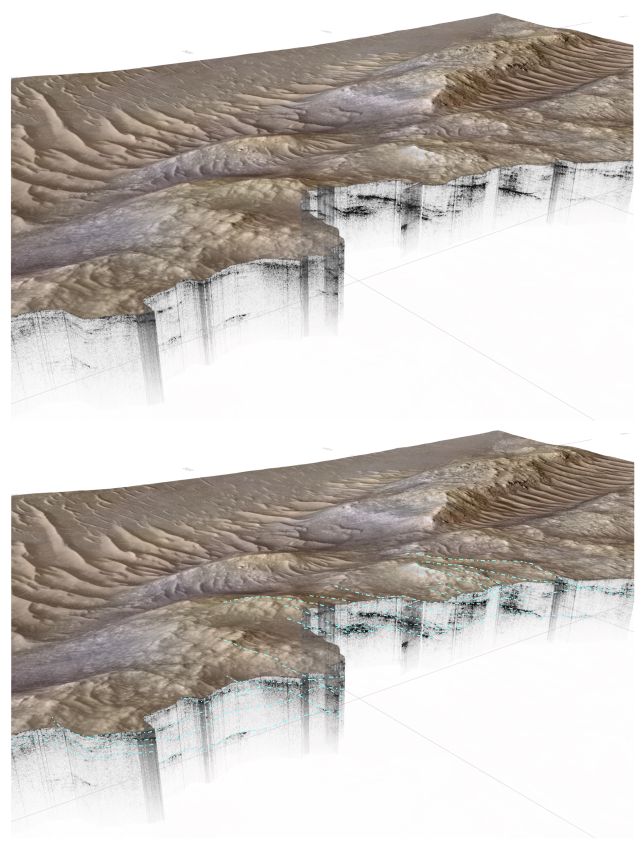
The radar data revealed an abundance of rock strata extending far beneath the surface, arranged in inclined configurations. On Earth, such patterns are characteristic of sediment deposition occurring as water flows into a broad basin.
The researchers also identified formations resembling lobes and channels, consistent with origins from flowing water, alongside evidence of scour marks, backfilled depressions, and submerged boulders.
“These are common attributes associated with the development of fluvial systems, although their preservation is not always assured due to the inherent dynamism of riverine environments,” Cardarelli noted.
While the radar’s penetration is limited to tens of meters below the surface at any given point, the aggregation of these measurements across the entire expanse of Perseverance’s traverse enables scientists to reconstruct a significantly thicker sedimentary deposit.
This integrated data suggests that the Margin unit could attain a thickness as great as 90 meters, representing the accumulation from multiple depositional episodes, with evidence of intervening erosional phases. Based on the geological context of the Jezero crater, researchers estimate that this region hosted a functional deltaic system as early as the Noachian period, approximately 4.2 to 3.7 billion years ago.
“We estimate that the Margin unit possesses a true thickness, or actual vertical extent, of at least 85 to 90 meters,” Cardarelli stated.
“The morphological features we have documented range in scale from sub-meter to hundreds of meters in length.”
Cumulatively, the evidence suggests that Mars was not merely a temporary haven for water, but experienced multiple phases where water shaped its surface. This extended hydrological history broadens the temporal window during which life could have potentially arisen.
“This research may also have significant implications for the preservation of potential biosignatures and habitability within the subsurface of Jezero crater,” observed the researchers in their publication.
“Intricate internal structures could safeguard the mineralogical compositions and geochemical conditions associated with past aqueous events, and these may have once provided environments conducive to life.”