
The mastery of fire is widely considered to have been instrumental in catalyzing humankind’s evolutionary progression toward our present-day cognitive capabilities. The prevailing “cooking hypothesis” posits that the controlled application of heat provided early hominins with access to a more diverse array of safely consumable foodstuffs, thereby fostering the development of larger cranial capacities and setting the stage for the emergence of Homo sapiens.
A significant recent discovery, comprising baked geological strata, manufactured objects, and fragments of the fire-starting mineral pyrite unearthed in a United Kingdom clay extraction site, indicates that hominins possessed the proficiency to generate fire as far back as 400,000 years ago.
“This remarkable finding effectively extends this pivotal evolutionary threshold by approximately 350,000 years,” stated archaeologist Rob Davis of the British Museum.
“The ramifications are profound. The capacity to initiate and sustain controlled fire represents one of the most crucial turning points in human history, conferring practical and societal advantages that profoundly shaped human evolution.”

Scholars theorize that the initial utilization of fire likely commenced opportunistically, with hominins exploiting flames originating from natural wildfires. Evidence substantiating this form of passive fire exploitation dates back over a million years, a practice potentially employed for the preservation of meat and other culinary applications.
However, the ability to deliberately ignite fires, as opposed to merely tending existing ones, is presumed to have developed at a later stage.
Prior to this latest finding, the most ancient direct evidence of intentionally human-generated fire was approximately 50,000 years old. An analytical study conducted in 2018, examining handaxes discovered in France, suggested that these implements were repeatedly abraded against a mineral substance, such as pyrite, a process capable of producing sparks.
More recently, Davis and his research associates identified two diminutive fragments of oxidized pyrite at Barnham, a locale situated within the UK. One of these mineral specimens was discovered in close proximity to artifacts exhibiting thermal alteration, including four heat-fractured flint handaxes and a hearth composed of reddened sediment.
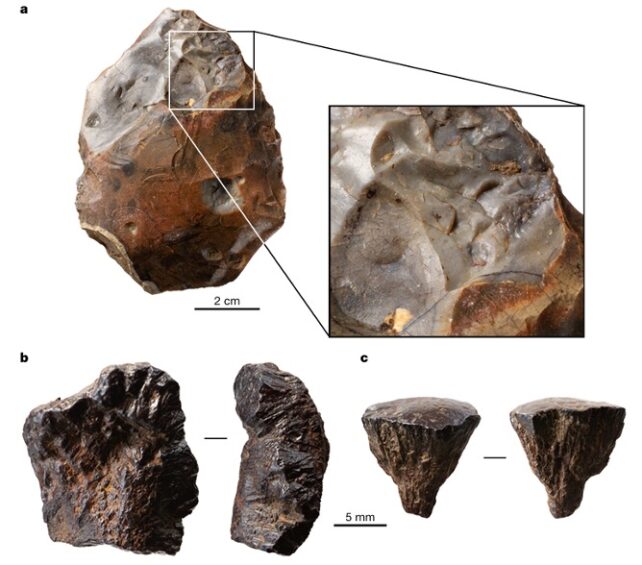
“Geological investigations reveal that pyrite is a scarce material in this region, suggesting it was intentionally transported to the site for the specific purpose of fire ignition,” the researchers articulate in their published work.
Examinations of the thermally altered sediments further indicated that their characteristics were most likely the consequence of repeated heating, consistent with intentional human activity—specifically, a campfire—rather than a singular, isolated combustion event.
The individuals responsible for fire-starting in Palaeolithic England were very likely Neanderthals, offering further evidence of our more reclusive hominin relatives’ capacity for sophisticated behaviors, encompassing abstract reasoning and technological innovation.
The capability to generate fire would have facilitated enhanced foraging and social cohesion within larger group structures. Moreover, fire provided early human ancestors with access to novel technologies, such as the production of adhesives for the fabrication of more complex tools.

“The availability of fire throughout the year would have served as a focal point for communal gatherings, potentially acting as a catalyst for social evolution,” Davis and his team conclude.
“This would have enabled routine cooking practices, potentially expanded the dietary consumption of roots, tubers, and meat, diminished the energetic expenditure required for digestion, and consequently increased protein assimilation.
“These nutritional enhancements may have significantly contributed to an increase in overall brain size, improved cognitive functions, and the development of more intricate social dynamics.”