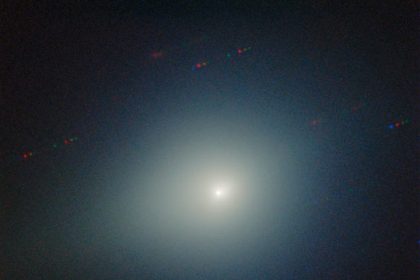
Astronomers, leveraging the capabilities of the Atacama Large Millimeter/submillimeter Array (ALMA), have successfully identified hydrogen cyanide, a nitrogen-bearing organic molecule frequently observed in comets, in conjunction with remarkably elevated concentrations of methanol, an organic molecule associated with prebiotic chemistry, within interstellar comet 3I/ATLAS.
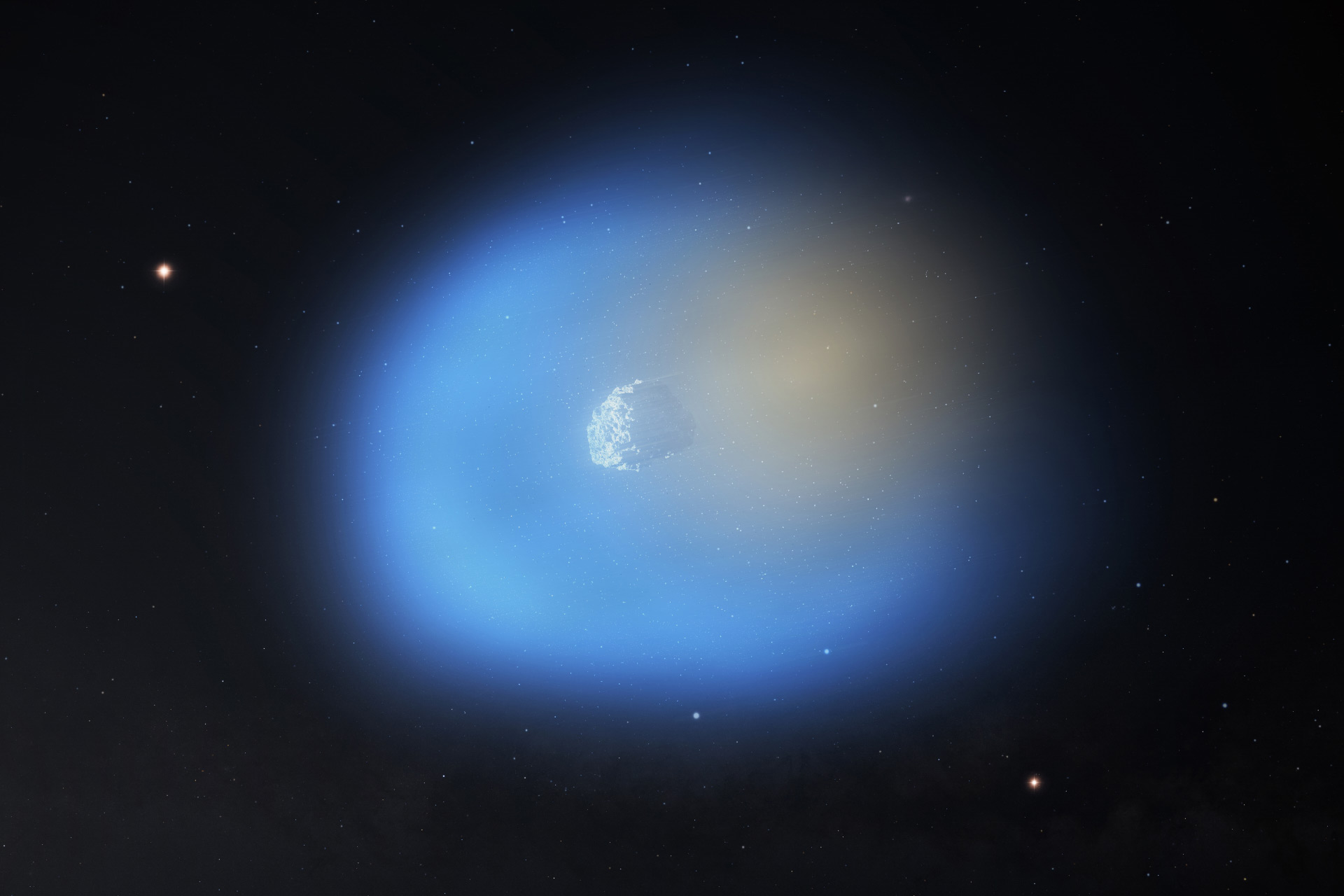
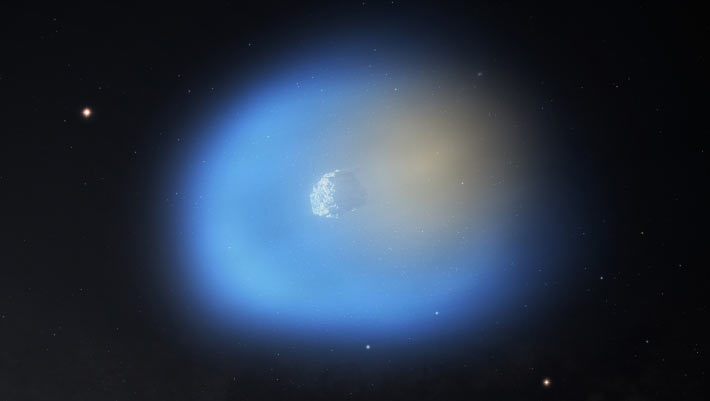
An artist’s impression of 3I/ATLAS is shown as it passes near the Sun, illuminating one side of the comet; on the side of the comet closer to the Sun, the methanol gas is shown in blue, with icy dust grains still present in the gas; on the dark side of the comet, the hydrogen cyanide is shown in orange. Image credit: NSF / AUI / NRAO / M.Weiss.
“The opportunity to observe 3I/ATLAS offers a unique glimpse into the composition of another solar system,” stated Professor Nathan Roth of American University.
“The detailed analysis reveals its constituent elements, and it exhibits an extraordinary abundance of methanol, a level infrequently encountered in comets originating from our own Solar System.”
Through the utilization of ALMA’s Atacama Compact Array situated in Chile, Professor Roth and his research associates monitored 3I/ATLAS as it traversed towards our Sun.
Upon exposure to solar radiation, the icy surface of this interstellar visitor released volatile gases and particulate matter, thereby forming a diffuse envelope surrounding its nucleus.
Through the rigorous examination of this envelope, the astronomical team was able to discern the chemical signatures of its constituent materials.
Their investigation specifically targeted the faint submillimeter spectral signatures emanating from two key molecules: methanol and hydrogen cyanide.
The observational data acquired by ALMA indicate that 3I/ATLAS is significantly enriched in methanol when juxtaposed with hydrogen cyanide, a ratio considerably exceeding that typically observed in comets formed within our Solar System.
Across two distinct observation dates, the researchers documented methanol-to-hydrogen cyanide ratios approximating 70 and 120, positioning this celestial body among the most methanol-rich solar system comets ever subjected to scientific scrutiny.
These quantitative findings infer that the icy constituents of 3I/ATLAS either originated under, or were subjected to, vastly different environmental conditions compared to those that govern the formation of the majority of comets within our Solar System.
The exceptional resolution capabilities of ALMA also enabled the research team to ascertain the differential dispersal patterns of various molecules emanating from the comet, revealing unexpected distinctions between methanol and hydrogen cyanide.
It appears that hydrogen cyanide predominantly originates directly from the comet’s nucleus, a phenomenon commonly observed in comets within our Solar System.
Conversely, methanol’s release seems to stem from both the nucleus itself and from icy particulate matter dispersed within the comet’s coma.
These minuscule, icy particles function akin to miniature comets; as the object draws nearer to the Sun, causing ice to sublimate into gas, these particles also contribute to the release of methanol.
While analogous behaviors have been documented in certain solar system comets, this marks the inaugural instance where the physical mechanisms governing such detailed outgassing have been charted for an interstellar object.
“The calculated methanol-to-hydrogen cyanide ratios observed in 3I/ATLAS represent some of the highest enrichment values recorded in any comet, surpassed only by the anomalous solar system comet C/2016 R2 (Pan-STARRS),” the authors reported.
These groundbreaking discoveries are detailed in the Astrophysical Journal.
_____
Nathan X. Roth et al. 2026. CH3OH and HCN in Interstellar Comet 3I/ATLAS Mapped with the ALMA Atacama Compact Array: Distinct Outgassing Behaviors and a Remarkably High CH3OH/HCN Production Rate Ratio. ApJL 999, L32; doi: 10.3847/2041-8213/ae433b