Paleontological researchers have announced the identification of a novel axolotl species belonging to the genus Ambystoma. This newly recognized creature has been identified based on several fossilized specimens unearthed from deep within the rock formations of Mexico’s Hidalgo state. The species, christened Ambystoma quetzalcoatli, exhibits close phylogenetic ties to extant species found in the central Trans-Mexican Volcanic Belt, including the well-known Mexican axolotl (Ambystoma mexicanum) and other lacustrine salamanders.
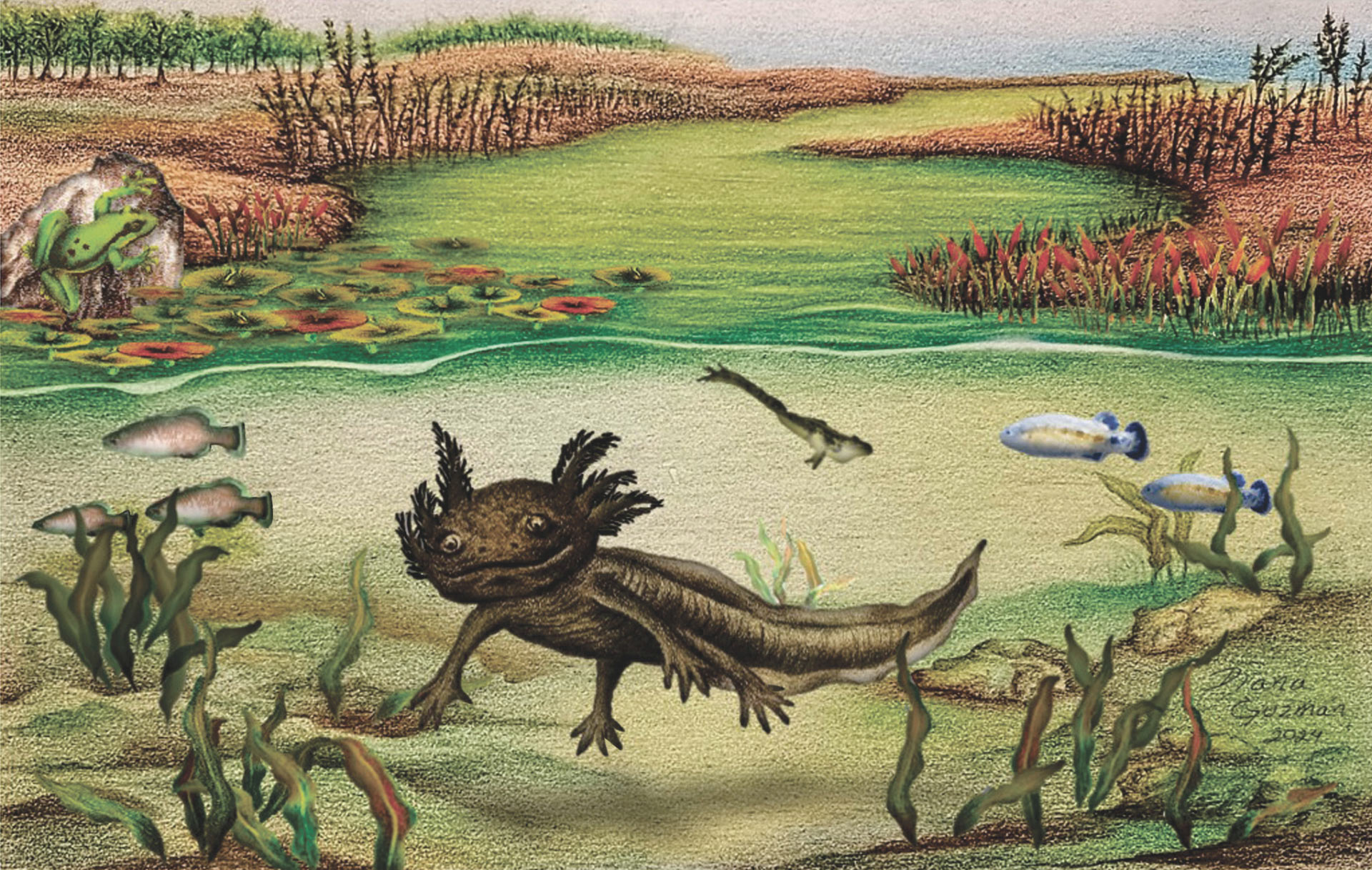
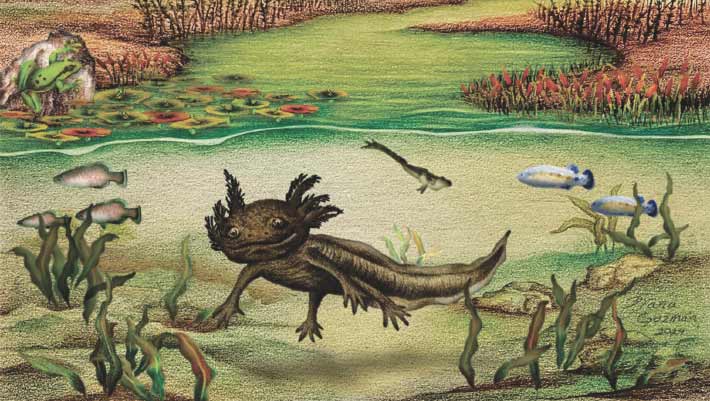
A reconstruction of the Santa María Amajac paleolake during the Late Pliocene epoch; the paleobiodiversity of this ancient aquatic environment encompassed microvertebrates such as the ambystomatid salamander Ambystoma quetzalcoatli, alongside Paleocharacodon guzmanae and Goodea-like fish, anurans, and a multitude of terrestrial and aquatic flora, including species of Nymphaea, Scirpus, and Typha. The illustration is credited to Diana Guzmán-Madrid.
The existence of Ambystoma quetzalcoatli dates back approximately 4.2 million years, to the Late Pliocene epoch. During this period, it inhabited a now-extinct mountain lake situated in the region currently known as Santa María Amajac in Hidalgo.
This discovery marks the earliest documented evidence of the genus Ambystoma within Mexico.
“The genus Ambystoma, named in 1838, comprises salamanders endemic to North America,” stated paleontologists Jorge Herrera-Flores and María Patricia Velasco-de León from the Universidad Nacional Autónoma de México.
“Among contemporary salamanders, this genus is distinguished by its unique developmental biology, notably the paedomorphosis observed in certain species, where adult individuals retain larval characteristics throughout their lives.”
“All extant species of Ambystoma are distributed across North America, with their geographical distribution spanning from southern Canada, through the majority of the United States, and extending to the Mexican Plateau.”
“The Ambystoma genus encompasses 38 living species, of which 18 are found in Mexico, with 17 of those being exclusive to the country.”
“The fossil record for Ambystoma is comparatively substantial, particularly in the United States, where fossils of the tiger salamander (Ambystoma tigrinum) are frequently encountered, and several extinct species have been formally described.”
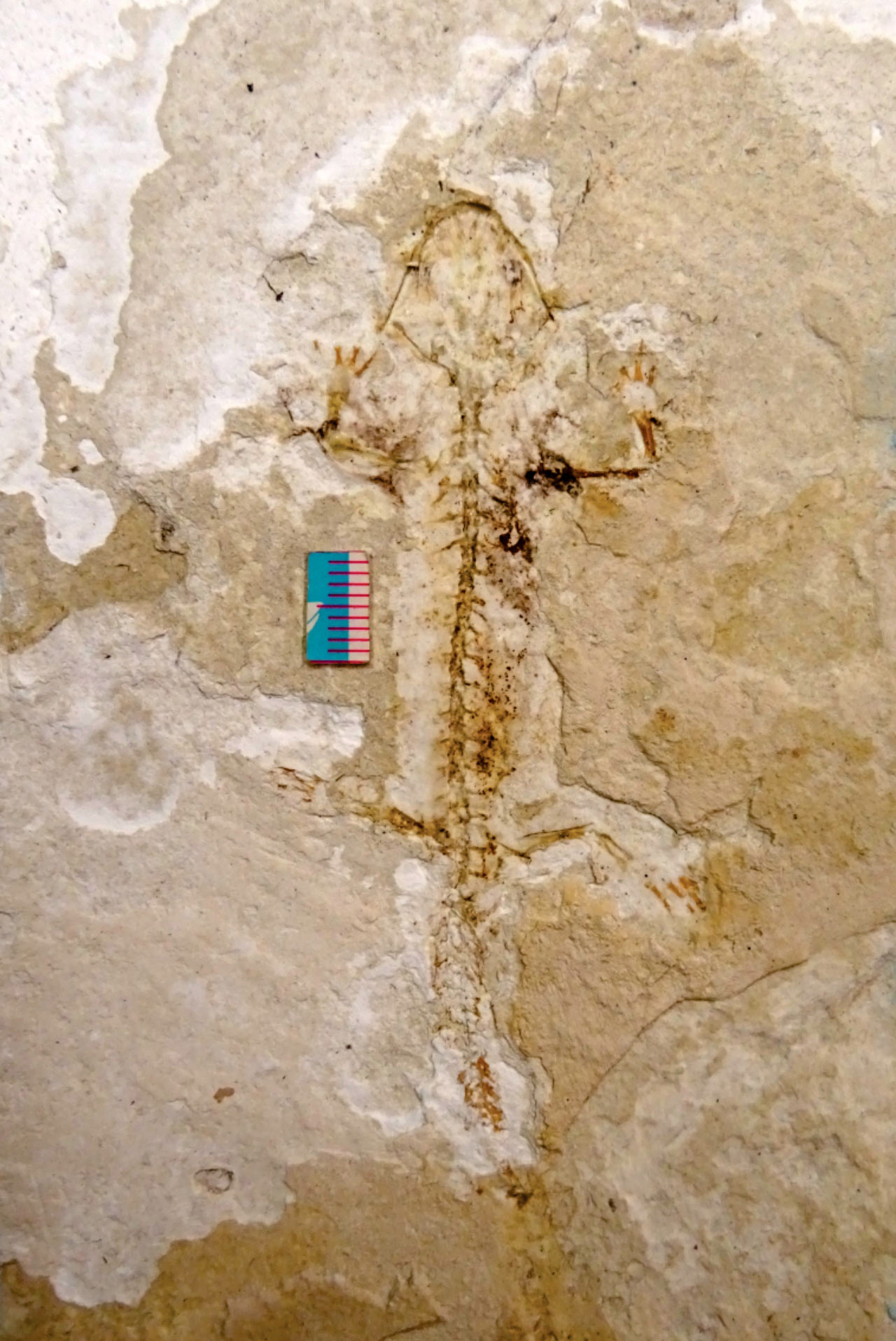
The skeletal remains of a subadult Ambystoma quetzalcoatli are depicted. Image credit: Jorge A. Herrera-Flores & María Patricia Velasco-de León, doi: 10.26879/1644.
In their investigation, the research team meticulously examined several fossilized salamander specimens that were procured in the early 2000s from the Sanctorum fossil site in the Santa María Amajac region.
Subsequent comparative analysis of these fossils against various related Mexican species served to validate that the collected material indeed represents a previously undiscovered Ambystoma species.
The newly identified species exhibited a unique constellation of skeletal features not observed in its extant relatives.
Foremost among these is a distinct V-shaped indentation situated at the anterior extremity of the premaxilla bones.
Secondly, a gap present at the superior aspect of the cranium persists across diverse developmental stages, a characteristic associated with neoteny—the retention of juvenile traits into adulthood.
The third distinguishing characteristic is an atypical morphology of the parasphenoid, a bone located at the cranial base.
“Our findings revealed three principal morphological aspects of the skull that substantiate the designation of Ambystoma quetzalcoatli as a distinct species,” the scientists reported.
The discovery of Ambystoma quetzalcoatli also contributes significantly to our understanding of the ancient Amajac lake system’s biodiversity.
This area has previously yielded several endemic fossil species, including extinct oak varieties, a beetle, a diatom, and a goodeid fish.
“The formal description of a new fossil ambystomatid species underscores the considerable diversity and morphological disparity evident within the Ambystomatidae family throughout its evolutionary trajectory, particularly concerning its Mexican lineages,” they concluded.
“Furthermore, the Santa María Amajac locale is reinforced as a pivotal site for comprehending the origins of present-day megadiverse faunas in Mexico, holding potential for additional significant discoveries.”
The research team’s findings were disseminated online in May 2026 within the pages of the journal Palaeontologia Electronica. A direct link to the publication is available here.
_____
Jorge A. Herrera-Flores & María Patricia Velasco-de León. 2026. Ambystoma quetzalcoatli sp. nov., a new species of fossil axolotl (Caudata: Ambystomatidae) from the Pliocene of Santa María Amajac, Hidalgo, Mexico. Palaeontologia Electronica 29 (2): a19; doi: 10.26879/1644