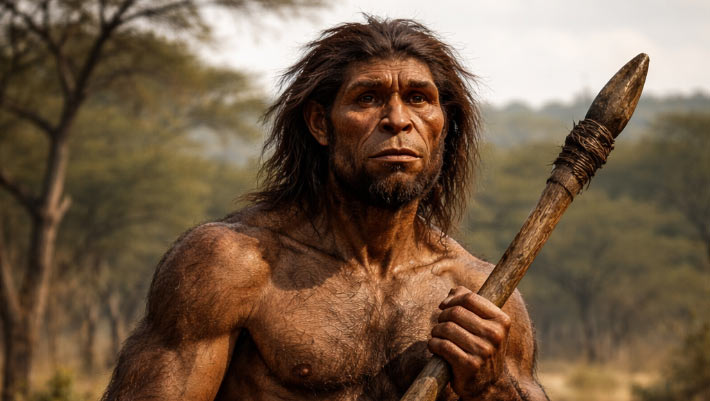
The identification of hominin skeletal remains from the Grotte à Hominidés at Thomas Quarry I in Casablanca, Morocco, is yielding significant new insights into the ancient origins of Homo sapiens. These discoveries suggest that the ancestral line leading to modern humans was already established on the African continent by approximately 800,000 years ago. The age of these fossils aligns with that of Homo antecessor found in Spain, yet they exhibit a mosaic of archaic characteristics and advanced features, evoking both Eurasian archaic hominins and later Homo sapiens.
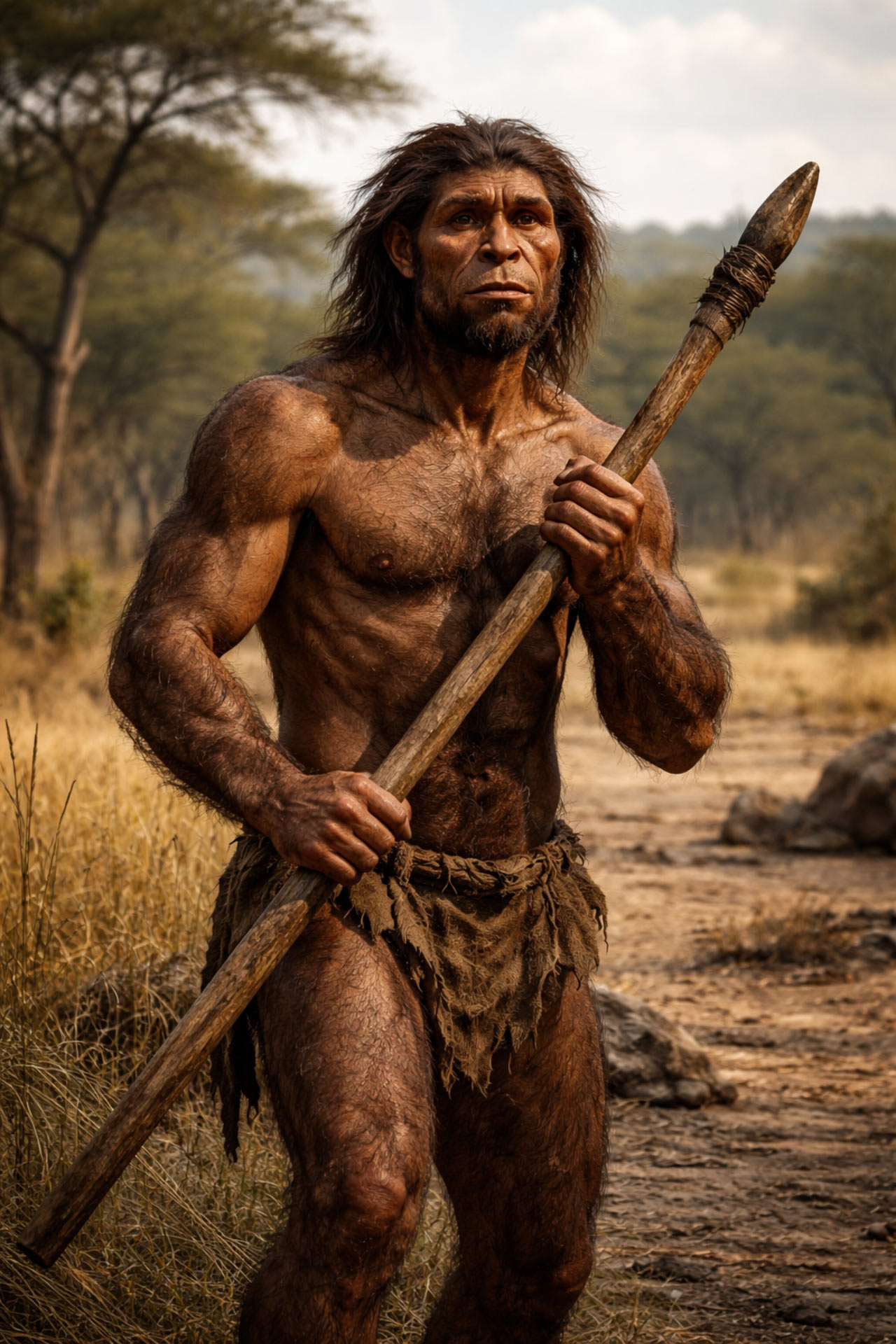
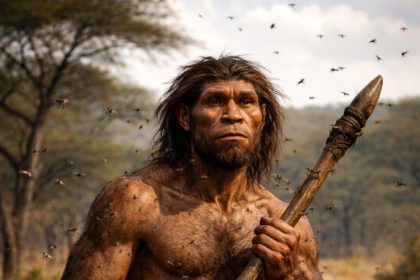
Reconstruction of Homo erectus.
Prior to these findings, paleoanthropologists were engaged in a debate regarding the geographical provenance of the last common ancestor shared by modern humans, Neanderthals, and Denisovans.
Genetic analyses had indicated that this ancestral population existed between roughly 765,000 and 550,000 years ago, but the paleontological evidence had remained inconclusive.
Certain researchers had posited a Eurasian genesis for this lineage, partly supported by hominin fossils from Atapuerca, Spain, dating between 950,000 and 770,000 years ago.
The newly unearthed hominin remains—comprising partial jawbones, teeth, vertebrae, and a femur fragment—from the Grotte à Hominidés provide compelling support for an African origin.
Radiometric dating of the surrounding geological strata reveals that the Moroccan fossils date to a period proximate to a significant reversal in the Earth’s magnetic field, occurring around 773,000 years ago, which places them in a similar temporal bracket as Homo antecessor.
Nevertheless, the newly discovered fossils present morphological distinctions from Homo antecessor, implying that distinct evolutionary trajectories between Europe and North Africa were already discernible during the late Early Pleistocene epoch (spanning approximately 1.8 million to 780,000 years ago).
The Moroccan fossils showcase a blend of primitive traits, reminiscent of species like Homo erectus, alongside more advanced characteristics observed in Homo sapiens and Neanderthals.
For instance, the patterns of their molar dimensions bear a resemblance to those of early Homo sapiens and Neanderthals, while the morphology of their mandibles aligns more closely with Homo erectus and other archaic hominins from Africa.
It is plausible that the Moroccan fossils do not represent the direct progenitors of modern humans, Neanderthals, and Denisovans, but rather are closely related ancestral forms.
“These Moroccan specimens likely represent a regionally evolved variant of Homo erectus in North Africa, situated close to the divergence point of African and Eurasian hominin lines,” the research team stated.
“Our findings underscore the significance of the Maghreb region in elucidating the evolutionary emergence of our species, thereby bolstering the hypothesis of an African, rather than Eurasian, ancestry for Homo sapiens.”
The research findings were published today in the distinguished journal Nature.
_____
JJ. Hublin et al. Early hominins from Morocco basal to the Homo sapiens lineage. Nature, published online January 7, 2026; doi: 10.1038/s41586-025-09914-y