Recent investigations spearheaded by paleontologists from University College London reveal that newly-hatched long-necked dinosaurs were a food source for numerous carnivorous species long before the advent of Tyrannosaurus rex.
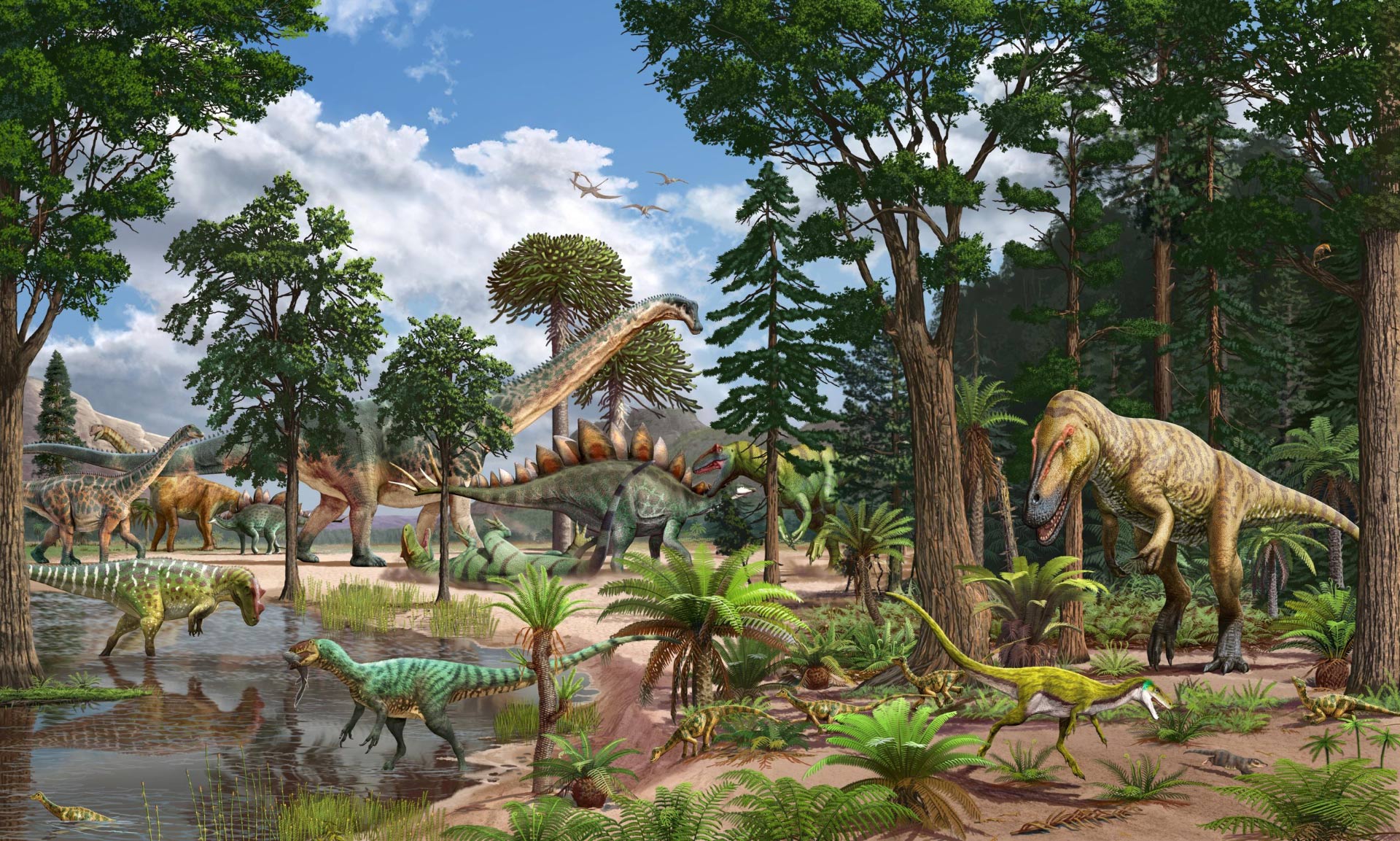
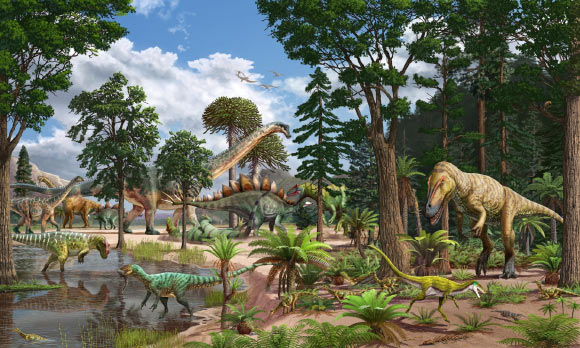
Ecosystem reconstruction of the Late Jurassic Dry Mesa Dinosaur Quarry around 150 million years ago in Colorado, the United States. Image credit: Sergey Krasovskiy / Pedro Salas.
“Mature sauropods, such as Diplodocus and Brachiosaurus, surpassed the length of a blue whale,” stated Dr. Cassius Morrison of University College London.
“Their presence on Earth caused the ground to tremble. However, their eggs were merely a foot in diameter, and upon hatching, their young required many years to attain full size.”
“The sheer magnitude of adult sauropods would have complicated their ability to safeguard their eggs without causing damage. Furthermore, evidence indicates that, much like contemporary baby turtles, juvenile sauropods did not receive parental care.”
In this study, Dr. Morrison and his associates meticulously examined fossilized remains unearthed from the 150-million-year-old Morrison Formation to construct a comprehensive food web of that era.
The specimens originated from a singular excavation site, the Dry Mesa Dinosaur Quarry, which yielded an exceptionally abundant collection of dinosaur fossils preserved over approximately 10,000 years. This site included at least six distinct sauropod species, such as Diplodocus, Brachiosaurus, and Apatosaurus.
To ascertain dietary relationships, the paleontologists leveraged existing data. This included assessing dinosaur size, dental wear patterns, the prevalence of specific isotopes within the remains, and, in certain instances, the stomach contents preserved within fossils, which revealed their final meals.
Subsequently, they charted the food web of that epoch—that is, all potential interconnections among dinosaurs, other fauna, and flora—with a higher degree of detail than previously achieved for dinosaurian ecosystems. This was accomplished with the assistance of software typically employed for analyzing contemporary ecological networks.
The researchers deduced that sauropods played a pivotal role within this ecosystem, exhibiting significantly more connections to both plant and animal life than the other primary category of herbivorous dinosaurs, the ornithischians. Ornithischians, such as the heavily armored Stegosaurus, were generally more formidable prey.
“Sauropods exerted a profound influence on their environment,” Dr. Morrison commented.
“Our research enables us to precisely measure and quantify their ecological role for the first time.”
“By reconstructing food webs, we can facilitate more effective comparisons between dinosaurian ecosystems from different geological periods.”
“This endeavor aids our understanding of evolutionary pressures and the factors that may have shaped dinosaurian development.”
The scientists observed that, approximately 70 million years later, during the era of Tyrannosaurus rex, a diminished availability of readily accessible sauropod prey might have contributed to the evolutionary adaptations (such as enhanced bite force, increased size, and superior vision) that enabled Tyrannosaurus rex to hunt more formidable and dangerous creatures, like the three-horned Triceratops.
“The dominant predators of the Late Jurassic, including Allosaurus and Torvosaurus, likely had a less challenging time securing sustenance compared to Tyrannosaurus rex millions of years later,” remarked Dr. William Hart, a paleontologist at Hofstra University.
“Certain Allosaurus fossils display evidence of severe injuries, for example, inflicted by the spiked tail of a Stegosaurus. Some of these wounds had healed, while others had not.”
“However, the abundance of easily obtainable prey in the form of juvenile sauropods may have facilitated the survival of injured allosaurs.”
The team’s discoveries are slated for publication in the New Mexico Museum of Natural History and Science Bulletin.
_____
Cassius Morrison et al. 2026. “Here, size is no accident”: a novel food web analysis of the Dry Mesa Dinosaur Quarry and ecological impact of Morrison Formation sauropod fauna. New Mexico Museum of Natural History and Science Bulletin