Beyond enhanced sleep quality, refined weight management, and an extended lifespan, along with a spectrum of other physical and mental health advantages, the prospect of cultivating a more youthful brain profile could emerge as another compelling rationale for engaging in physical activity.
In a recent 12-month clinical investigation involving 130 healthy individuals aged between 26 and 58, scientists affiliated with US institutions observed that participants adhering to a comprehensive weekly exercise program exhibited brains displaying markers of being biologically younger compared to those in a control cohort.
When scientific discourse addresses biological aging, it fundamentally pertains to the cumulative wear and tear associated with the passage of time. Although each individual experiences an annual birthday, disparate bodily systems can undergo attrition at varying rates.
A brain exhibiting a younger biological age potentially signifies the capacity to retain full cognitive faculties for a prolonged duration, coupled with a heightened resistance to neurodegenerative conditions such as dementia; however, the long-term implications were not within the purview of this particular study.
“Our findings reveal that a straightforward, guideline-adherent exercise protocol can render the brain measurably younger over a mere 12-month period,” articulates data scientist Lu Wan, associated with the AdventHealth Research Institute.
“While these observed changes were modest in magnitude, even a single year’s difference in brain age could prove significant over the span of decades.”
The volunteers assigned to the exercise regimen were instructed to comply with the established global weekly exercise recommendations from the World Health Organization: approximately 150 minutes of moderate-to-vigorous physical activity, encompassing any exertion that substantially elevates heart rate and respiratory pace.
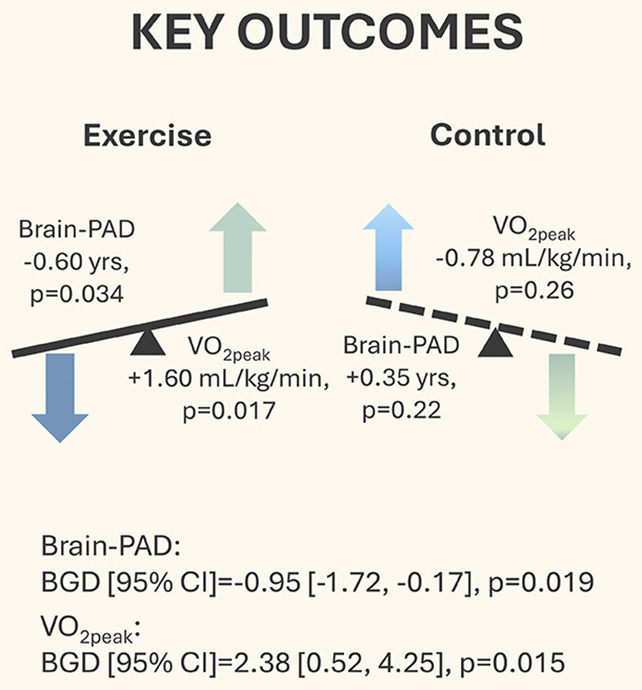
Evaluated against a diverse array of biomarkers, magnetic resonance imaging (MRI) scans of the brain demonstrated that individuals who consistently followed the exercise program possessed brains that appeared, on average, 0.6 years younger than their chronological age.
Conversely, participants who maintained their customary routines exhibited brains that seemed approximately 0.35 years older than their calendar age. The research team notes that this latter figure does not reach the statistical threshold for significance, but it underscores a substantial difference approaching a full year between the two groups.
The subsequent inquiry focuses on the precise mechanisms by which exercise might contribute to a younger-appearing brain. Previous research has established a connection between physical activity and enhanced cognitive function; however, despite investigating several potential contributing factors – including cardiovascular fitness, blood pressure levels, and beneficial protein production – the investigators in this latest study were unable to definitively pinpoint the causal link between exercise and brain aging.
“This outcome was unexpected,” admits Wan. “We had anticipated that improvements in physical fitness or blood pressure would account for the observed effect, but this proved not to be the case.”
“It is conceivable that exercise operates through additional, as-yet-unidentified pathways, potentially involving subtle alterations in brain structure, inflammatory processes, vascular health, or other molecular influences.”
These speculative pathways warrant further detailed exploration in subsequent research endeavors. Furthermore, the investigative team expresses a keen interest in expanding the scope of this research to encompass larger and more heterogeneous populations, particularly those individuals already identified as being at heightened risk for cognitive decline.
Scientific literature has consistently demonstrated that brain health challenges encountered later in life can often be attributed to a confluence of factors that exert their influence many years prior. It appears that engaging in physical activity during middle age can yield discernible positive impacts.
A brain maintaining a youthful state is more likely to resist decline and disease, and has also been associated with increased longevity. This adds valuable evidence to the growing body of research examining the critical determinants of the brain aging process.
“Individuals frequently pose the question, ‘What proactive measures can I undertake now to safeguard my brain health in the future?'” inquiries neuroscientist Kirk Erickson, also from the AdventHealth Research Institute.
“Our findings lend support to the notion that adherence to current exercise guidelines – specifically, 150 minutes per week of moderate-to-vigorous aerobic activity – may play a role in preserving a biologically younger brain, even during midlife.”