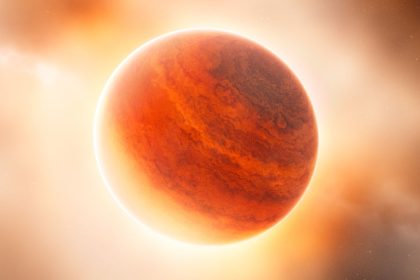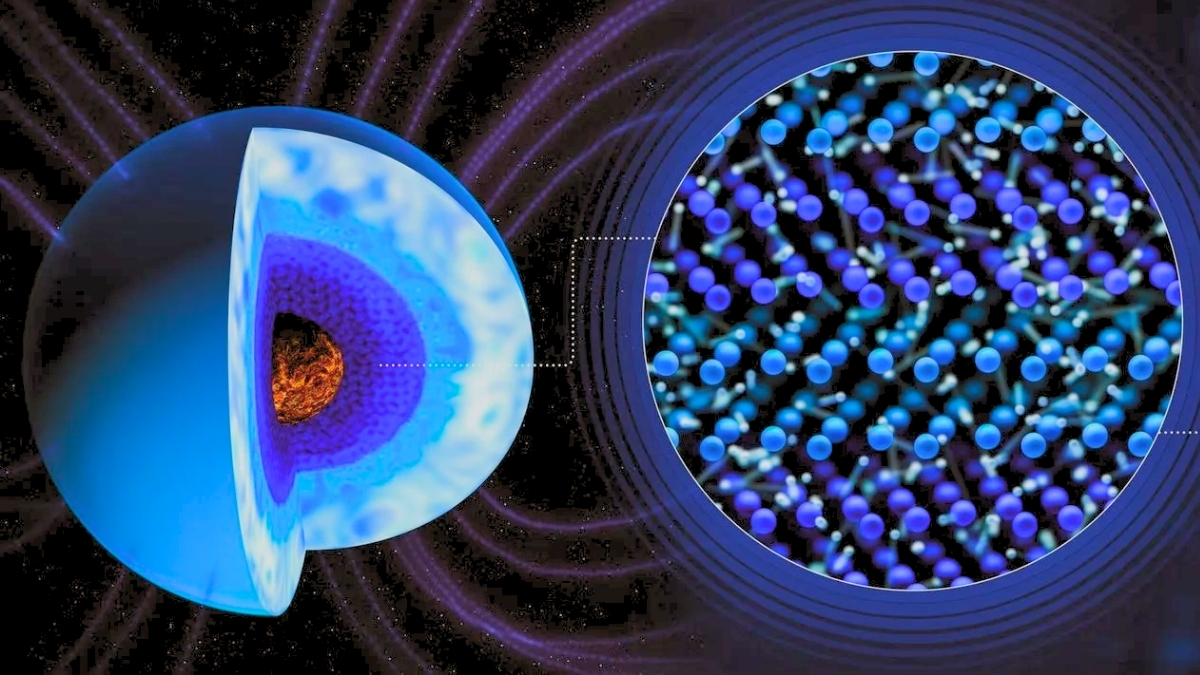
Within the central regions of ice giant planets, conditions of immense pressure and elevated temperature compel water to transition into a state that is entirely alien to natural terrestrial environments.
This manifestation, termed ‘superionic water,’ constitutes a unique form of ice. However, in stark contrast to conventional ice, it possesses a high temperature and exhibits a dark, opaque appearance.
For many years, the scientific community posited that the superionic water found deep within the cores of Neptune and Uranus was the causative agent behind the erratic, unaligned magnetic fields detected by the Voyager 2 probe during its flybys.
A comprehensive series of experimental investigations, detailed in a publication within the journal Nature Communications authored by Leon Andriambarijaona and his collaborators at the SLAC National Accelerator Laboratory and the Sorbonne, has now yielded empirical validation. These findings elucidate the precise mechanism by which this ice gives rise to these peculiar magnetic fields, revealing it to be significantly more disordered than previously surmised.
Standard educational curricula typically delineate four fundamental states of matter: solid, liquid, gas, and plasma. Nevertheless, under conditions of exceptionally high pressure and temperature, water can assume a superionic phase. While structurally resembling a solid, it is, in essence, a crystalline lattice. This lattice is composed of oxygen atoms, while hydrogen atoms move with relative freedom throughout its structure, facilitating electrical conductivity.
For an extended period, researchers hypothesized that the oxygen atom lattice within superionic water formed an ‘ideal’ crystal structure, characterized by atoms positioned either at the center of a cubic unit (a configuration known as body-centered cubic, or BCC) or at the faces of the cube (face-centered cubic, or FCC). Both configurations present the well-defined, orderly boundaries typically anticipated in crystalline arrangements.
However, these regimented crystalline lattices did not accord with the irregular, chaotic magnetic field observed by Voyager 2 during its passage by our solar system’s ice giants. Consequently, scientists determined the necessity of experimentally scrutinizing this distinctive water state to ascertain the validity of the lattice theory.
The undertaking to create superionic water itself presented considerable challenges. Its existence is contingent upon extreme temperatures and pressures; any reduction in either parameter prompts an immediate reversion to more stable water phases.
Achieving such elevated pressures necessitates the utilization of a specialized apparatus known as a diamond anvil. More precisely, a pair of these instruments is employed. By compressing a water sample between two anvils fashioned from the universe’s most robust substance, researchers were able to elevate the pressure to an astonishing 1.8 million atmospheres.
Subsequently, the sample was subjected to intense illumination from pulsed laser light, inducing a temperature rise to approximately 2500 Kelvin. At this juncture, a sample of superionic water had been successfully synthesized.
Yet, upon any decrease in pressure or temperature, the crystalline structure would rapidly disintegrate. Therefore, within mere trillionths of a second of attaining these conditions, the sample was irradiated with X-rays.
X-ray diffraction is a widely recognized technique employed in the structural analysis of crystals. Fundamentally, it functions as a method for capturing high-speed photographic records of atomic arrangements. However, upon analyzing the resultant data, the researchers discovered that their findings were incongruent with prevailing theories.
The lattice itself appeared as a composite of indistinct patterns, wherein different strata of the structure exhibited FCC characteristics, while others displayed an entirely distinct arrangement termed hexagonal close-packed (HCP).
Initially, when the authors conducted their experiments in California, the ambiguous nature of this data proved so perplexing that it led them to attribute the anomalies to potential environmental interference. This prompted them to seek assistance from another linear accelerator located in Germany, with the objective of mitigating any such extraneous influences.
Upon receiving identical results from the experiments conducted in Germany, they concluded that they were indeed observing the genuine, complex reality rather than an artifact of their experimental setting.
As their investigations continued across a range of pressures and temperatures, the researchers also ascertained that certain overlapping lattice structures emerged with increasing pressure. This observation directly contradicted the hypothesis of a sharply defined transition point at which the lattice structure would abruptly shift from one configuration to another.
Ultimately, these findings collectively indicate that superionic water is an exceedingly complex substance. These inherent complexities offer a potential explanation for the peculiar magnetic field characteristics observed in Neptune and Uranus.
It is important to note that replicating the precise conditions of planetary interiors by creating materials that exist for mere femtoseconds does not constitute a perfect analogue. It is conceivable that over extended durations, the crystalline structure might achieve a more stable, ordered state. Alternatively, the observed chaotic behavior might persist in a random fashion throughout the interiors of the ice giants.
While this particular water state is not encountered naturally on Earth, its prevalence in the internal composition of ice giant planets suggests that it may, in fact, represent the most abundant form of water within the galaxy.
Ice giants constitute a substantial proportion of identified exoplanets, though this may be attributable to their size and orbital characteristics, both of which are readily detectable using current exoplanet observation methodologies, rather than necessarily reflecting their true prevalence among celestial bodies.
Regardless of the precise proportions, the understanding that water – the fundamental element for life as we know it – exists in such a diverse array of forms across myriad cosmic locations is, at the very least, an intriguing scientific discovery.
This article was originally published by Universe Today. Read the original article.