Within the isolated rainforests adorning New Guinea’s Vogelkop Peninsula, two marsupial species—the pygmy long-fingered possum (Dactylonax kambuayai) and the ring-tailed glider (Tous ayamaruensis)—have been observed by scientific researchers. These creatures were previously presumed to have vanished approximately 6,000 years ago. Such resurgences imply that the pristine ecosystems of New Guinea might still harbor vestiges of an antiquated animal kingdom.
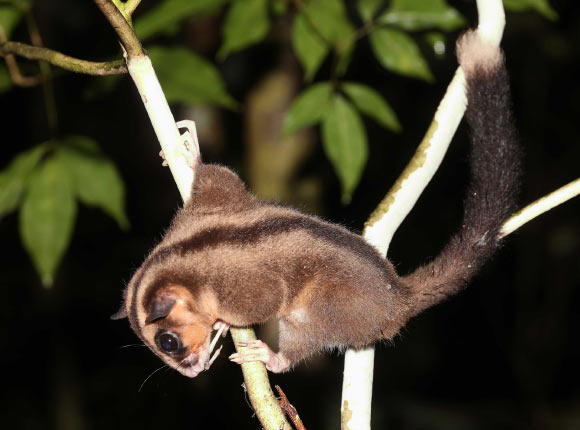
The pygmy long-fingered possum (Dactylonax kambuayai), a female encountered in the Klalik region of the Vogelkop Peninsula. The image credit is attributed to Carlos Bocos.
“The reappearance of a single ‘Lazarus taxon,’ even one presumed extinct in the recent past, constitutes an extraordinary finding,” remarked Professor Tim Flannery of the Australian Museum.
“However, the confirmation of two species, both believed to have disappeared millennia ago, is genuinely remarkable.”
“These revelations serve to highlight the paramount significance of safeguarding these distinctive biogeographical zones and underscore the immense value of cooperative scientific endeavors in the identification and preservation of concealed biological diversity.”
The pygmy long-fingered possum and the ring-tailed glider, once known solely from Pleistocene fossil records in Australia and from Pleistocene-early Holocene fossil evidence in New Guinea, have now been located within secluded lowland forest environments on the Vogelkop Peninsula.
“The Vogelkop represents an ancient segment of the Australian mainland that has become integrated into the island of New Guinea,” Professor Flannery elaborated.
“Its forested areas may potentially conceal additional hidden remnants of Australia’s past.”
Characterized by its prominent striping, the pygmy long-fingered possum is a marsupial exhibiting a striking evolutionary trait—a single digit on each of its hands is precisely twice the length of the digit immediately adjacent to it.
This species appears to have ceased existing in Australia during the Pleistocene epoch, a geological era coinciding with the extinction of iconic megafauna such as the diprotodon and the marsupial lion.
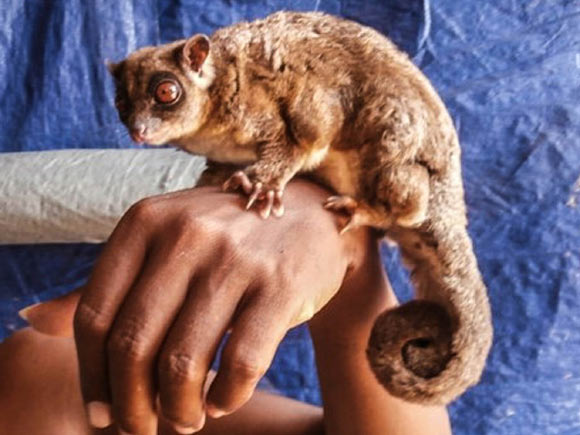
The ring-tailed glider (Tous ayamaruensis), observed as a subadult in the South Sorong vicinity of the Vogelkop Peninsula. The photograph was taken by Arman Muharmansyah.
The ring-tailed glider stands as the closest living relative to the Australian greater glider (Petauroides) and signifies the inaugural new genus of New Guinean marsupial to be formally described since 1937.
This species, which is smaller than its Australian congeners, possesses unfurred ears and a highly prehensile tail. It forms lifelong pair bonds and typically raises only a single offspring annually.
Similar to greater gliders, this marsupial constructs its nest within tree hollows found in the canopy of the tallest arboreal specimens and faces considerable threats from deforestation activities.
“Known locally as Tous by certain clans of the Tambrauw and Maybrat communities, this glider holds significant cultural and spiritual importance,” stated Rika Korain, a member of the Maybrat people.
“It is revered as an embodiment of ancestral spirits and plays a central role in an educational tradition referred to as ‘initiation’.”
“Our fieldwork was conducted with extreme caution and in close partnership with the Tambrauw Elders. The identification process simply would not have been feasible without the invaluable cooperation of the Traditional Owners, and this collaborative relationship has been indispensable for our ongoing research efforts.”
“I am immensely proud of the contributions made by Papuan researchers to these monumental discoveries, and I extend my sincere gratitude to the communities of the Misool, Maybrat, and Tambrouw regions who provided us with essential support in the field,” added Dr. Aksamina Yohanita, a researcher affiliated with the University of Papua.
A scholarly publication detailing these significant findings was released on March 6th in the Records of the Australian Museum.
_____
Tim F. Flannery et al. 2026. Rediscovered after 6,000 years: contemporary records of a purportedly ‘extinct’ Papuan marsupial, Dactylonax kambuayai (Marsupialia: Petauridae), accompanied by a re-evaluation of the systematics and zoogeography of the genus Dactylonax. Rec. Aust. Mus 78 (1): 17-34; doi: 10.3853/j.2201-4349.78.2026.3003