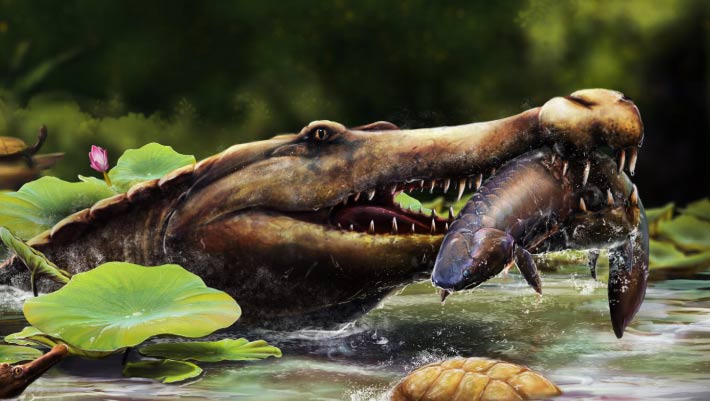
The discovery of two incomplete crania and three partial mandibles belonging to an early-branching dyrosaurid crocodyliform has been reported from the Quseir Formation strata in Egypt.
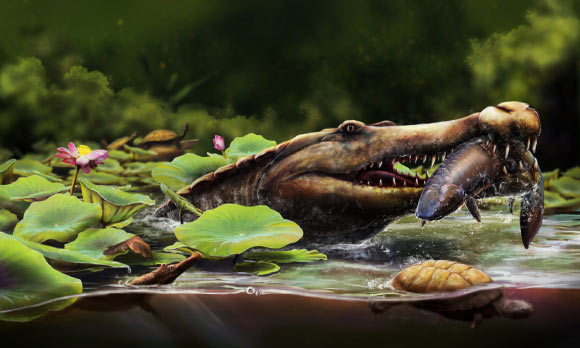
This newly identified crocodyliform species inhabited the region now known as Egypt approximately 80 million years ago, during the Late Cretaceous epoch.
Designated Wadisuchus kassabi, this creature was a member of the dyrosaurid family, a lineage of crocodyliforms renowned for their varied cranial structures and widespread presence from the Late Cretaceous through the Paleogene periods.
“While extant crocodiles predominantly inhabit freshwater environments, dyrosaurids flourished in coastal and marine settings. They possessed elongated rostrums and delicate, needle-sharp dentition perfectly suited for capturing elusive prey like fish and turtles,” stated Assiut University paleontologist Sara Saber and her research team.
“Their remarkable resilience and geographical dispersal following the dinosaur extinction event are pivotal for comprehending reptilian adaptation and diversification amidst global ecological upheaval.”
Individuals of Wadisuchus kassabi are estimated to have measured between 3.5 and 4 meters in length, characterized by a distinctly elongated snout and robust, sharp teeth.
“A key distinguishing factor from other dyrosaurids was the presence of four teeth at the anterior portion of the snout, diverging from the ancestral count of five. Furthermore, its nares were situated dorsally on the snout, facilitating surface respiration, and a pronounced notch was present at the rostral tip where the jaws articulated,” explained Dr. Saber. “These anatomical traits signify a progressive evolution in the bite mechanics of dyrosaurids, representing a significant milestone in their evolutionary trajectory.”
The fossil specimens, comprising two incomplete skulls and three partial jaws from four distinct Wadisuchus kassabi individuals, were unearthed at the Kharga and Baris oases within Egypt’s Western Desert.
“Beyond its unique morphological characteristics, Wadisuchus kassabi holds substantial importance in elucidating the origins of the dyrosaurid clade,” Dr. Saber emphasized.
“This new species offers earlier evidence for an African genesis of Dyrosauridae, suggesting their diversification commenced prior to what was previously hypothesized — potentially during the Early Coniacian-Santonian interval (approximately 87-83 million years ago), rather than the traditionally accepted Maastrichtian period (around 72-66 million years ago).”
“This finding strongly implies that Africa served as the birthplace of dyrosaurid evolution, from which subsequent lineages disseminated globally. Our phylogenetic analyses consistently position Wadisuchus kassabi as an ancestral member of the dyrosaurid group,” commented Belal Salem, a researcher affiliated with Mansoura University, Ohio University, and Benha University. “The significance of Wadisuchus kassabi extends beyond its revelations concerning the evolutionary history of this extraordinary crocodile lineage, a major scientific achievement in itself. It also serves as a potent reminder that Egypt’s Western Desert continues to yield invaluable specimens that unlock the profound secrets of our planet’s ancient past.”
The research findings were published today in the Zoological Journal of the Linnean Society.
_____
Sara Saber et al. 2025. An early dyrosaurid (Wadisuchus kassabi gen. et sp. nov.) from the Campanian of Egypt sheds light on the origin and biogeography of Dyrosauridae. Zoological Journal of the Linnean Society 205 (2): zlaf134; doi: 10.1093/zoolinnean/zlaf134