A recent investigation has revealed a startling prevalence of plastic particles, measuring less than a micrometer in diameter, which may significantly outnumber their larger counterparts found adrift in oceanic environments.
The research, spearheaded by a collaborative team from Utrecht University in the Netherlands, involved the meticulous examination of samples collected from diverse depths across 12 distinct locations within the North Atlantic. Advanced high-resolution imaging techniques, coupled with sophisticated chemical filtration, were employed to detect nanoplastics, notoriously elusive due to their minute dimensions – a mere fraction of the width of a human hair.
The analytical outcomes were unequivocal: the marine realm is awash with nanoplastics, with estimates suggesting approximately 27 million metric tons distributed throughout the entire North Atlantic Ocean. This staggering figure represents nearly 10% of the total volume of waste material discarded annually in the United States.
“This projection indicates that nanoplastic particles constitute a greater mass of floating plastic in this oceanic sector than larger micro and macroplastic fragments found within the Atlantic, or even across all the world’s oceans,” states Helge Niemann, a biogeochemist associated with Utrecht University.
These revelations underscore the profound magnitude of the environmental challenge presented by discarded plastic materials.
The study identified several common plastic types, including polyethylene terephthalate (PET), polystyrene (PS), and polyvinyl chloride (PVC), materials frequently utilized in plastic beverage containers, disposable cups, and flexible films.
Conversely, certain plastics, namely polyethylene and polypropylene, which are widely prevalent in the environment, were notably absent or present in minuscule quantities. The research team posits that this discrepancy might be attributable to the masking effect of organic particulate matter or limitations in the sensitivity of the current analytical methodologies for detecting these specific polymer types.
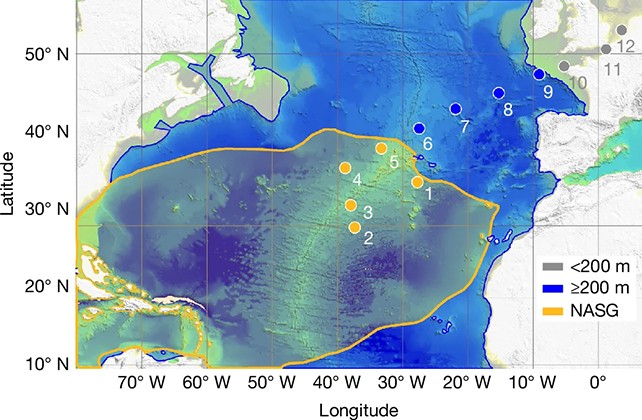
Nanoplastics were detected at all surveyed depths, exhibiting a heightened concentration near coastal areas (originating from fluvial discharge and surface runoff) and within the subtropical gyre. This oceanic region, characterized by its vast, swirling currents, is recognized for its propensity to trap plastic debris, which subsequently fragments into increasingly smaller constituents.
The precise impact of these plastic particles on marine ecosystems, and consequently on the species that depend on them, remains to be fully elucidated. Nanoplastics, owing to their extremely small size, possess the capacity to interact with water, sediment, and biota in ways fundamentally distinct from their larger microplastic counterparts.
“The minuscule scale of nanoplastics and nanoparticles means that the physical principles governing larger entities often cease to apply,” explains Dušan Materić, a chemist affiliated with the Helmholtz Centre for Environmental Research in Germany.
Future research endeavors aim to expand the scope of oceanic sampling to encompass additional regions and investigate a broader spectrum of plastic types. This expansion is anticipated to be feasible through the adaptation of the methodologies employed in the current study. Furthermore, it is deemed essential to examine nanoplastics at various stages of their degradation process, correlated with their duration of immersion in aquatic environments.
Given the immense scale of plastic contamination, its complete eradication presents a formidable challenge. Consequently, the researchers advocate for intensified efforts focused on preventing the entry of plastics into the environment from the outset.
“Mere a few years ago, the very existence of nanoplastics in nature was a subject of debate,” observes Materić. “A significant number of academics continue to hold the view that nanoplastics are thermodynamically improbable to persist in natural settings, given the substantial energy requirements for their formation.”
“Our findings demonstrate that, by mass, the quantity of nanoplastic is comparable to that previously documented for macro and microplastics – at least within the confines of this specific oceanic system.”