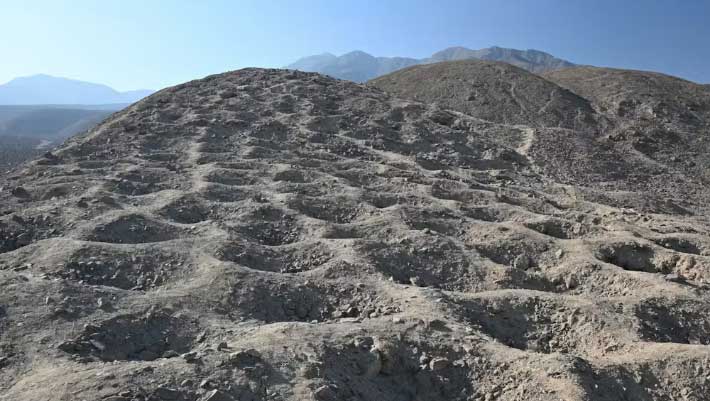
Monte Sierpe, a designation that translates to ‘serpent mountain’ and is colloquially referred to as the ‘Band of Holes,’ is situated within the Pisco Valley of southern Peru. This extensive site comprises roughly 5,200 meticulously arranged perforations. Emerging research posits that this ancient archaeological locale originally functioned as a hub for barter and trade, facilitating gatherings of diverse populations for commercial endeavors.
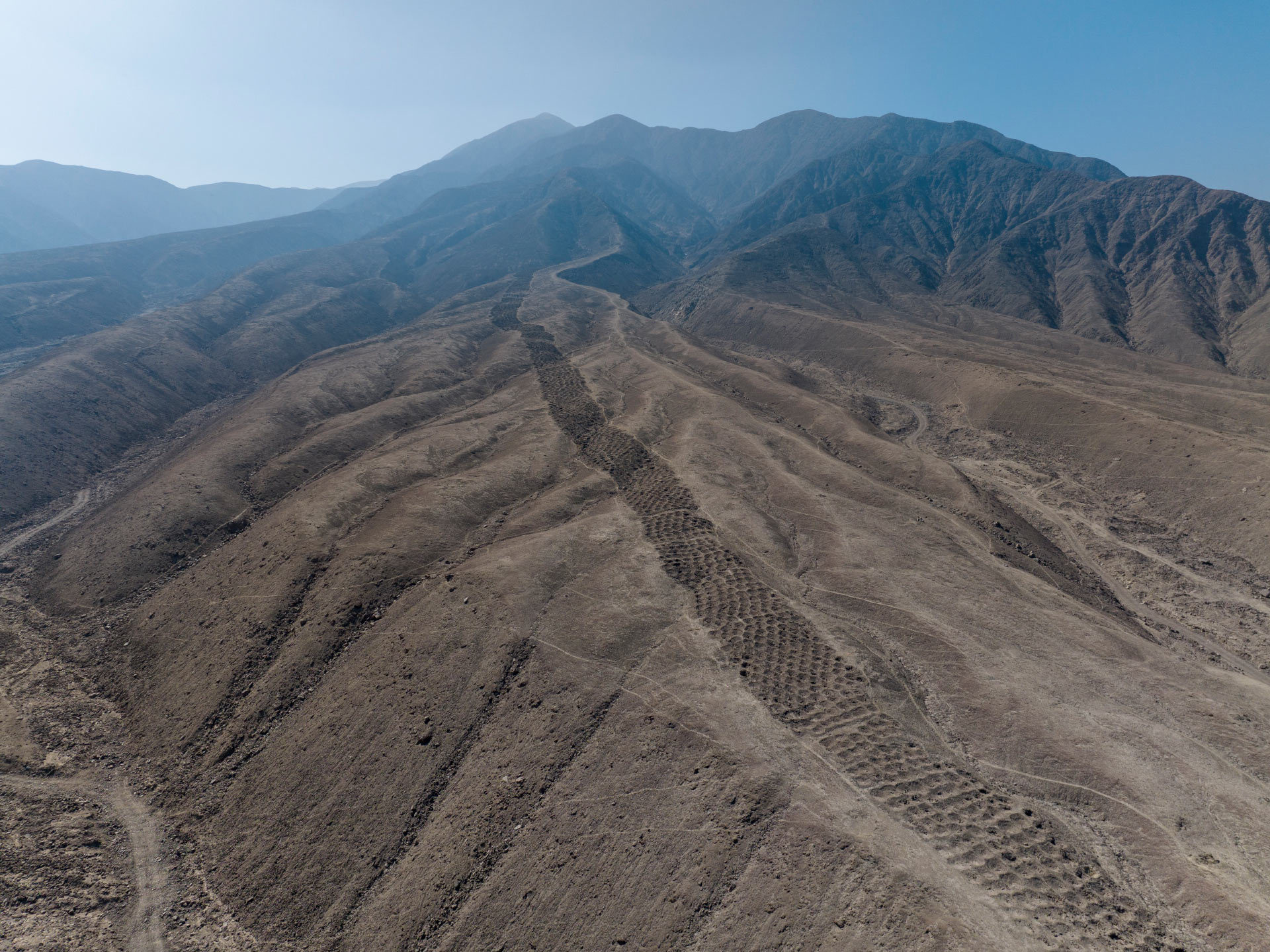
Aerial photo of Monte Sierpe, facing northeast. Image credit: Jacob Bongers, University of Sydney.
Spanning 1.5 kilometers across the Pisco Valley in the southern Peruvian Andes, Monte Sierpe presents as a substantial linear arrangement of approximately 5,200 precisely ordered cavities, each measuring between 1 to 2 meters in diameter and 0.5 to 1 meter in depth, segmented into distinct sections or blocks.
This impressive man-made structure is presumed to date back at least to the Late Intermediate Period (circa 1000-1400 CE), with its utilization persisting into the Inca era (1400-1532 CE).
The site first attracted modern scholarly interest in 1933, following the publication of aerial imagery depicting the holes in National Geographic magazine; however, the monument’s definitive function remains a subject of considerable debate.
Speculative theories regarding its purpose encompass defensive measures, storage facilities, accounting mechanisms, water harvesting, fog entrapment, and horticultural activities, yet the definitive role of the site continues to elude conclusive understanding.
“The perplexing question arises: why would ancient civilizations excavate over 5,000 apertures in the foothills of southern Peru? Were they intended for cultivation? Did they serve to collect water? Did they possess an agricultural purpose?” queried Dr. Jacob Bongers, a digital archaeologist affiliated with the University of Sydney.
“While the rationale behind their existence remains elusive, we have generated some compelling new data that offers significant insights and substantiates innovative hypotheses concerning the site’s application.”
Employing advanced drone technology, Dr. Bongers and his research associates meticulously surveyed the location, uncovering discernible numerical patterns within its configuration that suggest a deliberate organizational intent.
To their considerable surprise, the archaeological team also ascertained that the spatial arrangement of Monte Sierpe bears a striking resemblance to the structural composition of at least one Inca khipu, an ancient artifact utilized for record-keeping through knotted strings, which was previously unearthed in the same valley.
“This represents a truly extraordinary finding that broadens our comprehension of the genesis and variety of Indigenous accounting methodologies, both within and beyond the Andean region,” Dr. Bongers remarked.
Examinations of the soil samples collected from the perforations revealed the presence of ancient pollens from maize (corn), a foundational staple crop in the Andes, and reeds, materials traditionally employed for millennia in the creation of woven containers.
These unexpected discoveries importantly signify that vegetation was deliberately placed within the cavities, likely transported using woven baskets and/or bundles.
“This is profoundly intriguing. It is conceivable that this site served as a pre-Inca marketplace, akin to a contemporary flea market,” Dr. Bongers elaborated.
“We estimate the pre-Hispanic population of this region to have been approximately 100,000 individuals. It is plausible that itinerant merchants (both seafaring traders and those traveling with llama caravans), specialized artisans (farmers and fisherfolk), and others congregated at this locale to exchange indigenous commodities such as corn and cotton.”
“Fundamentally, my perspective is that these perforations functioned as a form of social infrastructure that fostered human interaction, subsequently evolving into a large-scale repository for accounting under the Inca Empire.”
“Numerous questions persist – for instance, why is this particular monument unique to this locale and not found throughout the Andes?”
“Could Monte Sierpe have functioned as a type of ‘landscape khipu’? Regardless, we are progressively advancing toward a deeper understanding of this enigmatic site. It is exceptionally stimulating.”
The comprehensive investigation was disseminated on November 10, 2025, within the esteemed journal Antiquity.
_____
Jacob L. Bongers et al. Indigenous accounting and exchange at Monte Sierpe (‘Band of Holes’) in the Pisco Valley, Peru. Antiquity, published online November 10, 2025; doi: 10.15184/aqy.2025.10237