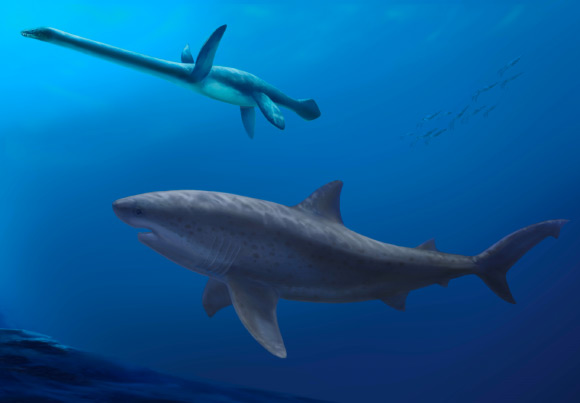
The order Lamniformes, commonly identified as mackerel sharks, encompasses some of the most recognizable shark species, such as the great white and mako sharks, alongside less frequently encountered ones like the goblin shark and megamouth shark. The unearthing of substantial shark fossils, dating back 115 million years, in the northern region of Australia has indicated that lamniform sharks attained immense body sizes approximately 15 million years earlier than previously hypothesized. This places them at the apex of oceanic food webs, sharing dominance with colossal marine reptiles during the Mesozoic Era.
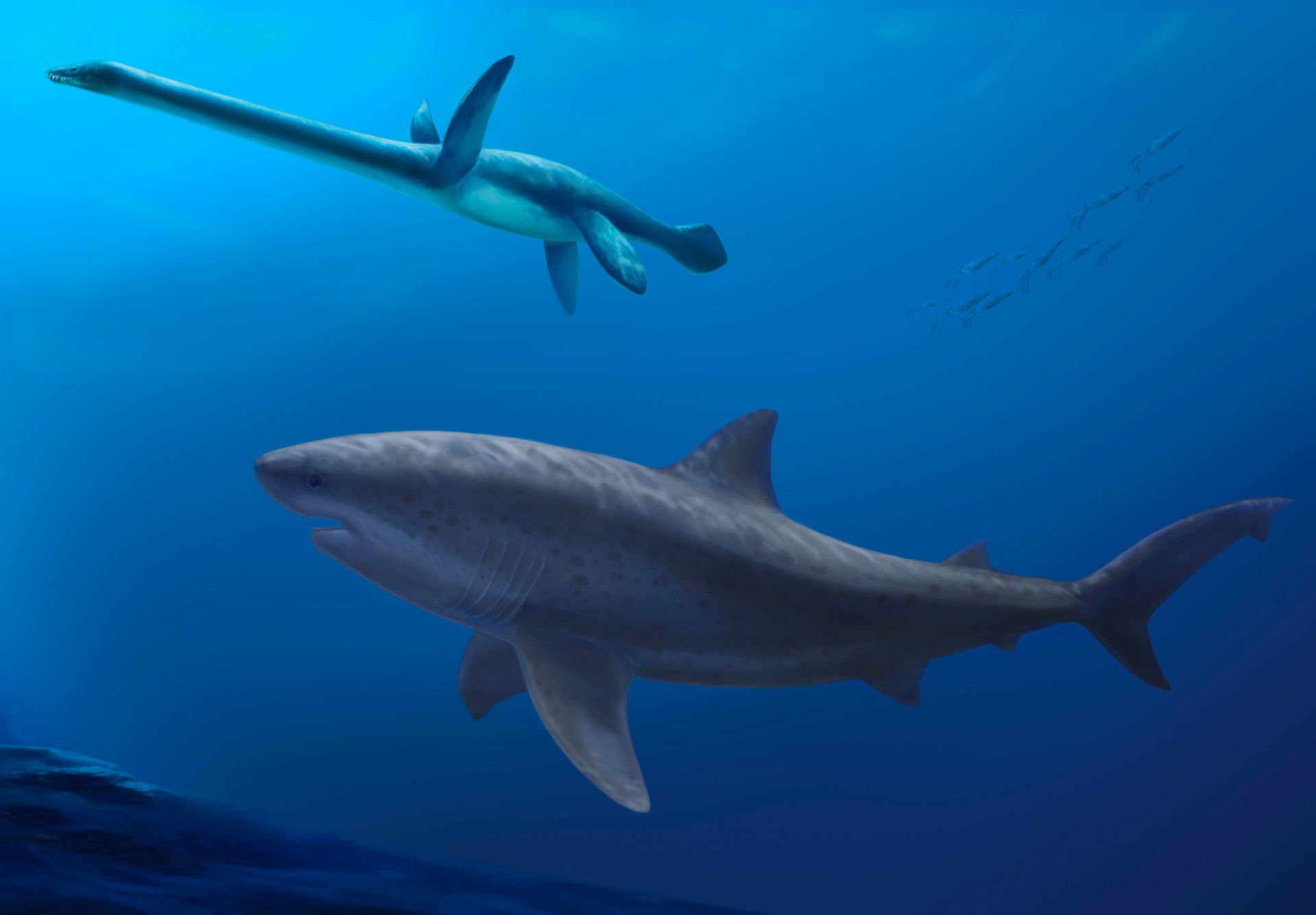
A gigantic 8 m long mega-predatory shark stalks an unwary long-necked plesiosaur in the seas off Australia 115 million years ago. Image credit: Polyanna von Knorring, Swedish Museum of Natural History.
Sharks, which are quintessential oceanic predators, possess an evolutionary lineage extending back over 400 million years.
However, the diversification of modern shark groups commenced during the age of dinosaurs, with the earliest identifiable fossils emerging from approximately 135 million years ago.
These ancestral modern sharks, known as lamniforms, were initially diminutive, possibly reaching only about 1 meter in length. Over eons, they would evolve into gargantuan forms, including the renowned ‘megalodon’, which might have surpassed 17 meters in length, and the extant great white shark, a dominant apex predator in contemporary marine environments, reaching lengths of around 6 meters.
Possessing cartilaginous skeletal structures, the fossil record of sharks is predominantly composed of their teeth, which they shed continuously during feeding.
Consequently, shark teeth are frequently discovered within sedimentary rocks formed on ancient seabeds, often found in association with the teeth and skeletal remains of other fauna, such as fish and immense marine reptiles that held sway as the principal predators in most marine ecosystems during the dinosaur era.
The rocky littoral zone adjacent to what is now Darwin was once the seabed of the ancient Tethys Ocean, an expansive body of water stretching from the southern fringes of Gondwana (present-day Australia) to the northern island chains of Laurasia (modern Europe).
Fossilized remnants of formidable marine creatures, including plesiosaurs, ichthyosaurs, and sizable bony fish, have been unearthed in this locale.
Most strikingly, a limited number of colossal vertebrae have been recovered, substantiating the presence of an unanticipated apex predator: a gargantuan lamniform shark.
The five recovered vertebrae, exhibiting partial mineralization that facilitated their preservation, are remarkably congruent with those of a present-day great white shark.
Nevertheless, while adult great whites possess vertebrae measuring approximately 8 cm in diameter, the fossilized lamniform vertebrae from Darwin exceeded 12 cm in width.
Furthermore, their morphological distinctiveness was sufficient for their classification as belonging to a cardabiodontid – colossal, predatory sharks that inhabited the world’s oceans from roughly 100 million years ago.
Crucially, the Darwin lamniform predates this period by approximately 15 million years and had already evidently achieved the characteristic immense body size associated with cardabiodontids.
“Our findings demonstrate that gigantism is an ancient trait within the Lamniformes, with the Australian cardabiodontid measuring approximately 6–8 meters and weighing over 3 tons,” stated lead author Dr. Mohamad Bazzi from Stanford University and his research collaborators.
“This size rivaled that of some of the largest contemporaneous marine reptiles, suggesting that lamniforms occupied apex predator roles from an early stage in their evolutionary development.”
“These sharks were of immense size and inhabited shallow coastal waters,” commented co-author Dr. Mikael Siversson, a researcher at the Western Australian Museum.
“This provides significant insights into the structure of ancient food webs and underscores the critical importance of Australia’s fossil sites for comprehending prehistoric life.”
“This discovery not only revises the established timeline of shark evolution but also reinforces Australia’s global prominence in paleontological research.”
“With each new paleontological revelation, our understanding of ancient marine environments and the extraordinary organisms that once dominated them is enhanced.”
This groundbreaking find is detailed in a recent publication within the journal Communications Biology.
_____
M. Bazzi et al. 2025. Early gigantic lamniform marks the onset of mega-body size in modern shark evolution. Commun Biol 8, 1499; doi: 10.1038/s42003-025-08930-y