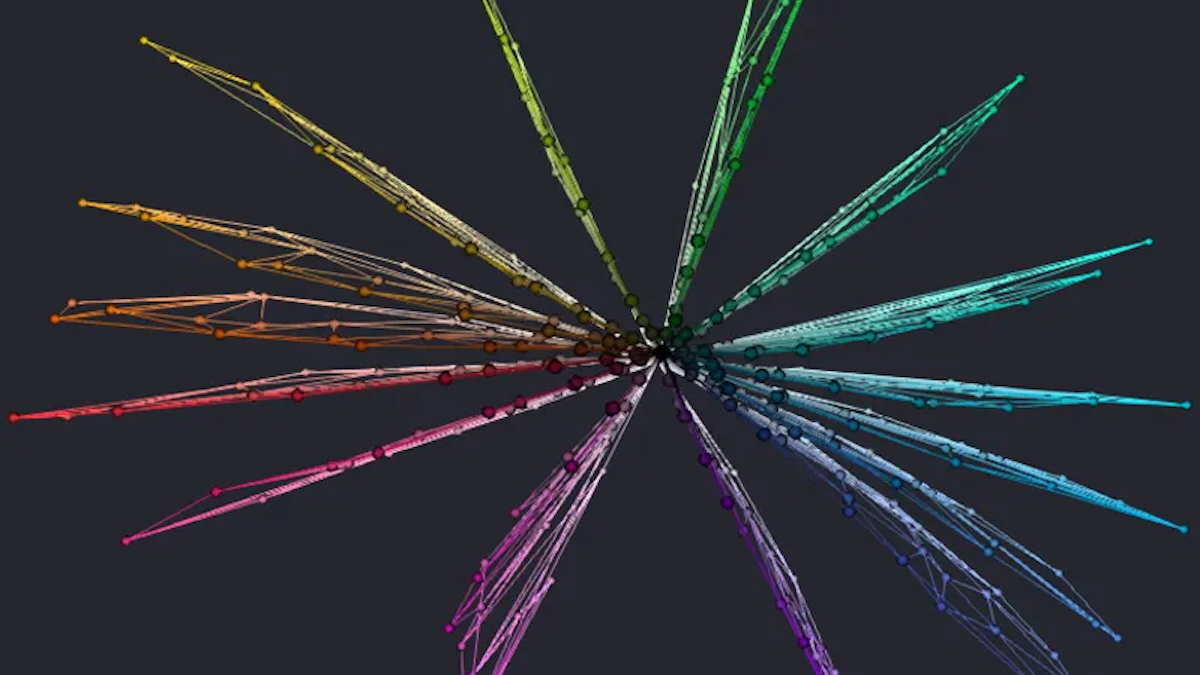
While aesthetic appeal might be subjective, the intrinsic perception of color attributes appears to be objective, according to a recent investigation conducted by scientists at Los Alamos National Laboratory in the United States.
This study posits that fundamental color distinctions are not shaped by external influences such as cultural norms or individual experiences, notwithstanding variations in color terminology and occasional internet disputes, like the widely discussed color of a particular dress in 2015.
The current research draws heavily upon the foundational work of Erwin Schrödinger, the renowned physicist celebrated for his “Schrödinger’s cat” thought experiment, who also delved into the complexities of color perception alongside other biological phenomena.
By integrating findings from color perception studies within a geometric framework, the authors of this new analysis identified deficiencies in Schrödinger’s mathematical descriptions of hue, saturation, and lightness. Their work not only elaborates on his theories but also rectifies these ambiguities, thereby completing his research endeavors over a century after their inception.
“Our determination is that these color qualities do not arise from supplementary external constructs, such as cultural or acquired experiences, but rather reflect the inherent properties of the color metric itself,” stated lead author and data scientist Roxana Bujack.
“This metric inherently encodes the perceived color distance—that is, the degree to which two colors appear dissimilar to an observer,” Bujack elaborated.
Human color vision, known as trichromatic vision, relies on three distinct types of cone cells in the retina responsible for color sensing. Each type of photoreceptor exhibits peak sensitivity at a different wavelength, and the combination of signal intensities generated by these cells allows us to perceive the full spectrum of colors.
This physiological mechanism establishes three dimensions within color spaces, which can be understood as organizational structures for color. These perceptual spaces function as cognitive frameworks where sensory input is processed into mental representations of the surrounding environment.
In the 19th century, the mathematician Bernhard Riemann proposed that our perceptual color spaces are not linear but curved, a concept underpinned by his specialized field of differential geometry.
While a straight line represents the shortest distance between two points in standard Euclidean space, Riemannian geometry often examines curved surfaces where the shortest path between two points, termed a geodesic, is not a straight line.
The physicist Hermann von Helmholtz theorized that individual color attributes could be geometrically defined solely based on their closest similarity within the Riemannian metric, a mathematical apparatus designed for the analysis of specific manifolds or higher-dimensional analogs of surfaces.
During the 1920s, Schrödinger employed the Riemannian model of color perception to formulate definitions for the perceptual attributes of hue, lightness, and saturation. His definitions were predicated on a color’s position relative to the neutral axis, which represents the gradient of grays from black to white.
These definitions remained largely accepted for the subsequent century, providing a foundational structure for understanding color attributes. However, as the authors of the current study engaged with algorithms for scientific visualizations, they encountered inconsistencies with Schrödinger’s propositions.
“With minor modifications, Schrödinger’s geometric framework for color attributes has, in essence, persisted to this day, despite also presenting discrepancies with certain experimentally observed phenomena,” they noted in their publication.
A significant point of contention, they highlight, is that Schrödinger did not formally define the neutral axis, even though his definitions of color attributes depended on the positions of colors in relation to it.
Recognizing an opportunity to advance the mathematical underpinnings of color perception, the researchers embarked on a mission to build upon and complete Schrödinger’s work more than a hundred years later.
Their success was achieved by establishing a definition for the neutral axis derived from the geometry of the color metric, which necessitated venturing beyond the confines of the Riemannian model, as they explained.
Furthermore, the researchers implemented several other crucial refinements. For instance, Schrödinger’s model failed to account for the Bezold-Brücke effect, a phenomenon where alterations in light intensity lead to a perceived shift in hue.
Bujack and her collaborators addressed this by replacing the straight-line approximation for stimulus quality between a color and black with the concept of the shortest geodesic path within the perceptual color space.
They also incorporated the principle of diminishing returns in color perception, which describes our tendency to perceive large color differences as less significant than the cumulative effect of smaller, incremental differences.
In a related publication from 2022, a significant portion of the same research team contended that this effect “cannot exist in a Riemannian geometry,” underscoring the imperative for enhanced methodologies in modeling color disparities.
Through their latest study, they present a novel conceptual framework for the geometric modeling of color in non-Riemannian spaces.
“Collectively, our solutions offer the inaugural comprehensive implementation of Helmholtz’s conceptualization: formal geometric definitions of hue, saturation, and lightness derived exclusively from the metric of perceptual similarity, entirely independent of external constructs,” the researchers concluded in their paper.