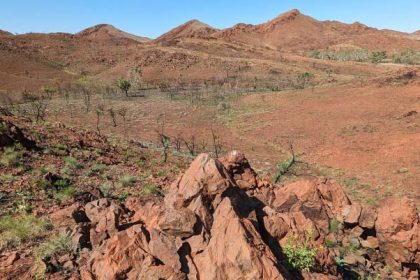
Researchers affiliated with West Virginia University have identified fossilized remnants of prokaryotic and eukaryotic cells encased within fluid pockets inside halite crystals. These crystals originate from the Neoproterozoic Browne Formation, located in the central region of Australia.

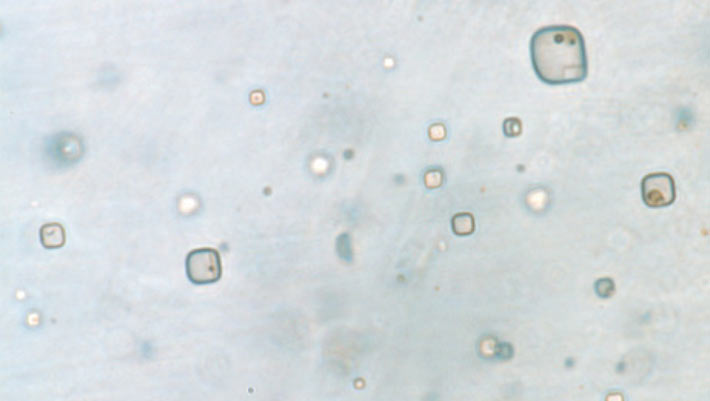
Distribution of microorganisms in primary fluid inclusions in Browne Formation halite from central Australia. Image credit: Schreder-Gomes et al., doi: 10.1130/G49957.1.
“As halite crystals precipitate from hypersaline surface bodies of water, they encapsulate the parent water in discrete primary fluid inclusions,” stated Sara Schreder-Gomes, in conjunction with her colleagues from the Department of Geology and Geography at West Virginia University.
“Beyond trapping parent waters, these inclusions possess the capability to engulf any solid particulates present in the water adjacent to or on the crystal surface during its formation.”
“Such entrapped solids encompass minute crystals of evaporite minerals or organic matter.”
“Prior investigations of halites, spanning from modern samples to those from the Permian period, have documented the existence of both prokaryotic and eukaryotic organisms, along with organic compounds such as beta carotene.”
Employing transmitted light petrography and UV-visible light petrography techniques, the research team meticulously examined primary fluid inclusions and their contents within 830-million-year-old halite specimens recovered from Australia’s Browne Formation.
The halite samples exhibited a remarkable degree of preservation, facilitating a detailed analysis of halite crystals drawn from 10 distinct halite beds. These samples were extracted from core depths ranging between 1,481 and 1,521 meters.
Their findings indicated that the solid materials trapped within the fluid inclusions were consistent in size, morphology, and fluorescence response to UV-visible light with prokaryotic and eukaryotic cellular structures, as well as organic compounds.
“A notable variation in the prevalence of microorganisms and organic compounds was observed, occurring both within and across individual growth strata of single crystals, as well as among halite crystals obtained from varying depths within the borehole,” the researchers reported.
“Certain crystals subjected to this study displayed an exceptionally high density of microorganisms and suspected organic compounds within their primary fluid inclusions.”
“For these particular crystals, it was estimated that approximately 40% of the inclusions harbored suspect microorganisms.”
“Conversely, some crystals, despite possessing numerous primary inclusions, did not reveal any discernible microorganisms.”
“In instances where fluid inclusions contained multiple microorganisms (ten or more), they typically also enclosed both prokaryotes and eukaryotes, alongside incidental daughter crystals and suspect organic compounds.”
“Primary fluid inclusions that contained several microorganisms were generally found to be larger than adjacent inclusions.”
The study provides compelling evidence for the long-term preservation of microorganisms within halite fluid inclusions over millions of years. This discovery suggests the potential for similar biosignatures to be identified in chemical sediments originating from Mars.
“The exceptionally well-preserved primary fluid inclusions found in Neoproterozoic Browne Formation halite represent enduring vestiges of ancestral surface waters that once supported prokaryotic and eukaryotic life, along with organic compounds,” the scientists commented.
“These microorganisms have remained entombed since the halite’s precipitation approximately 830 million years ago.”
“During this extensive geological epoch, they have undergone minimal decomposition, allowing for their optical recognition in situ.”
“The liquids contained within primary inclusions effectively function as microhabitats for the ensnared microorganisms, thereby enabling the extraordinary preservation of organic matter across vast spans of geological time.”
“Both terrestrial and extraterrestrial ancient chemical sediments ought to be considered as potential repositories for ancient microorganisms and organic compounds.”
The research team’s comprehensive publication has been featured in the esteemed journal Geology.
_____
Sara I. Schreder-Gomes et al. 830-million-year-old microorganisms in primary fluid inclusions in halite. Geology, published online May 6, 2022; doi: 10.1130/G49957.1