A collaborative endeavor involving a consortium of physicists from Germany, Finland, India, and Japan has announced the identification of a novel isotope belonging to the artificially created chemical element, seaborgium.

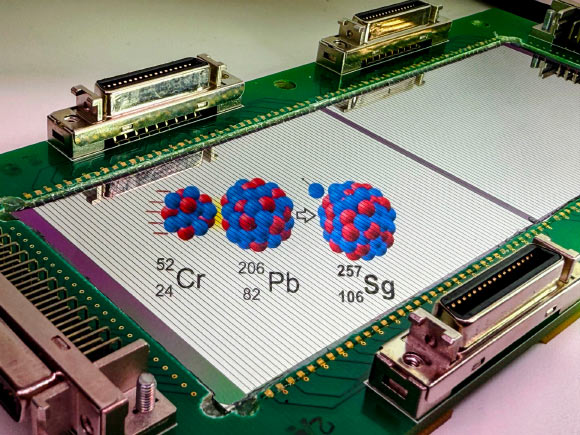
Mosat et al. report on the discovery of the new isotope seaborgium-257. Image credit: P. Mosat, GSI/FAIR.
Seaborgium, a transuranic chemical element designated by the symbol Sg and possessing atomic number 106, is fundamentally a product of laboratory synthesis.
First brought into existence in 1974, this element now boasts fourteen identified isotopes. Among these, seaborgium-271 stands out as the most stable, exhibiting a half-life of approximately 2.4 minutes.
The recently identified isotope, designated as seaborgium-257, undergoes radioactive decay via spontaneous fission and alpha-particle emission, characterized by a fleeting half-life of 12.6 milliseconds.
According to GSI/FAIR physicist Pavol Mosat and his collaborators, the creation of seaborgium-257 involved bombarding high-purity lead-206 targets with a potent beam of chromium-52, accelerated by the UNILAC linear accelerator at GSI/FAIR.
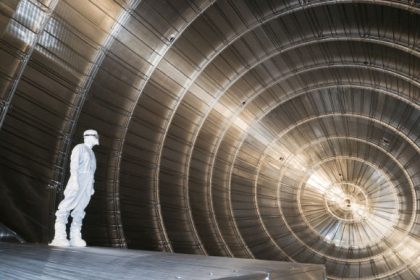
Through the deployment of TASCA (TransActinide Separator and Chemistry Apparatus), a highly effective gas-filled recoil separator designed for detection, the researchers meticulously documented a total of 22 instances of seaborgium-257 decay.
The researchers posited that their findings concerning seaborgium-257 offer compelling indications regarding the influence of nuclear shell effects on the fission characteristics of superheavy nuclei.
As a direct consequence of these observations, it is theoretically plausible that the next lighter, as yet undiscovered isotope, might undergo fission within an extremely brief temporal range, spanning from one nanosecond to six microseconds.
The upper bound of this predicted half-life spectrum hovers at or even dips below the threshold of current experimental detection capabilities, absent the presence of a so-called K-isomeric state.
Such excited nuclear states, bolstered by the stabilizing forces of quantum phenomena, are known to exhibit prolonged fission lifetimes, thereby providing an indirect pathway to probe the properties of otherwise short-lived nuclei.
Recent advancements toward the periphery of nuclear stability have been notably marked by the discovery of rutherfordium-252, which has a decay time of 60 nanoseconds, identified by virtue of its more enduring K-isomeric state.
The ongoing investigation into the isotopic boundaries of the element seaborgium represents a logical progression of these experimental pursuits, effectively charting the contours of the ‘island of stability’ within the realm of superheavy atomic nuclei.
To date, no K-isomeric state has been conclusively observed in any of the known seaborgium isotopes.
However, in the course of the present experimental campaign, the research team also subjected a lead-208 target to irradiation, yielding robust evidence suggestive of a K-isomeric state within the seaborgium-259 nucleus.
GSI/FAIR physicist Khuyagbaatar Jadambaa stated that their empirical findings related to a K-isomeric state in seaborgium-259 pave the way for exploring the phenomenon of K-isomerism in other seaborgium isotopes and potentially facilitate the synthesis of the transient isotope seaborgium-256, provided a similarly long-lived K-isomeric state exists within that nucleus.
The comprehensive outcomes of this research initiative have been formally disseminated in the esteemed scientific publication, Physical Review Letters.
_____
P. Mosat et al. 2025. Probing the Shell Effects on Fission: The New Superheavy Nucleus 257Sg. Phys. Rev. Lett 134, 232501; doi: 10.1103/s7hr-y7zq