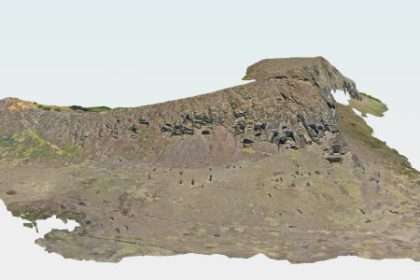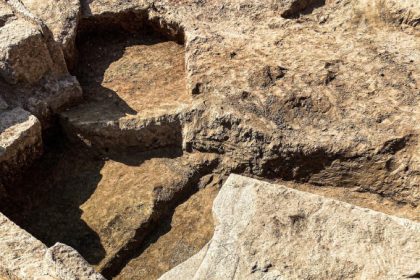
While the Middle Paleolithic era is recognized as a period of considerable activity in European and African history, it has typically been characterized as a quiescent phase in East Asia. However, the unearthing of an intricate assemblage of lithic artifacts at the Longtan site, situated in southwestern China and dated between 50,000 and 60,000 years ago, compels a re-evaluation of this established view.

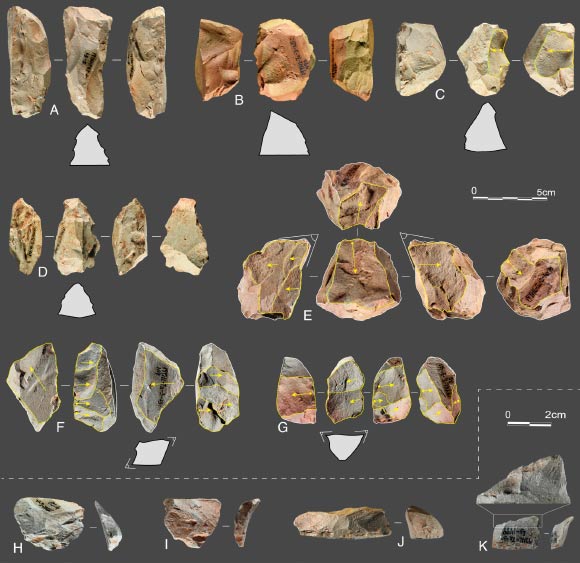
Products of the Quina system at the Longtan site, China. Image credit: Ruan et al., doi: 10.1073/pnas.2418029122.
The Middle Paleolithic epoch, spanning approximately 300,000 to 40,000 years ago, is widely regarded as a pivotal juncture in human evolutionary trajectories.
This period is often correlated with the emergence and diversification of anatomically modern humans in the African continent.
Across Eurasia, it is associated with the proliferation of various archaic hominin groups, including Neanderthals and Denisovans.
Nevertheless, a prevalent assertion has been that developmental progress in China during the majority of the Paleolithic was notably slow.
“Our findings serve to challenge the prevailing understanding of human history and technological advancements within East Asia,” stated Professor Bo Li from the University of Wollongong.
“This discovery calls into question the long-standing consensus among archaeologists that tools from the Middle Paleolithic in China were comparatively rudimentary and underwent minimal change.”
Professor Li, alongside his research associates, excavated a substantial collection of stone implements from the Longtan archaeological locale in China’s Yunnan province.
These artifacts evidenced a fully realized Quina technological tradition, encompassing core elements utilized for the production of substantial, thick flakes, which were subsequently refined and fashioned into scrapers.
The Quina industry stands as one of the most emblematic tool-manufacturing methodologies developed during the Middle Paleolithic era, roughly between 300,000 and 40,000 years ago.
It is distinguished by the employment of steep, angled retouching on thick flakes, resulting in the creation of robust scrapers exhibiting pronounced edge modification. This technique is frequently linked to Neanderthals and represents an adaptive strategy developed in response to the open forest-grassland settings and arid, cool climates characteristic of Marine Isotopic Stage 4, which occurred approximately 57,000 to 71,000 years ago.
While the Quina technological system had been identified in Western and Southern Europe during this timeframe, its presence in East Asia had not previously been substantiated.
Microscopic examination of wear patterns on the Longtan Quina scrapers indicates their utilization on a diverse array of materials, such as bone, antler, wood, animal flesh, hides, and non-woody vegetation.
“The empirical evidence demonstrates that the Longtan discovery significantly expands the known geographical distribution of hominin species, the tools they employed, and their capacity to adapt to varied climates and ecological settings,” Professor Li elaborated.
“The findings at Longtan also provide crucial insights for comprehending the evolutionary progression and diversification of hominin species in East Asia preceding the widespread arrival of early modern humans around 45,000 years ago.”
“By uncovering artifacts of considerably greater antiquity, we are compelled to revise our established models concerning hominin migratory patterns and the evolution of technological capabilities in this geographical region.”
“This revelation inaugurates promising new avenues for scholarly inquiry and has the potential to fundamentally reshape our understanding of East Asian prehistory.”
A publication detailing these discoveries was released this week in the esteemed journal, the Proceedings of the National Academy of Sciences.
_____
Qi-Jun Ruan et al. 2025. Quina lithic technology indicates diverse Late Pleistocene human dynamics in East Asia. PNAS 122 (14): e2418029122; doi: 10.1073/pnas.2418029122