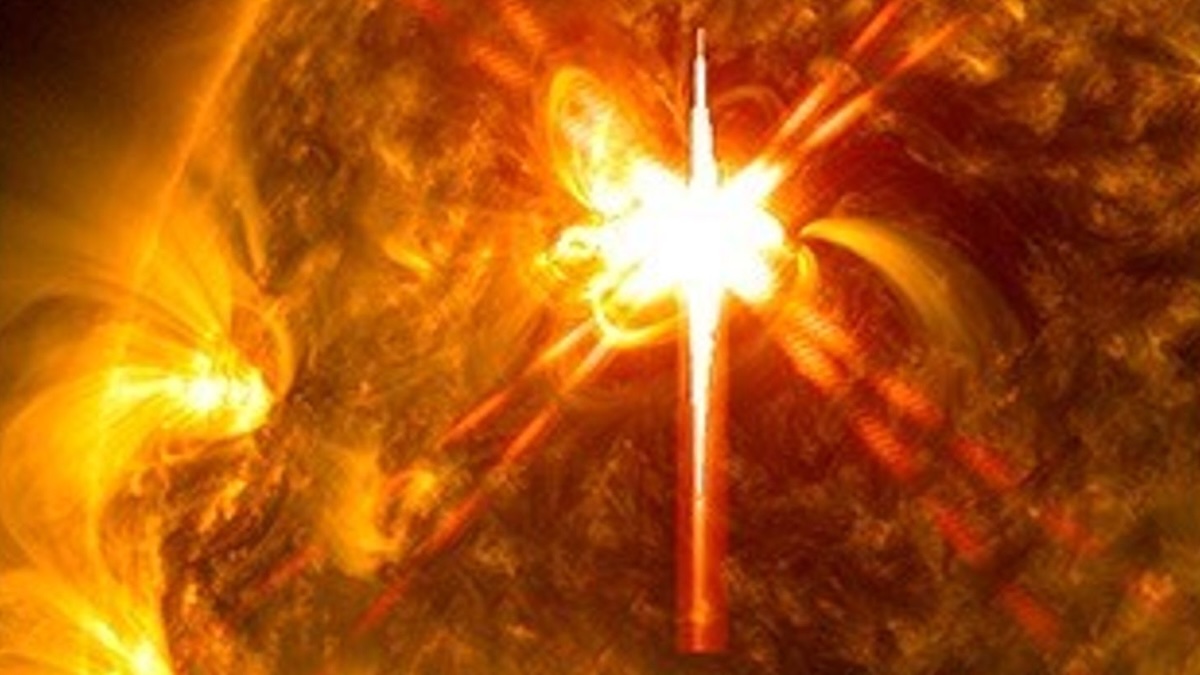
The Sun has recently discharged a series of four potent solar flares, signaling the potential for a dynamic week in terms of space weather phenomena.
This sequence commenced at 12:33 UTC on February 1, as the Sun emitted an X1.0 class flare.
Approximately 11 hours later, at 23:37 UTC, a significant outburst occurred, classified as an X8.1 flare. Two additional flares were recorded on February 2, with an X2.8 class event at 00:36 UTC and an X1.6 class event at 08:14 UTC.
X-class flares represent the zenith of solar eruptive power. In fact, the X8.1 event stood as the most formidable solar eruption observed since October 2024, and ranks as the 19th most intense event in recorded history.
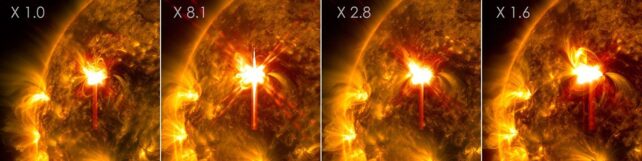
These solar eruptions originated from a concentration of sunspots identified as RGN 4366. This active region has only recently begun its transit across the Earth-facing side of the Sun, according to data from NOAA’s Space Weather Prediction Center.
“Should this sunspot group continue its development, maintain its complexity, and produce further powerful solar flares, there is an elevated probability of energetic particle events and potentially coronal mass ejections (CMEs) requiring monitoring,” stated the Space Weather Prediction Center in a recent advisory. (source)
Coronal mass ejections (CMEs) are substantial expulsions of plasma from the Sun, frequently linked to both the most spectacular and disruptive aspects of solar storms. These events are capable of generating breathtaking auroral displays but can also negatively impact satellite operations, power infrastructures, and critical communication technologies.
The perception that intense solar activity has been more prevalent in recent news has a tangible basis.
Our Sun has recently concluded its peak activity phase within its approximately 11-year cycle, an period that gifted us with remarkable celestial visual spectacles throughout 2024.
While it is anticipated that solar activity will gradually diminish leading up to the commencement of the subsequent cycle, projected around 2030, it appears we may still experience periods of volatile space weather.
“Forecasters anticipate continued noteworthy activity,” according to an update from the Space Weather Prediction Center. (source)