An examination of a fossilized trunk vertebra unearthed from Taiwan’s Chiting Formation has provided compelling evidence that pythons of approximately 4 meters in length inhabited the island during the Middle Pleistocene epoch.
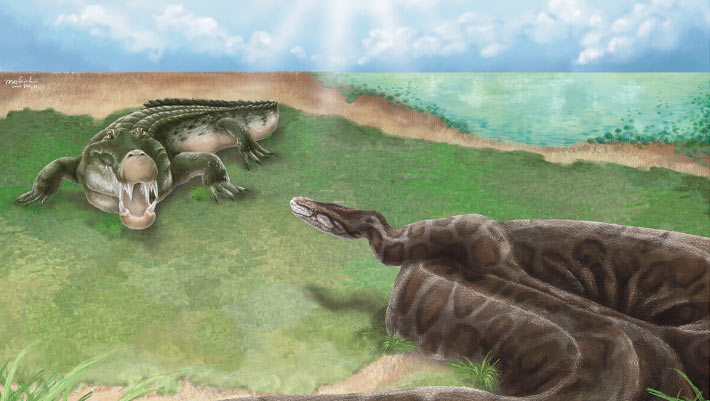
An artistic reconstruction depicting the potential interactions between Python and Toyotamaphimeia within Taiwan’s Middle Pleistocene ecosystem. Image courtesy of the Lab of Evolution and Diversity of Fossil Vertebrates, National Taiwan University / Cheng-Han Sun.
The genus Python encompasses close to ten distinct species of serpents belonging to the Pythonidae family. These reptiles are widely distributed across the tropical and subtropical zones of the Eastern Hemisphere.
Within the African continent, pythons are indigenous to the tropical regions south of the Sahara Desert, though they are notably absent from the extreme southwestern reaches of Southern Africa and the island of Madagascar.
In Asia, their geographic range extends from Bangladesh, Nepal, India, Pakistan, and Sri Lanka, proceeding through Myanmar and eastward to Indochina, encompassing southern China, Hong Kong, and Hainan. Furthermore, their presence is recorded across the Malayan region, including Indonesia and the Philippines.
“Currently, there are no extant members of the Python genus residing on the main island of Taiwan,” stated Yi-Lu Liaw and his team of researchers from National Taiwan University.
In their recent scientific endeavor, the paleontological experts meticulously analyzed a substantial single trunk vertebra discovered in the vicinity of Tainan City, Taiwan.
The geological period to which this fossil specimen has been dated is the Middle Pleistocene, falling between approximately 800,000 and 400,000 years ago.
The researchers conclusively identified the specimen as belonging to the genus Python, thereby establishing the first definitive fossil record of a python on Taiwan’s primary island.
By employing measurements derived from a meticulously reconstructed three-dimensional model of the specimen, the scientists have estimated that this ancient serpent achieved an overall length of approximately 4 meters. This measurement significantly surpasses the length of any indigenous snake species currently found in Taiwan.
Taiwan hosts over 50 species of snakes, yet none of these modern inhabitants approach the formidable size indicated by the fossilized remains.
“This particular fossil represents the most substantial and indeed the most unanticipated serpentine fossil discovered in Taiwan to date,” the scientists remarked.
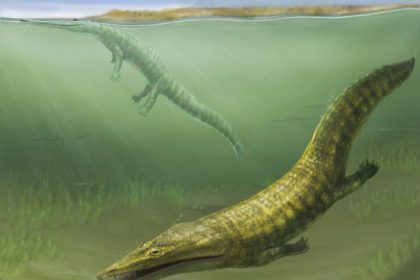
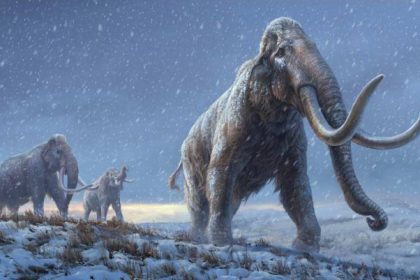
The vertebra was retrieved from the Chiting Formation. This is a geologically significant stratum in southern Taiwan, renowned for its rich fossil assemblages, which have also yielded the remains of saber-toothed cats, large crocodilians, and immense herbivores such as mammoths and ancient rhinoceros species.
Collectively, these discoveries paint a vivid picture of a sophisticated and predator-dominated ecosystem that thrived during the Middle Pleistocene, presenting a stark contrast to Taiwan’s contemporary fauna.
“The disappearance of apex predators, evidenced by this large Python specimen, as well as previously documented saber-toothed cats and considerable crocodiles, from Taiwan’s current biodiversity signifies a profound transformation in its faunal composition,” the researchers concluded.
“We posit that the ecological role of top predators in the contemporary ecosystem may have remained unfilled since the extinction events of the Pleistocene era.”
“Subsequent discoveries and comprehensive analyses will be instrumental in validating these hypotheses and shedding light on the evolutionary origins of modern biodiversity in the Far East.”
This significant finding is detailed in a research publication featured in the journal Historical Biology.
_____
Yi-Lu Liaw et al. An unexpected snake fossil (Pythonidae, Python) from Taiwan. Historical Biology, published online January 16, 2026; doi: 10.1080/08912963.2025.2610741