A significant paleontological discovery has been made by researchers affiliated with the University of Toronto Mississauga, who have identified numerous tooth impressions on the fossilized skeletal remains of three juvenile specimens of Diadectes. This ancient creature represents one of the earliest terrestrial vertebrates of substantial size that subsisted on vegetation. The observed damage patterns on these bones are posited by the investigators to constitute the most ancient, direct corroboration of predatory-prey dynamics involving land-dwelling carnivores and herbivores.
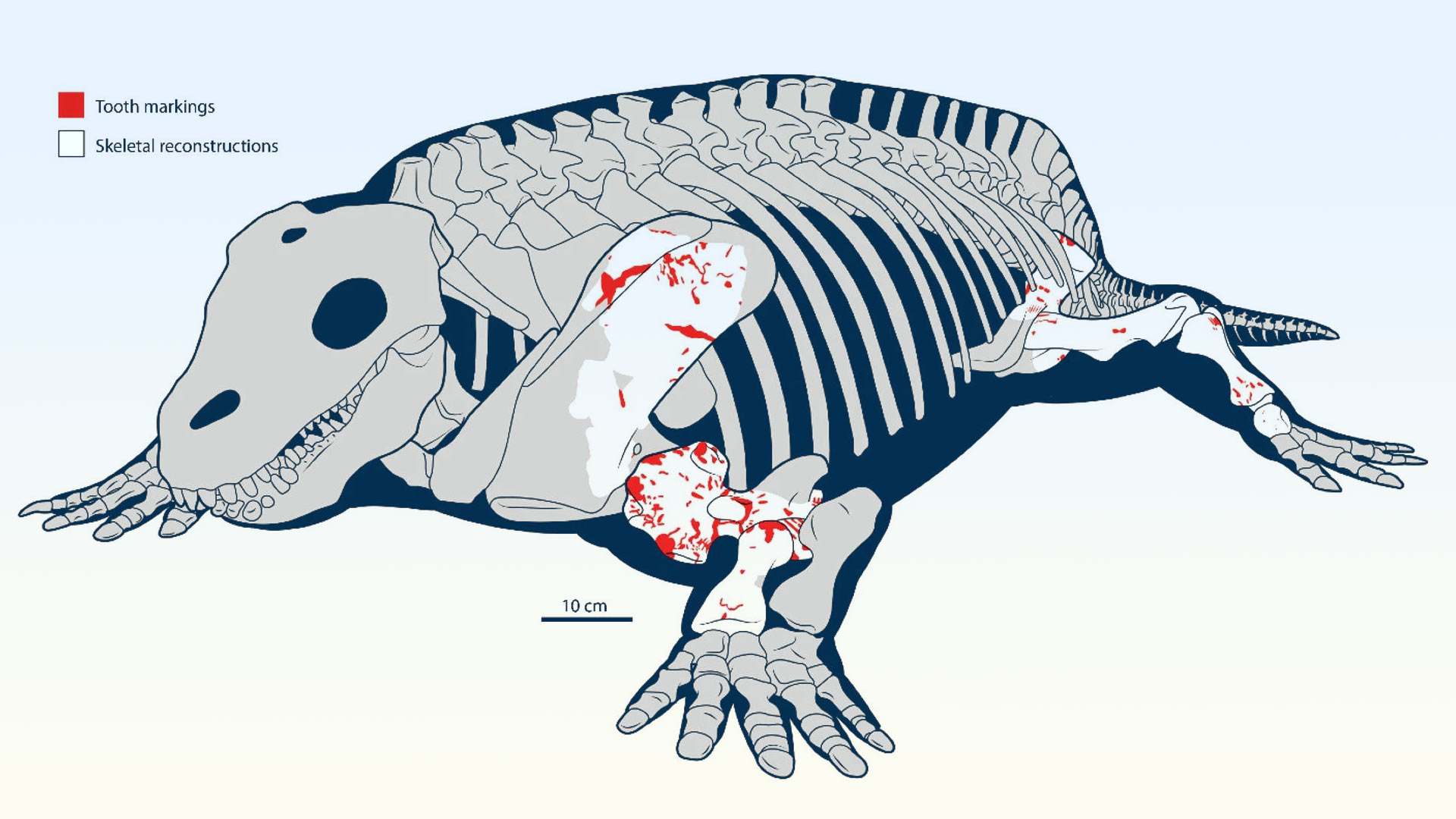
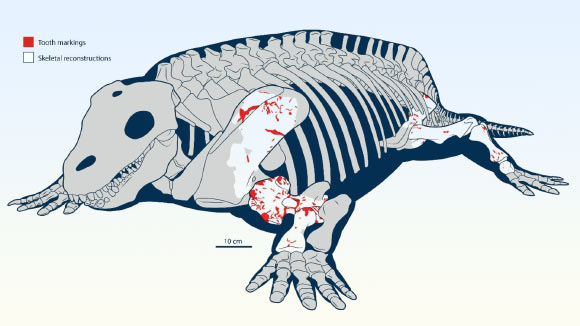
A skeletal depiction of Diadectes sideropelicus, annotated with left and right tooth marks and bore impressions, presented in a right lateral perspective. Credit for the image: Young et al., doi: 10.1038/s41598-026-38183-6.
While the existence of dominant predators roaming Permian ecosystems has been acknowledged by paleontologists for a considerable period, concrete physical evidence substantiating their predation on the nascent large herbivorous fauna has remained largely elusive.
In contrast to the Mesozoic Era, which is renowned for documenting dinosaurian bite marks, the fossil record from preceding geological periods has offered scant direct evidence of such predatory engagements.
“Our findings illuminate that predator-prey hierarchies were established at an earlier stage than was previously hypothesized,” stated Professor Robert Reisz, a distinguished paleontologist at the University of Toronto Mississauga and the senior author of the research.
“Although these types of interactions are extensively documented during the ‘Age of Reptiles,’ information pertaining to the Paleozoic Era, a period when terrestrial vertebrates first diversified into large apex predators and herbivores, has been notably scarce.”
Within the scope of their investigation, Professor Reisz and his research cohort meticulously scrutinized three disarticulated juvenile skeletons belonging to the herbivorous species Diadectes, originating from the Early Permian geological epoch.
These fossil specimens were unearthed at the Mud Hill locale, situated within the Vale Formation in Texas, United States.
The paleontological team cataloged five distinct categories of damage evident on the bones: superficial striations, deeper indentations, extensive grooves along the bone shafts, conical puncture marks, and minute boreholes.
A significant concentration of these marks was observed in proximity to joint areas rich in cartilage, suggesting that the predators were actively engaged in the removal of musculature and the exploitation of connective tissues.
Certain furrowed impressions run in parallel alignment with the longitudinal axis of the bones, indicative of a forceful pulling motion of the head during the process of tearing flesh from the carcass.
“The presence of puncturing, pitting, scoring, and furrowing marks on the skeletal remains of these three young herbivorous animals strongly suggests the involvement of large predators encountered at this geological site and in adjacent regions. These predators likely include varanopid (Varanops) and sphenacodontid (Dimetrodon) synapsids,” commented Jordan M. Young, a researcher at the University of Toronto Mississauga and the lead author of the study.
“Furthermore, scavengers and smaller arthropods also partook in this ‘Paleozoic feast.’”
“Evidence of arthropod borings was detected on areas of the skeletons that would have corresponded to cartilaginous bone ends on the ancient carcass.”
The comprehensive research findings were officially published on February 26, 2026, in the esteemed scientific journal Scientific Reports.
_____
J.M. Young et al. 2026. Earliest direct evidence of trophic interactions between terrestrial apex predators and large herbivores. Sci Rep 16, 6977; doi: 10.1038/s41598-026-38183-6