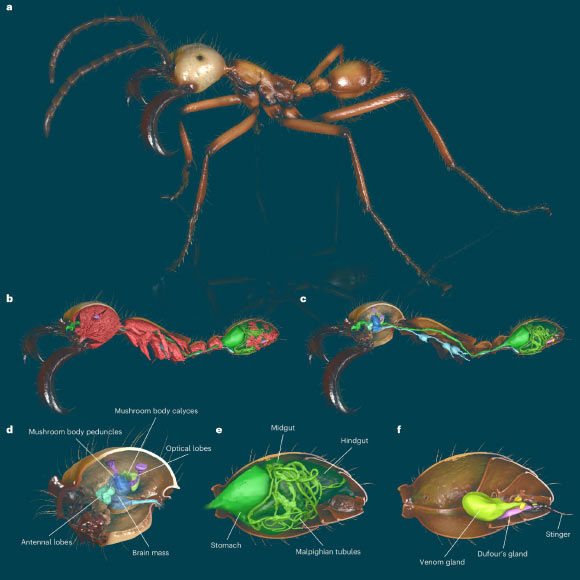
Through the deployment of potent X-ray apparatus, sophisticated automated robotics, and artificial intelligence, entomologists have successfully generated interactive, three-dimensional digital representations encompassing 212 ant genera and 792 distinct species.
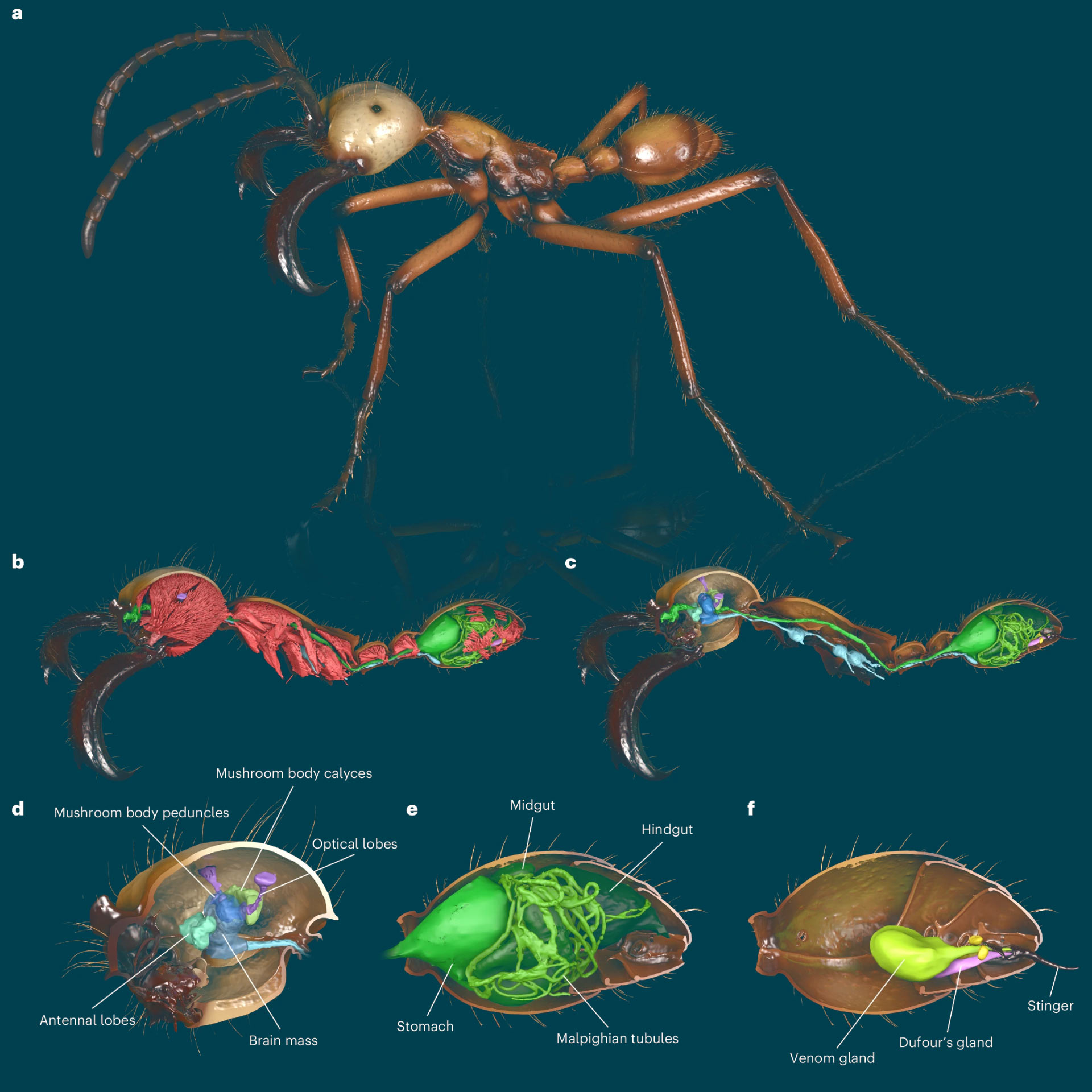
Renderings of an exemplary Antscan specimen: subsoldier of Eciton hamatum. Image credit: Katzke et al., doi: 10.1038/s41592-026-03005-0.
To facilitate the compilation of this extensive digital compendium, Julian Katzke, a researcher at the Okinawa Institute of Science and Technology, alongside his esteemed colleagues, procured ant specimens preserved in ethanol from collaborating academic bodies, archival museum collections, and international experts.
Following a meticulous process of categorizing these specimens according to their respective species and social castes, the researchers transported them to the Karlsruhe Institute of Technology (KIT) situated in Germany. At KIT, these samples underwent high-throughput X-ray micro-computed tomography (micro-CT) scanning, a methodology akin to medical CT imaging but capable of achieving significantly higher magnifications.
A synchrotron particle accelerator was instrumental in generating an exceptionally intense X-ray beam necessary for the rapid scanning of a considerable volume of specimens. Concurrently, an automated robotic system facilitated the rotation and exchange of these specimens at intervals of approximately 30 seconds.
This advanced technological integration enabled the creation of two-dimensional image sequences, which subsequently served as the foundation for the construction of intricate three-dimensional models.
While the resultant data proved to be remarkably informative, the initial raw image files presented the ant specimens in somewhat distorted orientations, falling short of the lifelike digital representations the scientific team envisioned.
The rendered three-dimensional imagery now offers unprecedented visibility into the internal anatomical structures of the ants, including musculature, nervous systems, digestive tracts, and venom delivery mechanisms, all depicted with micrometer-level precision.
These meticulously crafted models possess the inherent flexibility to be readily animated or seamlessly integrated into virtual reality environments, thereby broadening their utility across research, educational pursuits, and even the entertainment sector.
Dr. Katzke commented, “We had projected that undertaking this endeavor utilizing a conventional laboratory-based CT scanner would necessitate an operational period of six full years.”
He further elaborated, “However, by leveraging the sophisticated apparatus at KIT, we were able to complete the scanning of 2,000 specimens within a singular week.”
Professor Evan Economo, associated with both the Okinawa Institute of Science and Technology and the University of Maryland, added, “Executing this process manually would have demanded years of dedicated effort; consequently, without the aid of these advanced computational tools, this project would essentially remain unaccomplished.”
This initiative, officially designated as Antscan, holds the potential to establish a foundational framework for future digital preservation efforts, extending its applicability beyond the realm of ants to encompass a diverse array of biological species.
Professor Economo articulated, “The significance of this research extends far beyond the immediate focus on ants; its implications are considerably more expansive.”
He continued, “By digitizing specimens, we can establish comprehensive repositories of organisms that can profoundly accelerate their utilization, ranging from academic laboratories and educational institutions to the production studios of Hollywood.”
The collective research findings were formally unveiled today in the esteemed scientific journal, Nature Methods.
_____
J. Katzke et al. High-throughput phenomics of global ant biodiversity. Nat Methods, published online March 5, 2026; doi: 10.1038/s41592-026-03005-0