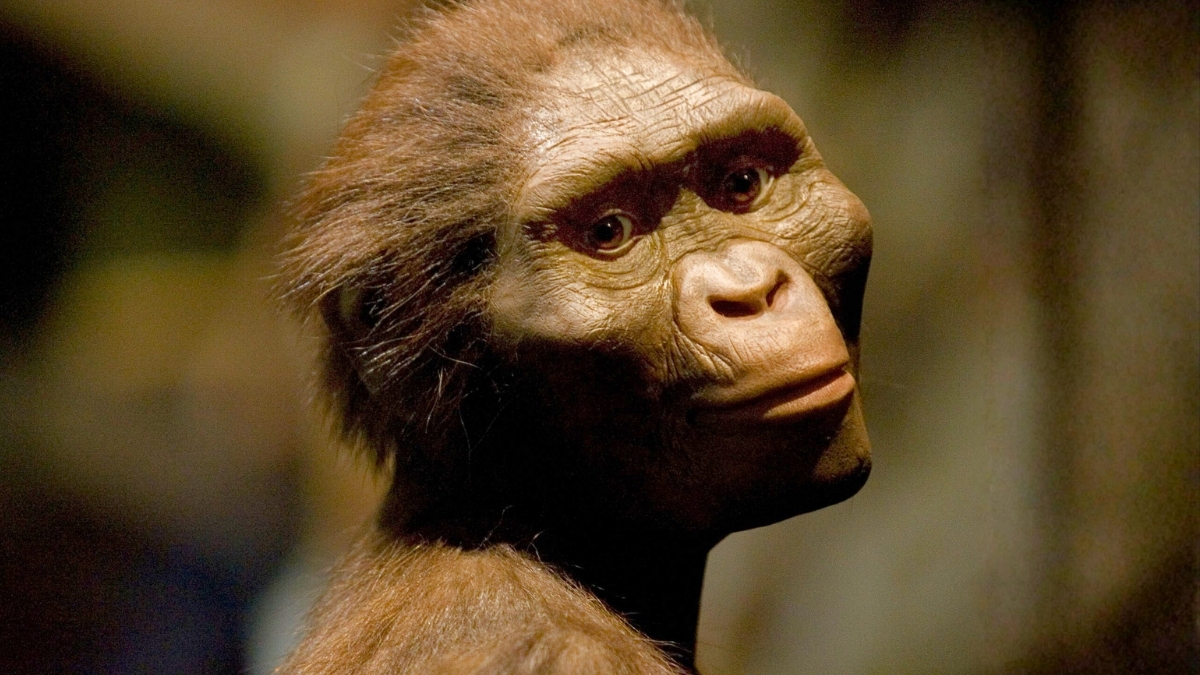
A collection of skeletal fragments and dental remains strongly indicates that two distinct hominin lineages coexisted over 3.3 million years ago within Ethiopia’s Afar Rift region.
This discovery represents the inaugural definitive evidence suggesting these ancient relatives not only shared temporal overlap but also occupied adjacent territories. As articulated by paleoanthropologist Yohannes Haile-Selassie of Arizona State University, the fossilized remnants of each distinct species were unearthed within a three-mile radius of one another, underscoring their proximity.
Haile-Selassie and his investigative team have posited that foot bones, recovered in 2009, are most probably attributable to a species predating the renowned hominin known as ‘Lucy’ (Australopithecus afarensis).
This newly identified species has been classified as Australopithecus deyiremeda, previously identified solely through partial mandibular fragments. The 3.4-million-year-old foot implicates a distinct mode of locomotion when contrasted with A. afarensis, thus hinting that despite their contemporaneous existence, these two species likely maintained significantly divergent lifestyles.
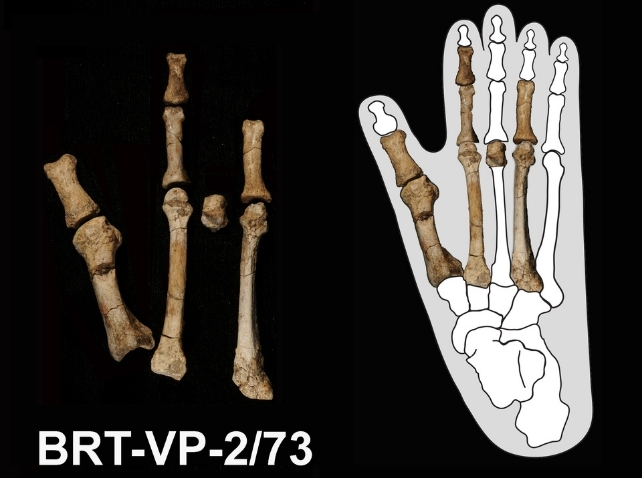
Whereas ‘Lucy’ was demonstrably adept at arboreal locomotion, the anatomical characteristics recovered suggest that A. deyiremeda exhibited even more pronounced adaptations for tree climbing.
Among the eight pedal elements recovered, fragments of a hallux (big toe) were present, indicating a considerably enhanced range of motion, allowing for opposability reminiscent of contemporary human thumbs. This anatomical feature strongly implies that A. deyiremeda retained significant adaptations for extensive periods spent navigating arboreal environments.

“The species to which this foot belongs was an accomplished climber, facilitating the exploitation of arboreal resources,” Haile-Selassie expounds.
Further analysis of the other phalanges reveals that this species possessed the capacity for foot hyperflexion. This physiological trait enables efficient push-off from flat terrain, signifying that this early hominin had already developed adaptations for comfortable bipedal locomotion.
“The morphology presents a combination of arboreal specialization… coupled with bipedality, which renders it markedly distinct from the characteristics observed in species like A. afarensis,” Haile-Selassie elaborates.
Isotopic examination of fossilized dentition from both A. deyiremeda and A. afarensis substantiated their divergent dietary preferences, thereby bolstering the hypothesis of differing ecological niches. It is understood that ‘Lucy’s’ species possessed a more varied dietary repertoire, encompassing diverse flora characterized by two primary photosynthetic pathways: C3 and C4.
It is theorized that hominin ancestors transitioned towards greater consumption of C4 plants, which demonstrated enhanced productivity in the arid environmental conditions prevalent during the Pleistocene’s climatic shifts.
Conversely, A. deyiremeda predominantly subsisted on C3 plants, which typically thrive in cooler, more mesic environments. This dietary inference is derived from the isotopic signature of their teeth, which closely mirrors that of earlier arboreal hominin taxa such as A. ramidus and A. anamensis.
Based on these converging lines of evidence, it is plausible that despite their close geographical proximity, ‘Lucy’s’ conspecifics and A. deyiremeda successfully circumvented interspecific competition for sustenance, maintaining distinct and presumably harmonious ecological roles through divergent dietary strategies.