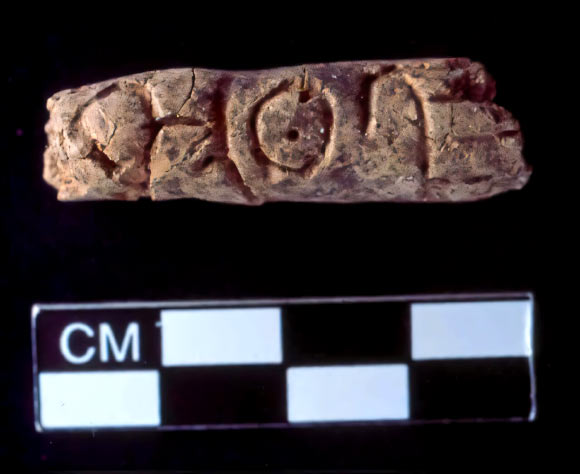
Dating back to approximately 2400 BCE, this inscribed material predates other recognized alphabetic systems by an estimated 500 years, according to Professor Glenn Schwartz of Johns Hopkins University.

The 4,400-year-old clay object discovered at the ancient city of Umm el-Marra, Syria; the engraved symbols may be part of the earliest known alphabet. Image credit: Glenn Schwartz, Johns Hopkins University.
“The advent of alphabets brought about a profound transformation in written communication, extending its reach beyond the confines of royalty and the privileged strata of society. Alphabetic script fundamentally reshaped human existence, influencing cognition, daily life, and interpersonal connections,” Professor Schwartz articulated.
“Furthermore, this groundbreaking discovery indicates that humanity was exploring novel communication technologies at a considerably earlier period and in a distinct geographical context than previously theorized.”
This early form of alphabetic inscription has been found etched onto small, finger-length clay cylinders that were unearthed at Tell Umm-el Marra, an archeological site identified as one of the initial medium-sized urban settlements to emerge in western Syria.
During excavations at Umm-el Marra, archeologists brought to light burial chambers originating from the Early Bronze Age.
Within one of the most remarkably preserved tombs, six individual skeletons were discovered, accompanied by an array of gold and silver adornments, culinary utensils, a spearhead, and an assortment of complete pottery vessels.
Positioned alongside the ceramic ware were four lightly fired clay cylinders bearing what appear to be alphabetic markings.

The 4,400-year-old clay object discovered at the ancient city of Umm el-Marra, Syria. Image credit: Glenn Schwartz, Johns Hopkins University.
“The presence of perforations in the cylinders suggests to me that they might have been attached to another item via string, serving as a form of identification tag,” Professor Schwartz posited.
“These tags could potentially indicate the contents of a container, its point of origin, or its owner.”
“Without the ability to decipher the script, our interpretations remain speculative.”
Through the application of carbon-14 dating methodologies, researchers were able to ascertain the precise age of the tombs, the accompanying artifacts, and the inscribed writings.
“Previously, scholarly consensus held that the alphabet originated in or near Egypt sometime following 1900 BCE,” Professor Schwartz remarked.
“However, our findings consist of artifacts that are chronologically earlier and originate from a different geographical locus, proposing that the alphabet’s genesis may possess a distinct evolutionary narrative compared to our prior understandings.”
Professor Schwartz presented these findings recently at the 2024 American Society of Overseas Research (ASOR 2024) annual meeting.
_____
Glenn M. Schwartz. The Case for Early Alphabetic Writing from Umm el-Marra, Syria, ca. 24th Century BCE. ASOR 2024