Innovations in administration within south-west Asia during the fourth millennium BCE, notably the utilization of cylinder seals impressed upon nascent clay tablets, established the groundwork for proto-cuneiform script, recognized as one of humanity’s earliest systems of written communication. While these seals were replete with rich visual narratives, scholarly investigation into the specific impact of their motifs on the evolution of sign-based proto-cuneiform remained limited. A recent investigation, detailed in a new publication in the esteemed journal Antiquity, posits the identification of symbolic precursors to foundational proto-cuneiform characters within seal designs that depict the conveyance of vessels and textiles. This finding underscores the intricate interplay between early clay-based communication methodologies.

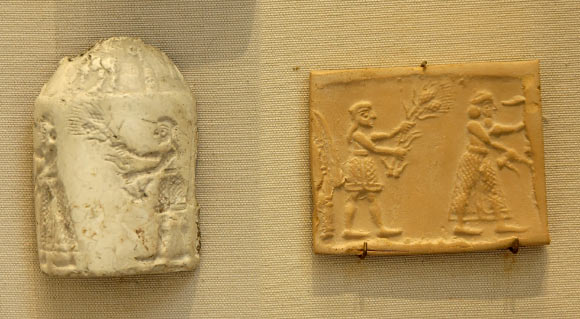
Cylinder seal and sealing impression: the king-priest and his acolyte feeding the sacred herd. Uruk period, ca. 3200 BCE. Image credit: Marie-Lan Nguyen.
Scholars frequently attribute the genesis of written language in south-west Asia to the accounting frameworks that emerged throughout the 4th millennium BCE. These systems provided a tangible record of transactions through the use of tokens, tags, bullae, numerical tablets, and seals.
Proto-cuneiform, first documented on clay tablets excavated from the ancient city of Uruk in southern Iraq and dating to approximately 3350-3000 BCE, represents a sophisticated accounting system characterized by hundreds of iconographic signs, many of which continue to elude definitive interpretation.
The refinement of tokens, which had been in widespread use across south-west Asia for an extended period, may have both spurred the development of proto-cuneiform and provided archetypes for numerous signs. Nevertheless, direct comparisons between tokens and signs, excluding numerical notations, are seldom demonstrable, suggesting that the origination of sign forms likely stemmed from a multifaceted visual expression environment.
“The conceptual leap from pre-writing symbolism to the establishment of writing constitutes a profound advancement in human cognitive technologies,” stated Professor Silvia Ferrara of the University of Bologna.
“The advent of writing signifies the demarcation between prehistory and history, and the discoveries presented in this study help to bridge this temporal chasm by illustrating how certain late prehistoric images were integrated into one of the earliest devised writing systems.”
“While the intrinsic connection between ancient sealing practices and the invention of writing in southwest Asia has long been acknowledged, the specific relationship between individual seal imagery and the resulting sign shapes has received scant attention,” she elaborated.
“Our foundational inquiry was thus: did the visual repertoire of cylinder seals contribute substantially to the genesis of signs within the region’s inaugural writing system?”
To address this query, Professor Ferrara and her research associates meticulously compared the designs adorning cylinders with extant proto-cuneiform signs, seeking correspondences that could illuminate direct links in both graphic form and semantic content.
“Our focus was specifically on seal imagery that predated the invention of writing yet persisted in its development into the proto-literate epoch,” explained University of Bologna researchers Kathryn Kelley and Mattia Cartolano.
“This methodological approach enabled us to pinpoint a series of designs associated with the transportation of textiles and pottery, which subsequently evolved into correlative proto-cuneiform signs.”
This revelation establishes a direct conduit between the cylinder seal paradigm and the inception of written language, thereby offering novel avenues for the examination of symbolic and orthographic system evolution.
“Our findings unequivocally demonstrate that the engravings found on cylinder seals are directly implicated in the progression of proto-cuneiform in southern Iraq,” Professor Ferrara affirmed.
“Furthermore, they elucidate the mechanism by which the meanings initially conveyed by these designs were assimilated into a formal writing system.”
_____
Kathryn Kelley et al. Seals and signs: tracing the origins of writing in ancient South-west Asia. Antiquity, published online November 5, 2024; doi: 10.15184/aqy.2024.165