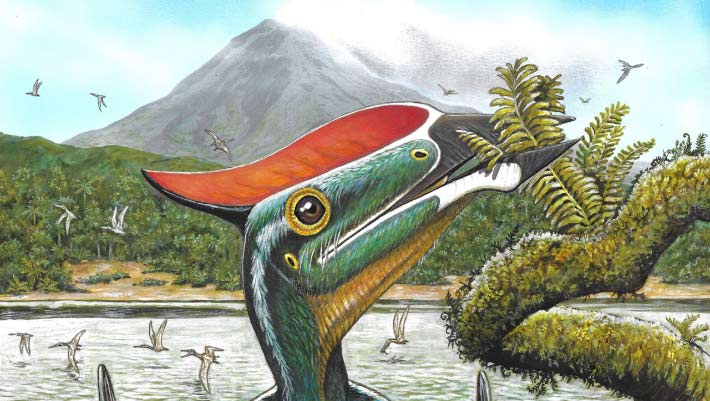
A collaborative endeavor involving paleontologists from China and Brazil has yielded the discovery of an aggregate of 320 phytoliths within the fossilized digestive tract of a pterosaur species designated as Sinopterus atavismus. These phytoliths are identified as microscopic, rigid bodies composed of mineral deposits that materialize within plant cells.
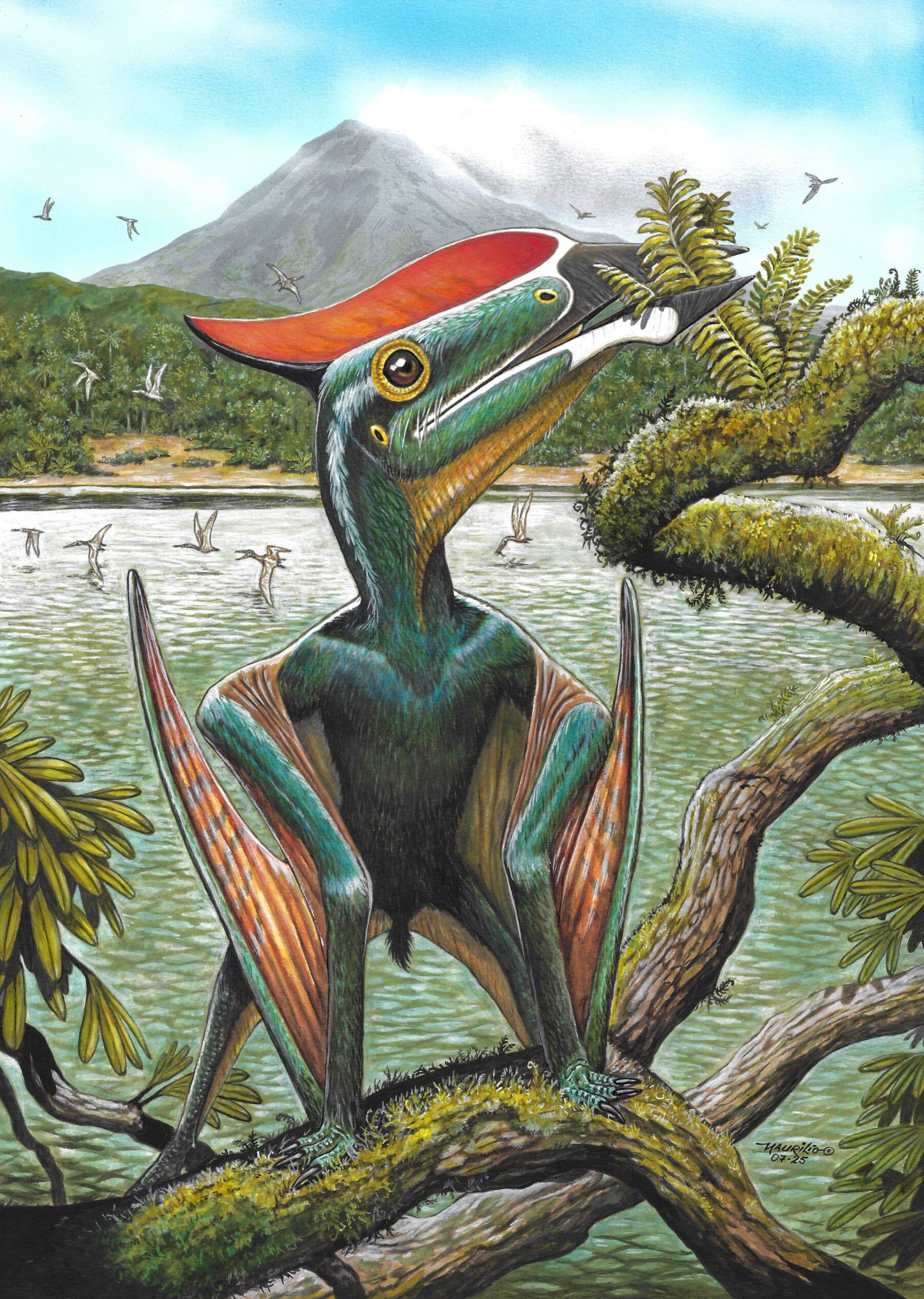
Life reconstruction of Sinopterus atavismus. Image credit: Maurilio Oliveira / Science China Press.
Pterosaurs, a classification of extinct reptiles that flourished during the Mesozoic Era, represent the earliest vertebrates to achieve the evolutionary milestone of powered flight.
A significant area of ongoing scientific inquiry pertains to the dietary patterns of these airborne reptiles, which continue to be inadequately understood.
A diverse array of dietary hypotheses has been posited for various pterosaur lineages, encompassing the consumption of insects, fish, other animals, hard-shelled prey, plants or fruits, filter-feeding, and omnivorous habits.
It is widely recognized that direct evidence derived from stomach contents constitutes an irrefutable, albeit exceptionally rare, form of paleontological data.
Apart from the vestiges of scales associated with the rib cage of Eudimorphodon, originating from the Late Triassic period in Italy, a mere five instances of confirmed pterosaur stomach contents have been formally documented. These rare findings are exclusively linked to the species Rhamphorhynchus, discovered within the Late Jurassic Solnhofen Limestone formations of Germany.
These previously identified stomach contents primarily comprise piscine remains, with a few indeterminate objects also noted.
In a recent scholarly investigation, Dr. Xiaolin Wang, affiliated with the Institute of Vertebrate Paleontology and Paleoanthropology at the Chinese Academy of Sciences, alongside his research associates, undertook an examination of the fossilized gastric contents pertaining to Sinopterus atavismus. This particular species, a member of the tapejarid pterodactyloid pterosaur group, inhabited China approximately 120 million years ago.
The analysis revealed the presence of a substantial quantity of small gastroliths within the stomach contents. Furthermore, an extraction process yielded 320 phytoliths from a minute fragment of this preserved material.
“Phytoliths are minute silica structures that develop during the vegetative growth of plants, and they exhibit distinctive morphologies that vary among different plant species, and indeed, even within distinct segments of the same plant,” the paleontological researchers explained.
“This particular discovery represents a dual achievement: it marks the inaugural extraction of phytoliths from any pterosaur specimen, and it constitutes the second recorded instance of a pterosaur fossil exhibiting the presence of gastroliths.”
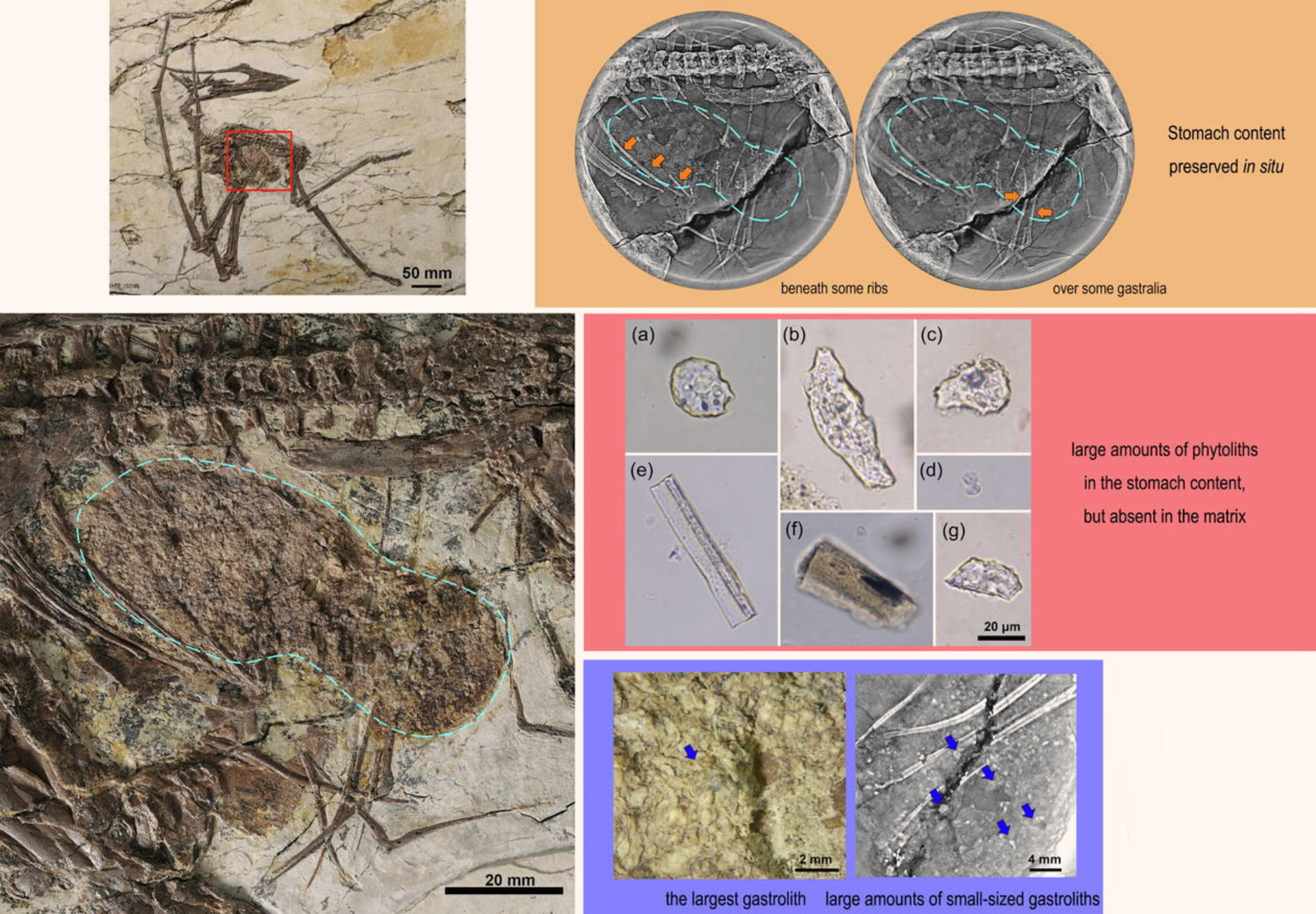
The specimen of Sinopterus atavismus. Image credit: Jiang et al., doi: 10.1016/j.scib.2025.06.040.
To definitively establish the hypothesis that Sinopterus atavismus was indeed herbivorous, the research team rigorously investigated alternative explanations.
“In the initial phase, we definitively excluded the possibility of contamination by verifying that the surrounding geological matrix did not harbor any of the phytoliths subsequently identified within the stomach,” they stated.
“Subsequently, we contemplated the scenario wherein the plant matter might have been ingested indirectly through the consumption of other herbivorous fauna.”
“However, evidence suggests that Sinopterus atavismus possessed a rapid, avian-like metabolic rate. Had it preyed upon vertebrates or invertebrates, residual traces such as osseous fragments, scales, or the resilient exoskeletons of insects would undoubtedly have persevered within its digestive system, yet no such indicators were found.”
“The proposition that it subsisted on invertebrates with soft bodies, such as caterpillars, was also found to be untenable. The necessity for such a significant quantity of gastroliths would be inexplicable if the organism were not engaging in the grinding of recalcitrant food substances.”
“These ingested stones are typically employed by fauna to facilitate the maceration of tough materials, including insect carapaces or plant tissues, rendering them superfluous for the digestion of soft-bodied prey.”
“Lastly, prior investigations focusing on Tapejara wellnhoferi—a closely related species to Sinopterus atavismus—revealed the presence of powerful mandibular structures adapted for the processing of vegetative matter, thereby providing further corroboration for this dietary conclusion.”
“Consequently, the identified phytoliths are interpreted as direct indicators of dietary intake, while the gastroliths served a functional purpose as abrasive agents for the mechanical processing of plant-based foodstuffs.”
The scientific publication detailing the team’s findings was featured in the October 15, 2025 edition of the esteemed journal Science Bulletin.
_____
Shunxing Jiang et al. 2025. First occurrence of phytoliths in pterosaurs — evidence for herbivory. Science Bulletin 70 (19): 3134-3138; doi: 10.1016/j.scib.2025.06.040