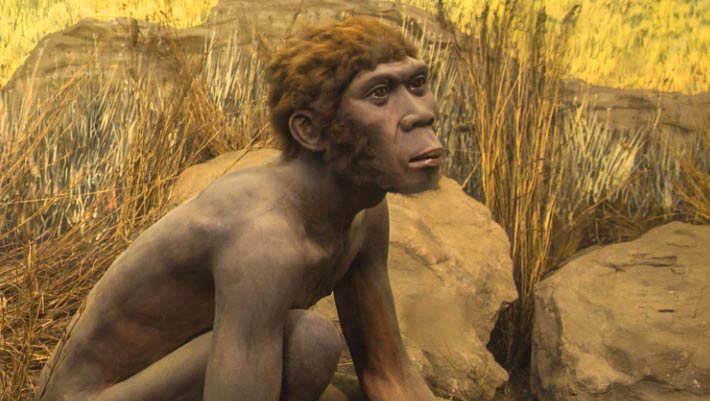
New scientific investigations indicate that Homo erectus, an ancestral species within the Homo genus, demonstrated remarkable resilience by enduring challenging and arid environments in Eastern Africa for extended durations, exceeding prior estimations.
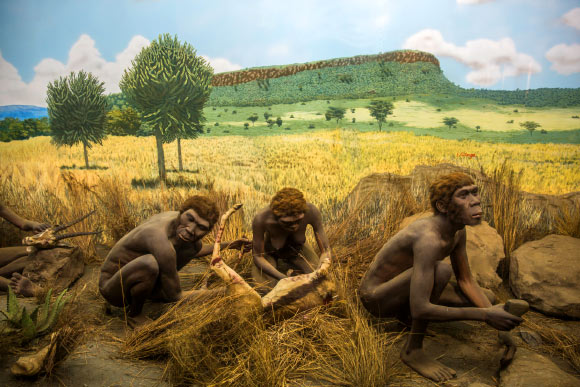
Archaic hominins. Image credit: Ninara / CC BY 2.0.
A long-standing scholarly debate has revolved around the timeline at which the Homo genus developed the capacity to flourish in such demanding ecological niches as deserts and dense jungles.
Until recently, it was widely presumed that only Homo sapiens possessed the inherent adaptability for sustained habitation within these demanding biomes, while earlier hominin species were thought to be confined to more limited geographical zones.
However, accumulating evidence now points towards the capability of early Homo species to acclimate to a wide array of fluctuating and precarious ecological settings, tracing back as far as two million years ago.
“Homo erectus, a species now extinct, persisted for a notable period exceeding an estimated 1.5 million years, positioning it as a significant evolutionary success in the human lineage when contrasted with our own species’ estimated current existence of approximately 300,000 years,” remarked Professor Michael Petraglia of Griffith University.
“This enduring success can be attributed to their inherent ability to subsist through extended eras marked by considerable environmental and climatic shifts,” added Professor Julio Mercader from the University of Calgary.
In an effort to scrutinize the impact of climatic variations on the ecological distribution, migratory patterns, and technological advancements of Homo erectus, the research team conducted a comprehensive interdisciplinary study at Engaji Nanyori, a pivotal early hominin site situated within Oldupai Gorge in Tanzania’s equatorial region.
Their findings revealed that the area experienced persistent semi-arid conditions, characterized by specific flora, between roughly 1.2 million and one million years ago.
The unearthed archaeological materials suggest that Homo erectus populations in this locale adapted to these prevailing conditions by repeatedly returning to areas offering access to freshwater sources, such as natural pools, and by developing specialized lithic implements, including scrapers and notched cutting tools (colloquially known as denticulates).
Taken collectively, these discoveries lead the researchers to conclude that Homo erectus possessed a far greater degree of environmental adaptability for survival in extreme conditions than was previously understood.
“This adaptive capacity, underscored by its resilience in arid territories, challenges prevailing assumptions regarding the limitations of early hominin dispersal and establishes Homo erectus as a highly adaptable generalist, being the first hominin species to successfully expand beyond strict environmental confines on a global scale,” Professor Petraglia stated.
“This propensity for adaptation undoubtedly facilitated the outward migration of Homo erectus into the parched landscapes of both Africa and Eurasia, thereby redefining their ecological role as versatile generalists capable of thriving in some of the most formidable terrains of the Middle Pleistocene epoch,” commented Professor Paul Durkin of the University of Manitoba.
These groundbreaking findings are formally presented today within the esteemed scientific journal, Nature Communications Earth & Environment.
_____
J. Mercader et al. 2025. Homo erectus adapted to steppe-desert climate extremes one million years ago. Commun Earth Environ 6, 1; doi: 10.1038/s43247-024-01919-1