In the year 2000, a significant archaeological revelation occurred in the Kashmir Valley, India, with the unearthing of skeletal remains belonging to three ancient elephants, estimated to be between 300,000 and 400,000 years old. Alongside these megafaunal fossils, 87 meticulously crafted stone implements were discovered at the Pampore site. A recently published investigation, featured in the journal Quaternary Science Reviews, details the identification of fractured elephant bones, strongly indicating that early hominins processed these bones to access the nutrient-rich marrow. Concurrently, in a distinct academic publication within the Journal of Vertebrate Paleontology, researchers have provided a comprehensive description of these elephant bones, which have been attributed to the extinct species of straight-tusked elephant, genus Palaeoloxodon.

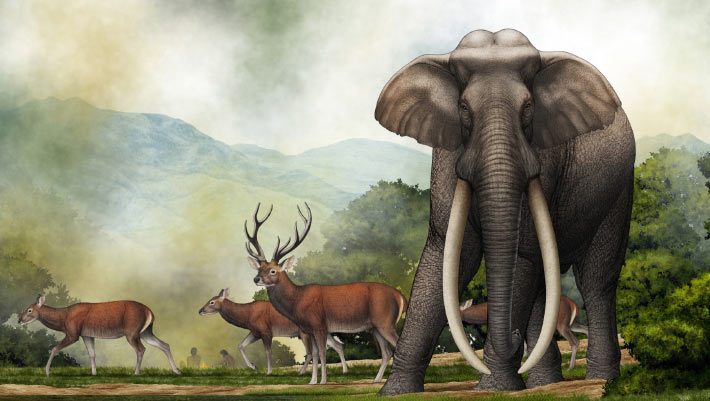
An artist’s impression of a Palaeoloxodon sp. Image credit: Chen Yu.
Up to this point, the Indian subcontinent has yielded the fossilized remnants of only a single hominin species, identified as the Narmada human.
The morphological characteristics observed in this hominin, exhibiting a combination of traits associated with both archaic and more modern human lineages, suggest that the Indian subcontinent likely played a crucial role in the early migratory routes of human populations.
Prior to the 1982 discovery of the aforementioned fossil, the archaeological record for hominin presence on the subcontinent was limited to stone tool assemblages, which offered only a rudimentary outline of ancestral activities.
“The pivotal questions then became: who were these hominins, what activities were they engaged in within this landscape, and were they actively pursuing large game?” posed Dr. Advait Jukar, a curator specializing in vertebrate paleontology at the Florida Museum of Natural History.
“Our current understanding confirms, at least within the confines of the Kashmir Valley, that these hominins were indeed interacting with and consuming elephants.”
The lithic artifacts uncovered at the Pampore excavation, presumed to have been utilized for the extraction of bone marrow, were fashioned from basalt. Notably, this type of volcanic rock is not indigenous to the immediate vicinity.
Paleontological analyses suggest that the raw materials were transported to the site from distant sources before undergoing the final stages of knapping, or shaping, on location.
Based on the technological sophistication evident in their manufacture, the researchers have dated the site and its associated tools to the period between 300,000 and 400,000 years ago.
Previously, the earliest corroborating evidence of butchery activities within India dated back less than ten millennia.
“It is plausible that such evidence has been overlooked due to insufficient detailed examination or exploration of appropriate locales,” commented Dr. Jukar.
“However, until this discovery, there was a distinct absence of direct empirical evidence substantiating the consumption of large animals by humans in India.”
The majority of the elephant remains recovered from the Pampore site originated from a single, adult male individual of the Palaeoloxodon genus.
Examination of the interior of its cranium revealed pathological bone proliferation, likely indicative of a chronic sinus infection.
Although it was evident that early humans had utilized the animal’s carcass, concrete proof of direct hunting, such as projectile points embedded in the bone, remained elusive.
It is conceivable that the hominins were responsible for the elephant’s demise, or they may have opportunistically acquired the carcass following its natural death. Potentially weakened by its persistent sinus ailment, the elephant might have become ensnared in the saturated alluvial deposits adjacent to the Jhelum River, the very location where subsequent paleontological investigations were conducted.
The Palaeoloxodon skull represents the most complete specimen of its genus discovered to date on the Indian subcontinent.
Analysis by the research team led to its identification as belonging to the extinct elephant species Palaeoloxodon turkmenicus. Fossils of this particular species have only been documented on one previous occasion, in 1955, consisting of a partial cranial fragment recovered from Turkmenistan.
While exhibiting variances from other known members of the Palaeoloxodon genus, the available fossil material was insufficient to definitively establish its status as a distinct species.
“A significant challenge with Palaeoloxodon fossils lies in the fact that their dental structures are largely indistinguishable across different species,” explained Dr. Jukar.
“Consequently, identifying the precise species of Palaeoloxodon from an isolated tooth is practically impossible. A comprehensive examination of the cranial morphology is requisite for accurate classification.”
Fortuitously, the hyoid bones, situated at the base of the throat and integral to tongue articulation, were preserved intact within the Pampore specimen.
The genus Palaeoloxodon is understood to have originated in Africa approximately one million years ago, subsequently expanding its range into Eurasia. Numerous species within this genus are characterized by an exceptionally prominent forehead, a feature absent in extant elephant species, and a distinctive cranial crest that overhangs the nasal aperture.
However, earlier African representatives of the Palaeoloxodon genus did not exhibit this prominent frontal bulge.
The Palaeoloxodon turkmenicus specimen occupies an intermediate evolutionary position, possessing an enlarged forehead but lacking the pronounced cranial crest.
“This finding illustrates a transitional phase in the evolutionary trajectory of Palaeoloxodon,” stated Dr. Jukar.
“This particular specimen holds the potential to assist paleontologists in elucidating the migratory patterns and evolutionary development of this extinct elephant genus.”
Considering the extensive history of hominin carnivory, spanning millions of years, the researchers posit that a considerable volume of evidence pertaining to bone processing likely remains undiscovered.
“My accumulated experience over many years has led me to conclude that significant effort is required to locate these sites, necessitating thorough surveys and meticulous collection of all available materials,” Dr. Jukar emphasized.
“Historically, when paleontologists collected specimens, their focus was primarily on retrieving intact skulls or major limb bones.”
“Fragments such as shattered bone, which could provide crucial insights into percussion marks or breakages indicative of human intervention, were often disregarded.”
_____
Ghulam M. Bhat et al. 2024. Human exploitation of a straight-tusked elephant (Palaeoloxodon) in Middle Pleistocene deposits at Pampore, Kashmir, India. Quaternary Science Reviews 342: 108894; doi: 10.1016/j.quascirev.2024.108894
Advait M. Jukar et al. 2024. A remarkable Palaeoloxodon (Mammalia, Proboscidea) skull from the intermontane Kashmir Valley, India. Journal of Vertebrate Paleontology, published online October 11, 2024; doi: 10.1080/02724634.2024.2396821
This article is based on a press-release provided by the Florida Museum of Natural History.