In 2009, the renowned supermodel Kate Moss ignited considerable controversy with her unequivocal declaration that “nothing tastes as good as skinny feels.” While this sentiment may have appeared astonishing to many, Moss’ succinct remark effectively captures a prevailing contemporary Western mindset.
From an evolutionary standpoint, however, Moss’ assertion is demonstrably illogical, if not outright absurd.
Such a viewpoint could only originate from an individual unconcerned with securing their next sustenance, let alone with navigating the harsh realities of winter or arid seasons without succumbing to starvation.
How do populations in non-Western societies perceive corpulence and the potential for increased adiposity? Numerous cultures historically considered plumpness to be a desirable attribute. However, this perspective is undergoing a rapid transformation.
Comparative ethnographic investigations across eleven traditional Western and non-Western societies indicate that a swift and recent phenomenon of “global fat stigmatization” has occurred.
Up until at least the 1990s, several of these communities, including those in American Samoa, Puerto Rico, and Tanzania, were characterized as “fat-positive,” signifying a cultural preference for fuller physiques.
However, over the past two decades, coinciding with escalating globalization, these same regions have begun to associate fatness with social opprobrium. Where once corpulence symbolized fertility, affluence, and attractiveness, it is now linked to unattractiveness, a lack of sexual appeal, and general undesirability.
It is imperative to acknowledge that these negative perceptions permeate emotional, psychological, and physical dimensions at both individual and collective levels.
The underlying causes of this abrupt transformation are intricate. Nevertheless, scholarly inquiry in Fiji and other locales suggests that the advent of television and global media, coupled with subsequent exposure to predominantly Western cultural norms and entertainment, played a significant role.
Consequently, in addition to the health and physiological challenges associated with increased body fat, there is now well-documented emotional detriment resulting from the “pathologization of substantial body mass” within these societies.
(Furthermore, semantic ambiguities exist: What is the distinction between being fat and being obese? Or between plump and overweight? Or heavyset and corpulent? The U.S. Centers for Disease Control and Prevention defines an obese adult quantitatively as an individual with a body mass index of 30 or greater.)
These cultural transformations are striking and prompt contemplation regarding how diverse body types and adiposity were perceived in ancient civilizations.
However, addressing this inquiry presents considerable difficulties. It is relatively straightforward to examine variations in stature among ancient populations by measuring recovered long bones (i.e., those from the arms and legs) and subsequently performing calculations based on these measurements.
Ascertaining the body mass of ancient individuals is substantially more arduous. What metric would be employed? Adipose tissue is a soft substance that decomposes rapidly post-mortem.
One might hypothesize that taller individuals are inherently larger and, therefore, heavier than their shorter counterparts. Yet, this observation offers limited insight and provides no data on the prevalence of excess weight in historical populations.
Equally confounding is that the correlation between height and weight is not consistently maintained: numerous individuals of short stature possess a more substantial build and weigh more than taller, more slender individuals. From an archaeological perspective, definitively determining adiposity from excavated skeletal remains is not feasible.
To investigate the prevalence of fatness in antiquity, recourse must be made to material culture.
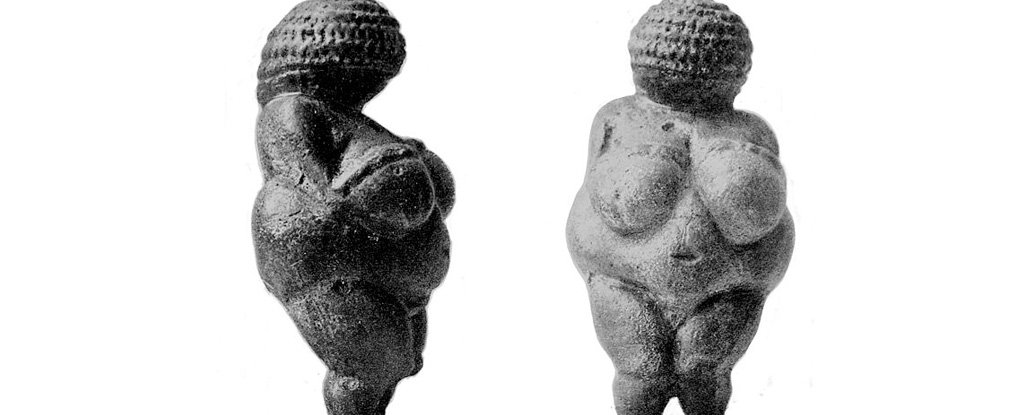
One of the most celebrated artifacts indicative of obesity within the archaeological record is the Venus of Willendorf, one of numerous so-called Venus figurines unearthed from Upper Paleolithic sites (dating approximately from 50,000 to 10,000 years ago) across Europe and Central Asia.
Discovered in Austria in 1908, the Venus of Willendorf is an 11-centimeter-tall statuette expertly carved from limestone, adorned with red pigment, and estimated to date from 25,000 to 27,000 years ago.
The figure exhibits detailed and anatomically accurate rendering; however, its face and head are obscured by an intricate woven headdress, rendering the countenance indiscernible. Nevertheless, one aspect is unequivocally apparent: the figure is not merely plump but demonstrably corpulent.
Over the past century, the Venus of Willendorf has been subjected to various interpretations, including its designation as a fertility goddess, a plaything, or an educational tool for expectant mothers. In the absence of more definitive contextual evidence (such as its discovery within a votive context or shrine), speculation regarding the figurine’s precise purpose and significance remains necessary.
Currently, over 200 distinct Venus figurines are documented from archaeological sites spanning Europe and Central Asia, representing a period of more than 10,000 years.
While all these figurines depict female forms, a broad spectrum of body types is represented, and not all exhibit such pronounced adiposity. Consequently, it is challenging to definitively assert that they constitute a comprehensive record of fatness.
Another notable collection of figurines was discovered at Neolithic sites (spanning approximately 11,000 to 4,000 years ago) on the island of Malta and in other regions of the Mediterranean basin.
Dating to approximately 5,000 years ago, these effigies, commonly referred to as the Fat Ladies of Malta, portray seated or reposed female figures, many of which are devoid of heads. When heads are depicted, they are often disproportionately small relative to the body’s mass.
There is no indication that these figures represent pregnancy; however, all clearly exhibit significant body weight. The majority of the Maltese figurines have been recovered from burial sites and mortuary chapels, lending credence to the hypothesis of a cultic or religious association and suggesting a degree of veneration or special status.
What about masculine representations? Is there evidence of corpulent males in antiquity? One illustrative example is a jade carving originating from Guatemala, known as the Fat Lord and Frog, which dates to approximately 700 BCE.
This individual is clearly depicted as someone of importance (lesser individuals did not typically have their likenesses intricately carved and preserved in jade). His obesity is also evident, although the specific reasons for this representation remain unknown.
The Venus figurines, the Fat Ladies of Malta, and the Fat Lord and Frog collectively suggest that certain individuals of substantial size were held in high regard in past cultures, and that the societies from which they originated may have subscribed to the belief that fatness was synonymous with virtue, or at least that it was not inherently negative.
It is my conjecture that a degree of adiposity has been present in all human societies, with the exception of those existing at the very edge of survival or inhabiting exceptionally austere environments. I surmise that individuals afflicted with obesity have, at various times, been either revered, disparaged, or perhaps simply accepted without opprobrium. Nevertheless, recent ethnographic research conducted in Fiji and other regions strongly indicates that contemporary cultural attitudes towards fatness are less varied than they were in historical periods.
A substantial, all-encompassing, and collaborative research initiative, integrating expertise from archaeology, anthropology, physiology, psychology, sociology, and public health, will be requisite to begin truly comprehending the intricate relationship between adiposity and human societies across millennia.
Such research will undoubtedly present formidable challenges, as corpulence, while demonstrably a pressing public health concern, concurrently engenders detrimental social stigmatization and prejudice that complicate the understanding of these issues, let alone the implementation of effective interventions.
However, this complexity does not diminish the inherent value of such an undertaking.
This content was originally published on SAPIENS under a CC BY-ND 4.0 license. The original article is available here.