During the 4th century BCE, an invasion force utilizing at least four wooden plank vessels met their demise off the coast of Denmark, specifically on the island of Als. The indigenous population successfully repelled these assailants, subsequently submerging the enemy’s armaments within the bog, entombed in one of these ships, identified as the Hjortspring boat. This ritualistic act was most likely a gesture of thanksgiving for the hard-won victory. Contemporary archaeologists have conducted radiocarbon dating and analyzed the caulking and cordage materials recovered alongside the vessel. Furthermore, a partial human fingerprint was unearthed on a fragment of the caulking substance. This exceptional fingerprint offers a tangible connection to the ancient mariners who navigated the Hjortspring boat.
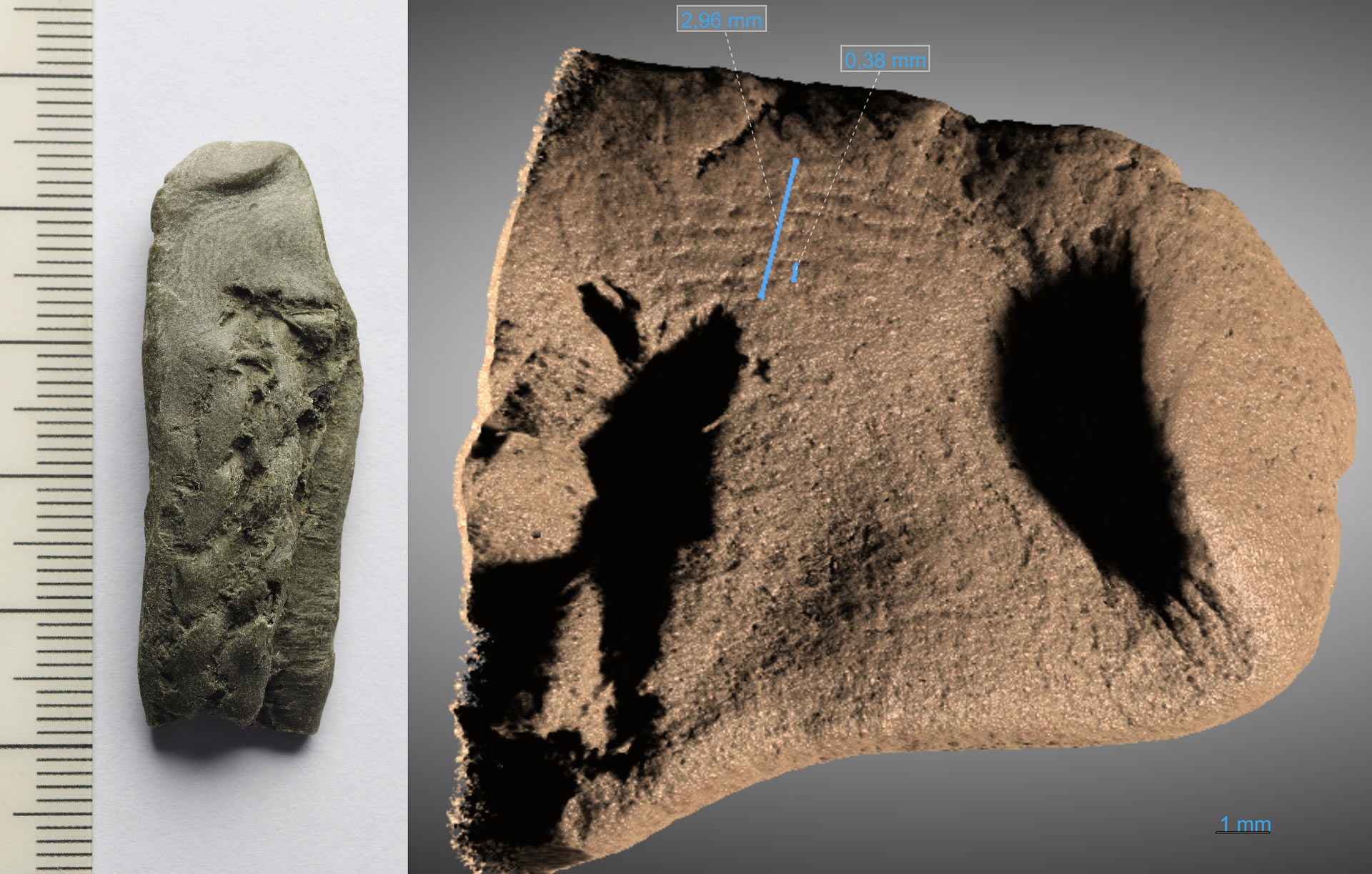
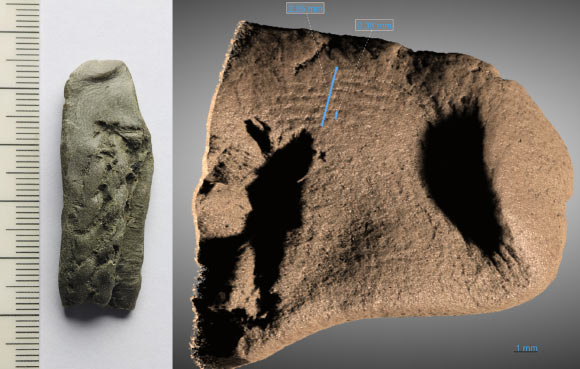
Photo of caulking fragment showing fingerprint on the left and high-resolution X-ray tomography scan of fingerprint region on the right. Image credit: Erik Johansson / Sahel Ganji.
The Hjortspring vessel was brought to light in the 1880s during peat extraction operations within the Hjortspring bog, situated on Als island, off the southeastern periphery of Jutland, Denmark.
Formal archaeological investigations of the bog and the discovery of the boat commenced in 1920, subsequent to the reintegration of southern Jutland into Denmark.
Gustav Rosenberg oversaw the excavation of the boat between 1921 and 1922. Approximately 40% of the original construction was salvaged from the bog, facilitating a comprehensive reconstruction of its original configuration.
An ample quantity of iron spearheads and shields, sufficient to equip a formidable contingent of approximately 80 combatants, were interred alongside the boat—a number far exceeding the vessel’s carrying capacity.
These findings have led to the hypothesis that a raiding party, originating from an unspecified locale and traveling in as many as four vessels akin to the Hjortspring boat, launched an assault on Als island. Their defeat resulted in the victorious inhabitants depositing the vanquished foes’ weaponry, along with one of their own vessels, into the bog as a votive offering in gratitude for their triumph.
Following its excavation, the boat underwent conservation and has been exhibited at the National Museum of Denmark since 1937.
In a more recent scholarly endeavor, Lund University archaeologist Mikael Fauvelle and his research team performed radiocarbon dating on and analyzed certain previously unexamined caulking and cordage materials recovered with the boat.
Employing gas chromatography-mass spectrometry, their analysis indicated that the caulking agent was likely a composite of animal fat and pine resin.
At that historical juncture, Denmark itself possessed a limited abundance of pine forests.
“The possibility exists that pine resin was transported to Denmark through commercial exchange,” the researchers posited.
“However, other coastal territories bordering the Baltic Sea, situated to the east of Denmark, did indeed harbor pine forests, leading us to infer that the vessel may have originated from these regions, and its occupants, including its warriors, could have hailed from that eastern expanse.”
“Should this hypothesis prove accurate, the boat would have necessitated a considerable transit across open water to reach Als, potentially signifying a notably well-coordinated and pre-meditated military operation.”
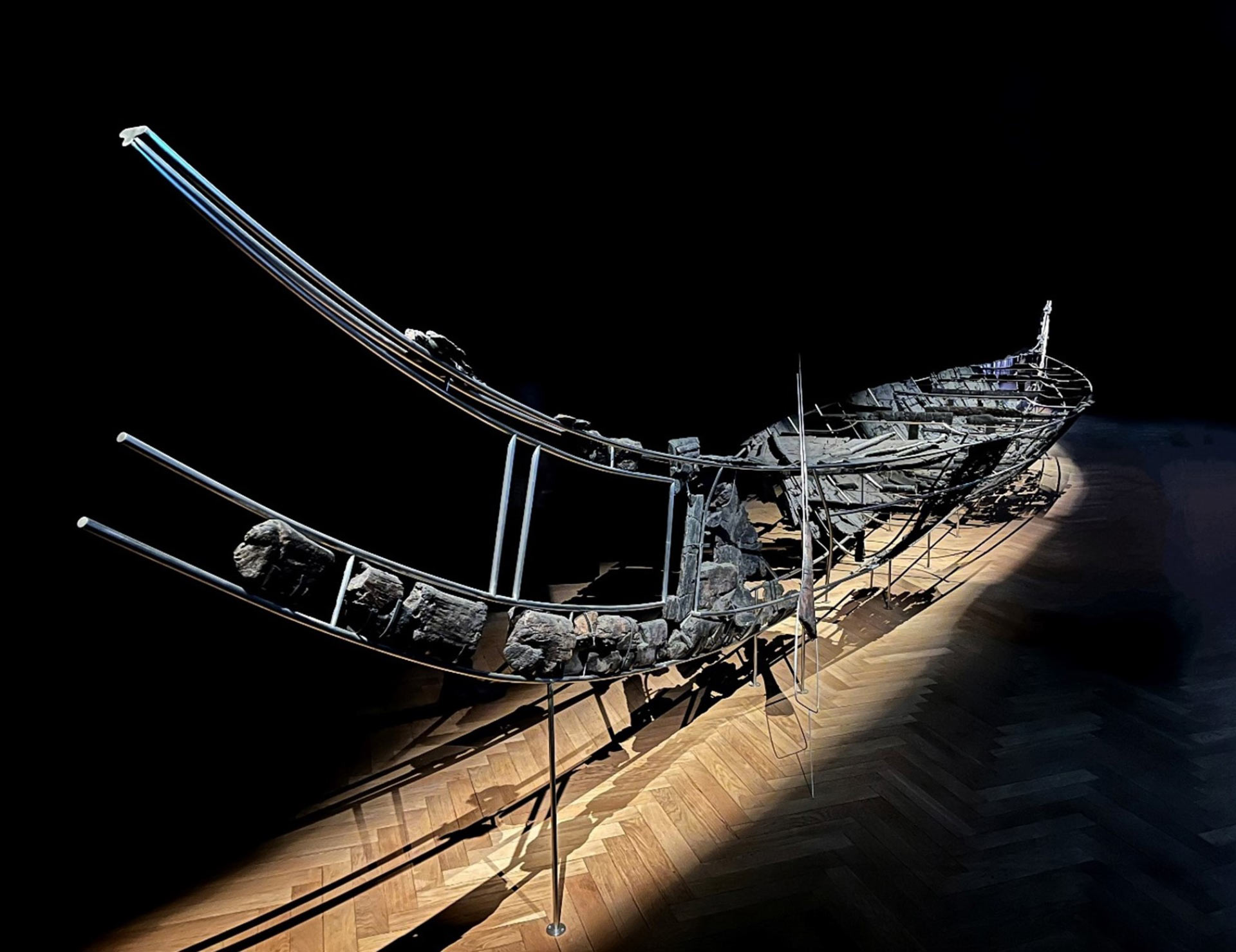
The Hjortspring boat as currently displayed at the National Museum of Denmark. Image credit: Boel Bengtsson.
Radiocarbon dating of the associated cords and caulking substance indicated that the boat was likely constructed sometime between the 4th or 3rd century BCE, which aligns with prior chronological assessments of timber from the Hjortspring site.
Furthermore, during the course of the investigation, the scientists identified a partial human fingerprint within a segment of the caulking material.
Although precisely determining the origin of this fingerprint proved challenging, it is plausible that it was imprinted by one of the crew members during a repair operation on the vessel, thereby establishing a direct linkage to the ancient mariners who utilized this craft.
“This new analysis of Scandinavia’s most ancient plank-built vessel brings us incrementally closer to resolving the century-old enigma surrounding the origins of this historical artifact,” the researchers stated.
“By deploying advanced scientific methodologies, we have pinpointed the Baltic Sea Region as the most probable provenance for this approximately 2,400-year-old vessel, while also uncovering a fingerprint imprinted by an ancient seafarer in the tar used for waterproofing the craft.”
“The discovery of a fingerprint within the tar fragments of the boat was an unexpected revelation for our team.”
“Such fingerprints dating from this historical period are exceptionally uncommon.”
“It is immensely satisfying to have established a direct connection with one of the individuals who operated this ancient vessel.”
“The boat served a force of invaders who launched an attack upon the island of Als in southern Denmark over two millennia ago.”
“The invaders were ultimately repulsed, and the local populace submerged the boat in a bog as a propitiatory offering to express gratitude for their victory.”
“Since the boat’s excavation from the bog in the early 1920s, the question of the invaders’ origin has remained an unresolved mystery.”
“The weaponry discovered within the boat was relatively commonplace for the era and saw use throughout Northern Europe, offering scant clues regarding their specific point of origin.”
“Numerous divergent hypotheses regarding the boat’s provenance have been advanced over the preceding century, with some academics suggesting that the boat’s complement originated from a location in northern Germany or potentially another area within present-day Denmark.”
“Now, our scientific examination of the boat’s caulking material furnishes the first significant new lead in over a hundred years.”
“The vessel was rendered watertight using pitch derived from pine trees, which were scarce in both Denmark and northern Germany during the first millennium BCE.”
“We contend that this implies the boat and its crew most probably originated from points further east along the Baltic Sea coastlines where pine forests were more prevalent.”
“The boat was excavated before modern dating techniques were available, and a substantial portion of the retrieved materials was immediately subjected to chemical preservation, rendering radiocarbon dating impossible.”
“However, by delving into archival records, we were fortunate enough to locate some original cordage that had not undergone conservation treatment.”
“We secured a radiocarbon date from this cordage, which yielded a temporal range between 381 and 161 BCE, thereby corroborating the pre-Roman Iron Age chronology of the vessel.”
The research was disseminated online through the esteemed journal PLoS ONE.
_____
M. Fauvelle et al. 2025. New investigations of the Hjortspring boat: Dating and analysis of the cordage and caulking materials used in a pre-Roman Iron Age plank boat. PLoS One 20 (12): e0336965; doi: 10.1371/journal.pone.0336965