While the ocean’s apex predators, sharks, typically exhibit muted tones, rare instances occur where nature deviates dramatically.
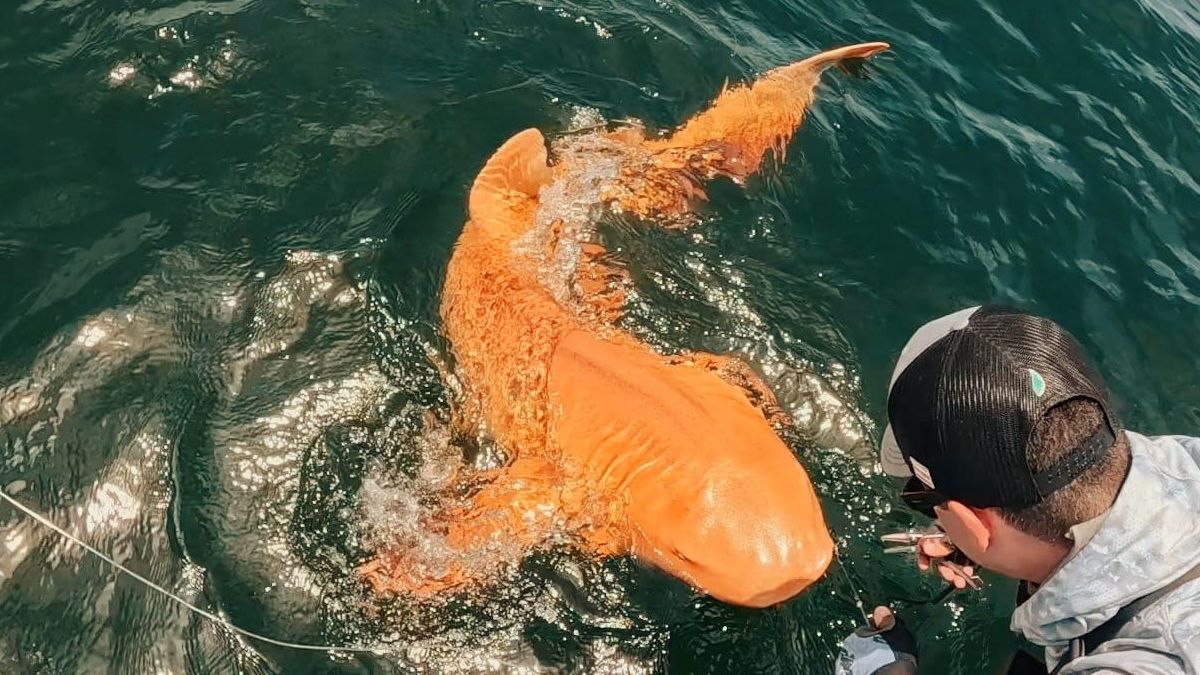
A remarkable instance of this phenomenon was recorded in August 2024 when sports fishermen off the coast of Costa Rica encountered and subsequently released a nurse shark (Ginglymostoma cirratum). This specimen defied the species’ conventional brown, cookie-dough coloration, presenting an extraordinary vivid orange hue complemented by striking white eyes.
Scientific investigation revealed that this unusual pigmentation stemmed from the confluence of two distinct genetic anomalies within the same organism: a deficiency in melanin, termed albinism, coupled with an overabundance of yellow pigment, known as xanthism.
Astonishingly, this dual condition, referred to as albino-xanthochromism, did not appear to impede the shark’s vitality, as it was observed thriving in the balmy waters of the Caribbean Sea.
The specific encounter transpired on August 10, 2024, in close proximity to Tortuguero National Park, along the Costa Rican coastline. Angler Juan Pablo reported snagging the strikingly colored creature at a depth of 37 meters (121.4 feet). Captivated by its unconventional appearance, he documented it with photographs and measurements prior to its safe return to the ocean.
Images of this unique shark were later disseminated on social media by the eco-tourism enterprise Parismina Domus Day.
This notable sighting prompted marine biologists, spearheaded by Marioxis Macías‑Cuyare of the Federal University of Rio Grande in Brazil, to engage with the fishermen. Utilizing the provided details, they were able to ascertain the cause of the shark’s aberrant coloration.
“The shark displayed an intense, uniform yellow to orange pigmentation and white ocular orbs, devoid of any discernible iris,” the researchers documented in their report, published in August 2025. The publication appeared in Marine Biodiversity.
“The characteristic white eyes, particularly the absence of the standard black iris (Fig. 1d), strongly indicate that the specimen most likely exhibited a rare condition known as albino-xanthochromism, rather than isolated xanthism.”
Although exceptionally uncommon, this dual genetic anomaly has been observed in the natural world, with a notable prevalence in avian species. Nevertheless, its occurrence has also been documented within marine environments.
Previously, a speckled hind (Epinephelus drummondhayi) captured off the North Carolina coast was identified as exhibiting albino-xanthochromism back in 1978. Furthermore, a scientific bulletin published in 2018 detailed an albino-xanthochromic spotted ray (Raja montagui) originating from the Irish Sea.
One might surmise that such conspicuous coloration would present a significant disadvantage for a shark’s survival, yet the measurements taken by the angler suggest this was not the case.
The vibrant, tangerine-hued shark measured 200 centimeters (6.56 feet) from snout to tail fin, a length indicative of full sexual maturity. This developmental stage typically requires a minimum of ten years to achieve for this particular species, as noted by resources like sharks.org.
Abnormal pigmentation is overwhelmingly attributable to genetic mutations. Considering the vast and relatively unexplored nature of the oceanic realm, this specific manifestation might be considerably more widespread than the limited number of documented instances would suggest.
Other recorded instances of atypical pigmentation in nurse sharks include albinism, piebaldism, and hypomelanosis, which involves a reduction in the production of dark pigment.
However, this particular specimen represents the first documented instance of an individual exhibiting both albinism and xanthism concurrently. The researchers have further proposed that environmental influences could also contribute to such expressions, advocating for continued in-depth study.
“Is this an isolated incident? Could it signify a burgeoning genetic trend within the regional population? Is it linked to specific environmental conditions in the northern Caribbean of Costa Rica, or does it merely reflect the inherent genetic diversity of the species and its adaptive capabilities in evolving environments?” the researchers queried in their publication.
“Resolving these inquiries underscores the imperative for further investigation into how localized environmental factors impact the manifestation of such genetic traits.”