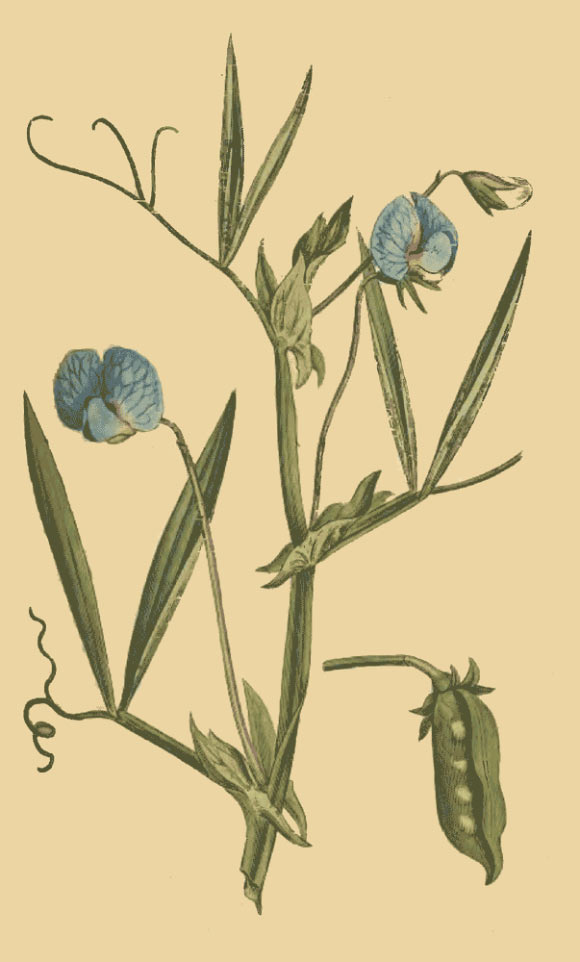
Scientists at the John Innes Centre have successfully sequenced and meticulously annotated the entire chromosome-scale genome of the grass pea (Lathyrus sativus). This significant legume crop exhibits remarkable resilience to various environmental stressors, holding considerable promise for cultivating climate-resilient agriculture.

Grass pea (Lathyrus sativus). Image credit: William Curtis / The Botanical Magazine.
The grass pea is a legume species distinguished by its exceptional hardiness amidst environmental adversities, such as arid conditions, waterlogged soils, and saline environments.
With a cultivation history spanning at least 8,000 years, this crop has seen extensive distribution across portions of Europe, Asia, and Africa. Currently, its primary cultivation areas are concentrated in South Asia and the elevated regions of Ethiopia and Eritrea.
A primary impediment to the widespread cultivation and improvement of the grass pea has been the presence of a potent neurotoxin within its seeds and shoots. In populations experiencing malnutrition, this toxin can induce neurolathyrism, a debilitating condition resulting in permanent paralysis.
Furthermore, the absence of a comprehensive genomic blueprint has been a significant barrier to advancing crop breeding initiatives for this species.
The advent of this new genome sequence empowers researchers to employ advanced gene-editing techniques and contemporary breeding methodologies. These tools will facilitate the development of grass pea varieties possessing enhanced agronomic traits, including significantly reduced or entirely absent toxin levels.
Consequently, the grass pea is now exceptionally well-positioned to contribute substantially to a future food system that is both more diverse and robustly adapted to climate variability.
“Our objective is to establish this newly sequenced genome as the definitive reference for the grass pea research community. We are thrilled to make this invaluable resource available to fellow scientists for their studies and exploration of grass pea,” stated Dr. Peter Emmrich, a researcher affiliated with the Norwich Institute for Sustainable Development and the John Innes Centre.
“In an era marked by escalating weather volatility, this genomic data provides us with the means to unravel the inherent resilience of the grass pea. This will enable us to further refine this crop for agricultural producers and inform the development of related crops, such as the common pea.”
The assembled grass pea genome sequence, which is nearly double the size of the human genome, was constructed from the ground up, representing a substantial enhancement over a prior draft assembly of the robust grass pea line designated LS007.
“As we brace for a future characterized by intensified climate change, it is imperative that we cultivate crops capable of withstanding challenges like drought, flooding, and saltwater intrusion,” commented Dr. Anne Edwards, a researcher at the John Innes Centre.
“This newly elucidated genome sequence brings us considerably closer to integrating the grass pea into the repertoire of climate-smart crops for the future.”
“This represents a particularly exhilarating period for those engaged in grass pea research.”
The comprehensive results of this research have been formally published in the distinguished journal Scientific Data.
_____
M. Vigouroux et al. 2024. A chromosome-scale reference genome of grasspea (Lathyrus sativus). Sci Data 11, 1035; doi: 10.1038/s41597-024-03868-y