An ancient cataclysm, previously estimated to have transpired 1.2 billion years ago, is now understood by researchers to have occurred 990 million years ago. This colossal cosmic event is credited with the formation of the Stac Fada Member, a geological stratum offering profound insights into Earth’s primordial history. New investigations, spearheaded by Curtin University, have recalibrated the age of this deposit, thereby revising the timeline for some of the United Kingdom’s most ancient non-marine microfossils and their significance in dating the initial colonization of land by eukaryotic organisms.
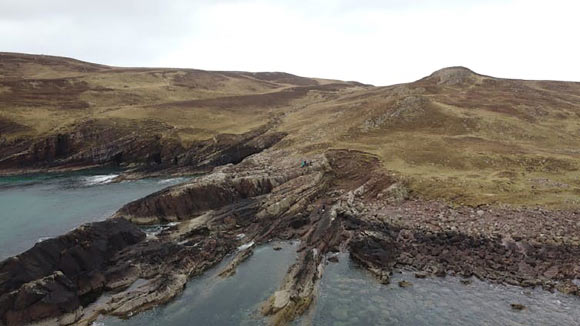
The Stac Fada Member. Image credit: Tony Prave.
“Using minute zircon crystals as geological chronometers, we were able to ascertain that the impact event took place 990 million years ago,” stated Professor Chris Kirkland of Curtin University.
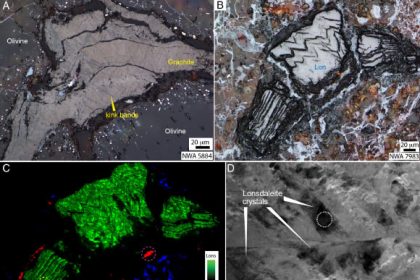
“These microscopic crystalline structures preserved the precise moment of impact, with some undergoing a transformation into reidite, an exceedingly rare mineral that exclusively forms under conditions of immense pressure.”
“This alteration provided conclusive evidence that the Stac Fada deposit was the consequence of a meteorite impact.
“When celestial bodies collide with a planet, they can partially recalibrate the isotopic clocks within zircon crystals, rendering these ‘defective timekeepers’ difficult to date. However, we devised a computational model to reconstruct the timing of this disturbance, thereby validating the impact at 990 million years ago.”
This impact event coincided roughly with the evolutionary emergence of some of the earliest freshwater eukaryotes, which represent the ancestral lineages of flora, fauna, and fungi.
“The updated chronological determinations suggest that these nascent life forms in Scotland materialized around the same epoch as this extraterrestrial impact,” Professor Kirkland observed.
“This correlation prompts compelling inquiries into whether substantial impact events may have modulated environmental conditions in ways that influenced the development of nascent ecosystems.”
“Although the impact crater itself has not yet been identified, this research has yielded additional indicators that could ultimately pinpoint its location.
“Comprehending the temporal sequencing of meteorite impacts assists us in investigating their potential influence on Earth’s environmental trajectory and the proliferation of life beyond aquatic realms.”
The team’s findings have been published in the esteemed journal Geology.
_____
C.L. Kirkland et al. A one-billion-year-old Scottish meteorite impact. Geology, published online April 28, 2025; doi: 10.1130/G53121.1