A comprehensive examination of fossilized dental remains spanning Africa, Asia, Oceania, and Europe has revealed a consistent presence of lead exposure among a diverse array of hominid species, including Australopithecus africanus, Paranthropus robustus, early Homo sp., Gigantopithecus blacki, Pongo sp., Papio sp., Homo neanderthalensis, and Homo sapiens, across more than two million years. This finding challenges the prevailing notion that lead toxicity is a purely contemporary concern.
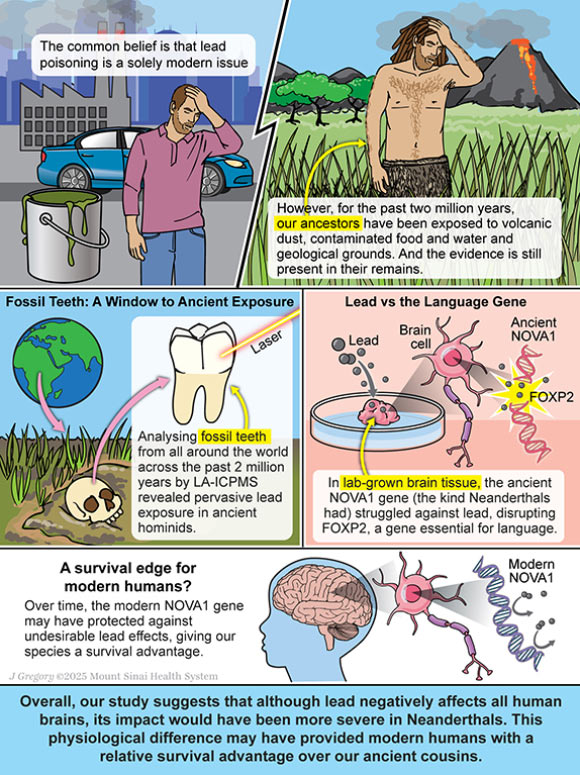
Lead exposure to humans in modern times versus our ancestors. Image credit: J. Gregory / Mount Sinai Health System.
“Our findings indicate that lead exposure was not merely a byproduct of industrial development but was an intrinsic element of our evolutionary milieu,” stated Professor Renaud Joannes-Boyau, affiliated with Southern Cross University.
“Consequently, the cognitive faculties and communal interactions of our forebears may have been shaped over eons by their developmental processes occurring within the context of a potent neurotoxicant.”
Employing meticulously validated protocols for laser ablation micro spatial sampling, the research team meticulously analyzed 51 fossil specimens from the aforementioned hominid lineages.
The investigation identified unambiguous evidence of intermittent lead exposure in a substantial proportion of the samples, specifically 73% overall, and 71% among the hominin groups consisting of Australopithecus, Paranthropus, and Homo.
Geologically ancient samples, such as those of Gigantopithecus blacki, with estimated origins in the early (1.8 million years ago) and middle Pleistocene (1 million years ago) epochs, exhibited recurrent episodes of lead assimilation interspersed with periods of minimal lead uptake.
The scientific cadre further delved into laboratory investigations to elucidate potential impacts of this ancient exposure on neural development.
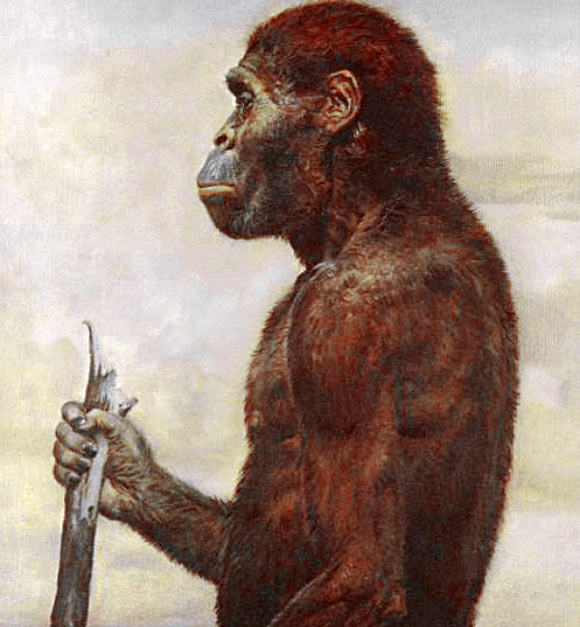
Australopithecus africanus. Image credit: J.M Salas / CC BY-SA 3.0.
Utilizing human brain organoids—miniaturized, laboratory-cultivated models of brain tissue—the researchers conducted comparative analyses on the effects of lead on two distinct variants of a crucial developmental gene, designated NOVA1. This gene is recognized for its role in regulating gene expression during neurodevelopment in response to lead exposure.
While the modern human variant of NOVA1 diverges from that found in Neanderthals and other extinct hominids, the underlying reasons for this evolutionary divergence remained previously unclarified.
Upon exposure to lead, organoids harboring the archaic NOVA1 allele demonstrated significant dysregulation in the activity of neurons expressing FOXP2 within the cortical and thalamic regions of the brain. These brain areas are paramount for the intricate development of speech and language capabilities.
The adverse effects observed were notably attenuated in organoids possessing the contemporary NOVA1 allele.
“These experimental outcomes suggest that our specific NOVA1 variant may have conferred a degree of resilience against the deleterious neurological repercussions of lead,” commented Professor Alysson Muotri from the University of California San Diego.
“This represents a remarkable illustration of how an environmental challenge, in this instance, lead toxicity, could have acted as a selective pressure, driving genetic adaptations that enhanced survival and facilitated sophisticated linguistic communication, while concurrently influencing our susceptibility to contemporary lead exposure.”

An artist’s impression of a group of Gigantopithecus blacki within a forest in southern China. Image credit: Garcia / Joannes-Boyau, Southern Cross University.
Subsequent genetic and proteomic analyses performed as part of this research indicated that lead exposure disrupted pathways critical for neural development, social interaction, and communicative functions in organoids with the archaic NOVA1 variant.
The observed alterations in FOXP2 activity, in particular, point towards a potential nexus between ancient lead exposure and the evolutionary refinement of linguistic capacities leading to modern human language.
“This investigation underscores the profound influence of our environmental exposures on the trajectory of human evolution,” observed Professor Manish Arora, a researcher at the Icahn School of Medicine at Mount Sinai.
“From the perspective of inter-species competition, the inference that detrimental exposures might confer an overall survival advantage presents a novel framework for environmental medicine to explore the evolutionary underpinnings of disorders associated with environmental factors.”
The findings were formally presented in the esteemed journal Science Advances.
_____
Renaud Joannes-Boyau et al. 2025. Impact of intermittent lead exposure on hominid brain evolution. Science Advances 11 (42); doi: 10.1126/sciadv.adr1524