An intriguing and seemingly contradictory intolerance to lactose throughout the region of South Asia might shed light on the evolutionary development of milk consumption in adult mammals within disparate human groups.
A consortium of scientists, spearheaded by investigators from the University of California, Berkeley, conducted an extensive genome-wide examination of individuals residing across the Asian subcontinent to elucidate the mechanisms and reasons behind the proliferation of the capacity to metabolize the sugar prevalent in dairy products.
Notwithstanding their status as the world’s foremost dairy producers and consumers, the majority of adults in India, Pakistan, and Bangladesh exhibit insufficient production of lactase, the crucial enzyme instrumental in the breakdown of lactose. Consequently, dairy items consumed in South Asia—such as ghee, yogurt, and various other fermented preparations—frequently possess reduced lactose content.
Globally, a specific genetic variation situated proximate to the lactase gene bestows upon certain individuals the ability to sustain enzyme production well beyond their infantile stages. It is posited that the genetic alterations responsible for this physiological adaptation originated among nomadic pastoralist communities approximately 5,000 years ago in the geographical area now recognized as western Russia.
The recently disseminated research findings indicate that while this genetic variant was introduced to the subcontinent during historical and medieval epochs, it did not achieve widespread dissemination among South Asian populations in the same manner as observed in European populations.
Instead, the genetic variant, an allele designated as -13910*T, experienced minimal propagation into the broader populace through natural selection, with the notable exception of two isolated pastoralist communities, where it exhibited exceptionally strong selective pressure, among the most potent documented in recent human evolutionary history.

Indeed, the research authors note in a preliminary report published on bioRxiv, “The selective forces operating on this allele may have been more intense within South Asian pastoralist groups compared to their Northern European counterparts.”
Distinguished anthropologist Christina Warinner from Harvard University, who was not involved in the study, commented to Science Magazine, “This represents an excellent, meticulously conducted, and significant investigation. Our current understanding of how adult milk digestion functions, and our grasp of lactose tolerance and intolerance, remains fundamentally incomplete.”
Humans naturally produce lactase during infancy to facilitate the digestion of lactose found in maternal milk. However, with maturation into adulthood, lactase production typically diminishes considerably. Individuals possessing the capacity to consume and metabolize lactose constitute a global minority; it is estimated that approximately 70 percent of the world’s population experiences some degree of lactase deficiency, with considerable variability observed across different ethnic and age demographics.
In specific human populations, the -13910*T allele is associated with sustained high levels of lactase production extending well into adulthood. The precise mechanisms and impetus behind its global diffusion remain somewhat enigmatic, though scientists commonly attribute it to the evolutionary advantage conferred by natural selection in communities with high dairy consumption. Its comparatively low prevalence in South Asian populations thus presents a notable enigma.
Under the scientific direction of biologist Priya Moorjani from the University of California, Berkeley, a research collective compiled extensive genomic data, encompassing contemporary and ancient genetic material spanning from 3300 BCE to 1650 CE.
The investigators meticulously charted the geographical distribution of the -13910*T allele across the South Asian subcontinent, revealing a discernible north-to-south gradient.
The genetic determinant for milk consumption exhibits significantly greater prevalence in the northern regions, progressively diminishing in frequency as one moves southward, with a conspicuous exception found in the Toda (Southern India) and Gujjar (Pakistan) communities, traditional herders of buffalo, where lactase persistence approached 90 percent of the population.
Subsequently, the researchers meticulously traced the lineage of the -13910*T allele backward in time to ascertain its origin point and temporal emergence. Furthermore, they conducted comparative analyses of extensive DNA segments surrounding the allele in South Asian populations against those from other demographic groups to identify the closest genetic correspondences.
Both lines of evidence pointed towards the introduction of this genetic variant by pastoralist groups originating from the Eurasian Steppe, whose -13910*T haplotype bore a striking resemblance to that observed in South Asian populations.
Finally, the research team employed simulation models to explore various hypotheses regarding the potential mechanisms that might have facilitated the persistence of this variant at elevated frequencies, ranging from natural selection to genetic drift.
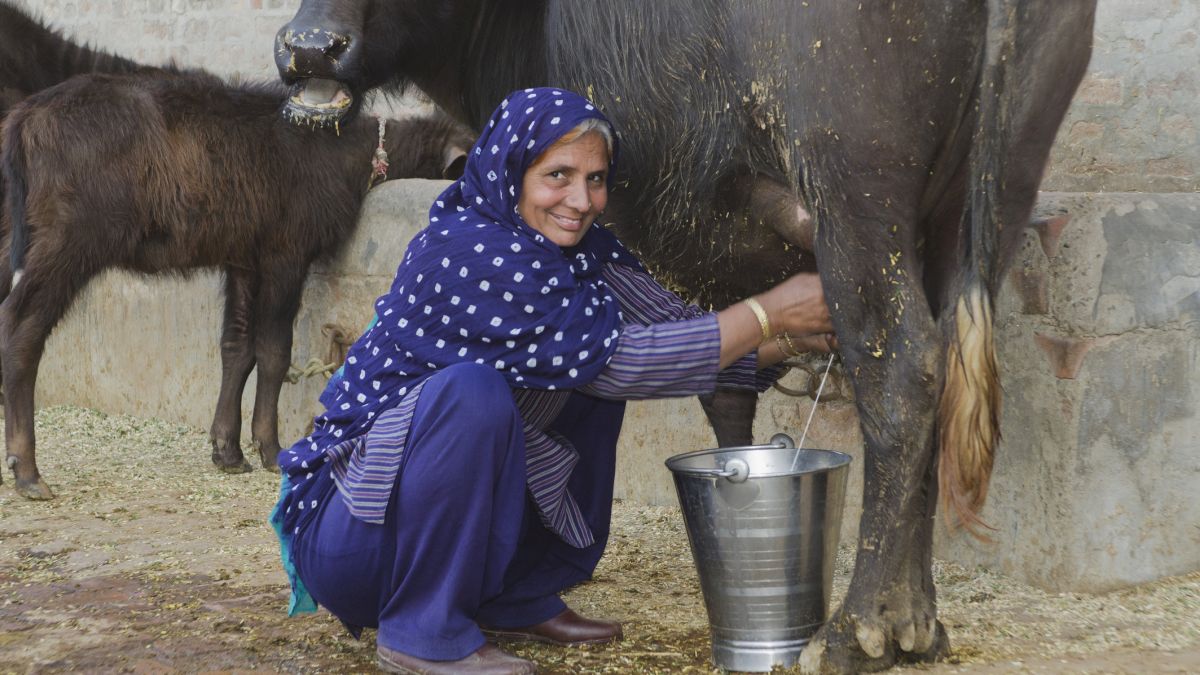
The most compelling explanation, aligning with the empirical data, posits that the gene was introduced from the Eurasian Steppe and subsequently amplified by positive selective pressures. The remarkable intensity of this selection pressure within the Toda and Gujjar populations may be intrinsically linked to their specific lifestyle. As herders of buffalo, their dietary staples are heavily reliant on fresh dairy products, encompassing liquid milk, butter, buttermilk, yogurt, and cheese.
Considering the traditional heavy dependence of both the Toda and Gujjar on fresh milk for sustenance, their exceptionally robust and recent selection for the milk-digesting gene strongly correlates with the influence of dairy-centric lifestyles.
The researchers conclude in their findings, accessible on bioRxiv, that “The evolution of lactase persistence is not a monolithic narrative of selection, but rather a complex tapestry woven from diverse demographic and cultural histories, each imprinting a unique genetic signature upon the human genome.”
This groundbreaking research is currently available for review on bioRxiv.