Recent astronomical observations of L 98-59d, an exoplanet orbiting within the five-body L 98-59 system, indicate the presence of an extensive global magma ocean. This phenomenon appears to sequester significant quantities of sulfur internally, thereby defining a novel classification of celestial bodies beyond our solar system.
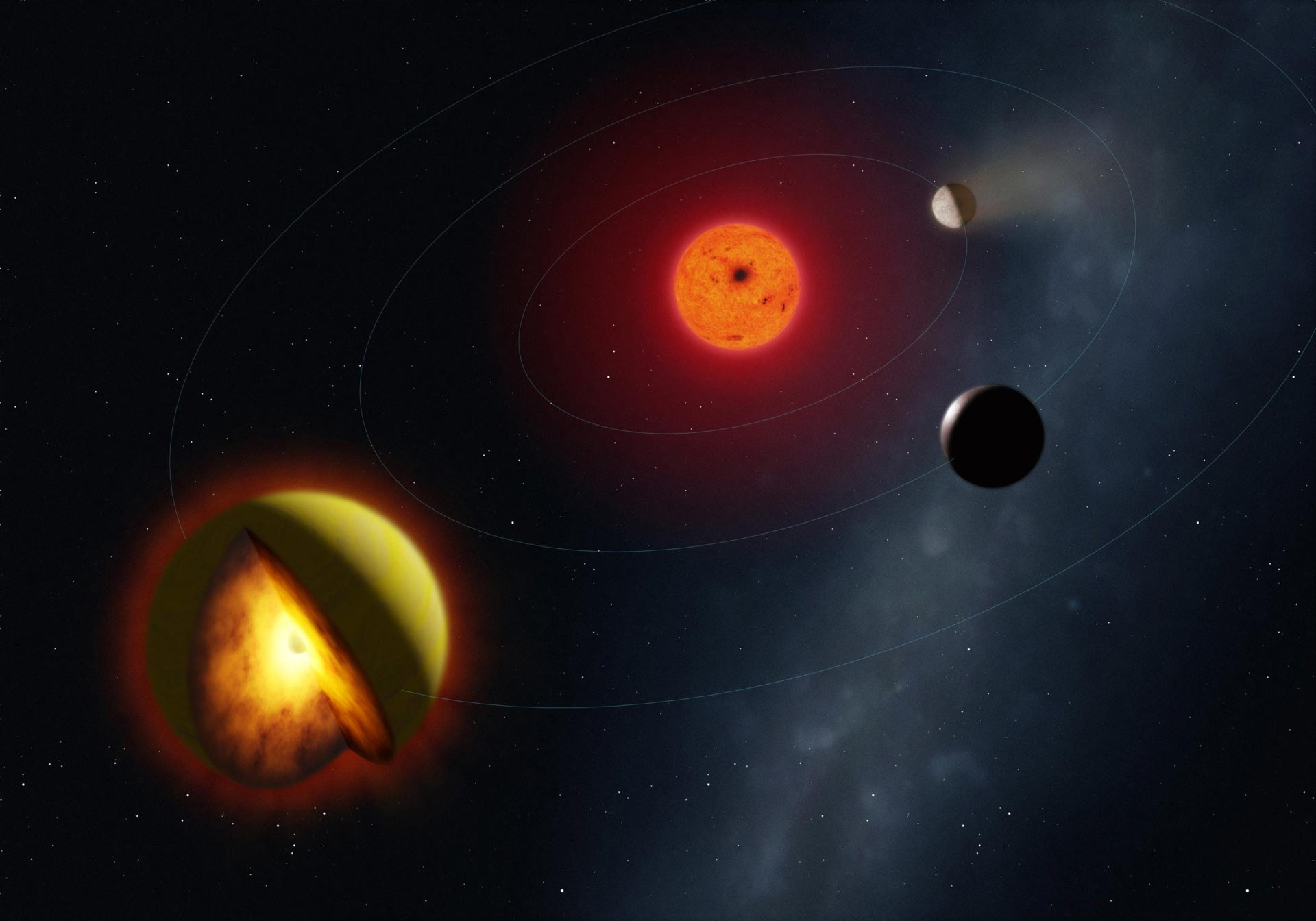
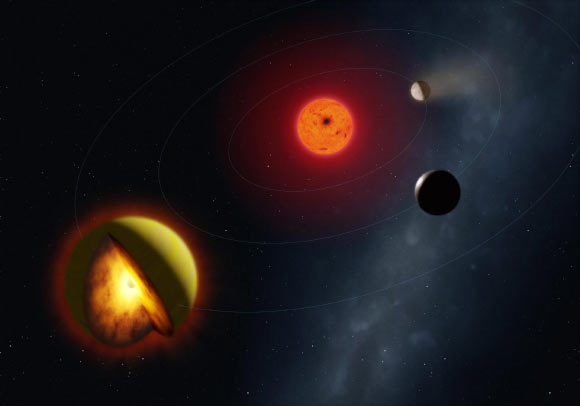
An artist’s impression of the planetary system L 98-59. Image credit: Mark A. Garlick / markgarlick.com.
Located approximately 34.5 light-years distant, L 98-59 resides within the southern celestial hemisphere, specifically in the constellation Volans.
This luminous M-dwarf star, also designated as TOI-175 and TIC 307210830, possesses roughly one-third the solar mass.
The stellar system encompasses a minimum of three exoplanets exhibiting transiting behavior and an additional two that do not: identified as L 98-59b, c, d, e, and f.
L 98-59d completes an orbital revolution around its parent star every 7.5 days. It is approximately 1.6 times the diameter of Earth and is subjected to roughly four times the terrestrial incident radiant energy.
In a recent investigative study, Harrison Nicholls, an astronomer affiliated with the University of Oxford, and his research associates endeavored to meticulously reconstruct the evolutionary timeline of this super-Earth, tracing its history from its nascent stages to its present state – a temporal scope spanning nearly five billion years.
Through the direct correlation of telescopic observational data with sophisticated physical models pertaining to planetary interiors and atmospheres, the team succeeded in elucidating the internal processes occurring within the planet.
Their findings posit that the lithosphere of L 98-59d is likely composed of molten silicate material, akin to terrestrial lava, with a pervasive magma ocean extending thousands of kilometers into its subsurface.
This substantial molten reservoir facilitates the internal sequestration of prodigious quantities of sulfur within the planet’s deep strata over geological epochs.
Furthermore, the magma ocean contributes to L 98-59d’s capacity to sustain a dense, hydrogen-rich atmosphere that includes sulfurous atmospheric constituents such as hydrogen sulfide.
Under typical astrophysical conditions, such an atmosphere would ordinarily dissipate into the void over extended periods, primarily due to the stellar X-ray emissions from its host star.
The intricate interplay of chemical exchanges between its incandescent interior and its gaseous envelope, over the course of eons, has shaped the observable characteristics of L 98-59d that are currently detected by astronomical instruments.
The research collective proposes that L 98-59d may represent the inaugural exemplar of a broader category of gas-rich, sulfur-laden exoplanets characterized by enduring magma oceans. Should this hypothesis hold true, the known diversity of planetary bodies within our galaxy could be considerably more extensive than previously conceptualized.
“This revelation suggests that the current taxonomic frameworks utilized by astronomers to categorize small planets might be overly simplistic,” commented Dr. Nicholls.
“Although this molten celestial body is improbable as a habitat for life, it serves as a compelling illustration of the vast array of worlds that exist beyond our Solar System. This prompts the question: what other planetary typologies await discovery?”
The comprehensive scientific article has been disseminated today within the esteemed journal Nature Astronomy.
_____
H. Nicholls et al. Volatile-rich evolution of molten super-Earth L 98-59 d. Nat Astron, published online March 16, 2026; doi: 10.1038/s41550-026-02815-8