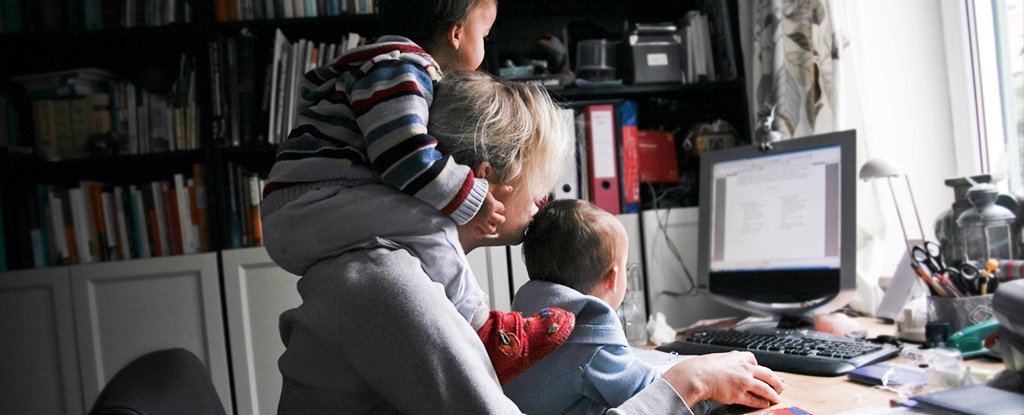
The concept of multitasking has historically been associated with the female gender. A woman, particularly a mother, is often expected to simultaneously manage professional responsibilities and household affairs – a demanding undertaking involving children’s meal preparation, domestic chores, and the coordination of appointments and social engagements.
However, a recent investigation, detailed in today’s edition of PLOS One, indicates that women do not possess a superior aptitude for multitasking compared to men.
This research sought to ascertain if women exhibited greater proficiency in task switching and concurrently handling multiple responsibilities. The findings revealed that the cognitive capabilities of men and women in these areas are comparable.
It is crucial to challenge such prevalent notions with empirical evidence, especially considering the continuous influx of work, family, and domestic obligations many women face.
Universal Limitations in Multitasking
Multitasking refers to the execution of several distinct tasks within a brief timeframe. This process necessitates rapid and frequent shifts in attention between activities, thereby intensifying cognitive load when contrasted with completing tasks sequentially.
This contemporary study supplements a substantial existing corpus of research that demonstrates the human brain’s inability to effectively manage multiple operations simultaneously. When two tasks share similar cognitive requirements, they compete for the same neural resources, significantly impeding the effectiveness of multitasking.
Nevertheless, the human brain excels at swiftly transitioning between different activities, creating the perception of multitasking. In reality, the brain dedicates its processing power to one undertaking at a time.
In this novel study, a cohort of German researchers assessed the comparative abilities of 48 males and 48 females in identifying letters and numbers. Certain experimental conditions required participants to focus on two tasks concurrently (termed “concurrent multitasking”), while others involved shifting attention between tasks (referred to as “sequential multitasking”).
The researchers meticulously recorded the reaction times and accuracy rates for these multitasking scenarios, benchmarking them against a control condition involving a single task.
The results unequivocally demonstrated that multitasking significantly impacted both the speed and precision of task completion for all participants, irrespective of gender. No discernible disparities were observed between the male and female groups.
Domestic Responsibilities Re-examined
My colleagues and I recently debunked another relevant stereotype: that women possess a keener eye for domestic disorder than men. Our findings indicated that both genders assigned similar ratings to the messiness of a space.
The disparity in the amount of cleaning undertaken by men and women may be attributed to societal expectations that hold women to higher standards of tidiness, rather than an inherent “dirt blindness” in men.
Contemporary data suggests an increase in the time Australian men are dedicating to domestic duties. However, women continue to bear the substantial majority of household labor.
Working Australian women have experienced an escalation in their total time commitment across both professional and familial activities. Specifically, mothers who are the primary breadwinners dedicate an additional four hours per week to these combined responsibilities compared to their male counterparts.
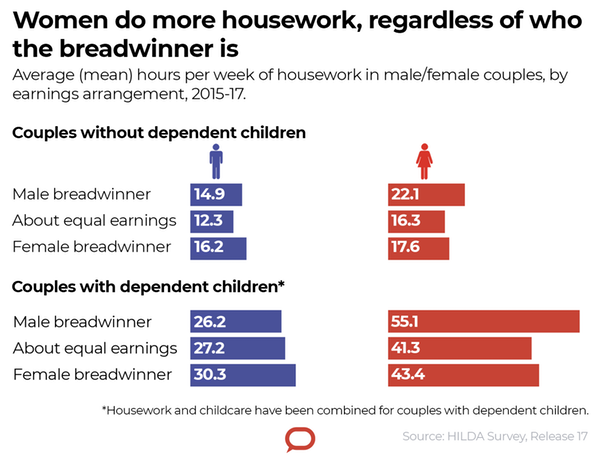
This signifies that working mothers are coordinating elaborate events like birthday parties, managing school drop-offs, and overseeing extracurricular activities, all in addition to their regular employment, commutes, and career progression.
Ramifications of the Multitasking Myth
If women’s cognitive resources are equally taxed by multitasking, why does the expectation persist that they should undertake this work? More importantly, what are the consequences of this assumption?
Our recent research indicates that mothers experience greater time constraints and report poorer mental well-being than fathers. We observed that the arrival of a child intensifies parental feelings of being rushed or time-pressed, with this effect being twice as pronounced for mothers as for fathers.
The birth of a second child further amplifies mothers’ time pressure, consequently leading to a decline in their mental health.
Women are also more prone to withdrawing from the paid workforce following childbirth or when familial demands escalate. They shoulder a more significant mental burden related to orchestrating the family’s needs – ensuring sufficient clean clothing, coordinating school pick-ups, and managing household supplies.
Women are frequently expected to manage familial responsibilities even during nighttime hours. Children are more likely to interrupt their mothers’ sleep than their fathers’.
While societal gender roles are evolving, and men are increasingly contributing to household chores and childcare compared to previous generations, significant gender disparities persist across numerous vital facets of professional and domestic life.
These disparities include the distribution of childcare responsibilities, the division of household labor, the gender pay gap, and the underrepresentation of women in senior leadership positions.
Consequently, the multitasking myth perpetuates the notion that mothers should be capable of “doing it all.” However, this obligation can adversely affect women’s mental well-being and their capacity to achieve professional success.
Deconstructing Preconceptions
A persistent public belief holds that women possess an inherent biological advantage as exceptionally proficient multitaskers. Yet, as this study demonstrates, this assumption lacks empirical validation.
This implies that the additional domestic labor performed by women is precisely that – additional labor – and it must be recognized as such.
Within the domestic sphere, this work requires systematic identification, open discussion, and equitable distribution. There is a greater contemporary commitment to gender equality, shared responsibilities, and co-parenting among men than ever before.
Beyond the home, these misconceptions must be challenged within the professional environment. The presumption of superior multitasking abilities in women can influence the assignment of administrative duties. Tasks such as minute-taking and meeting coordination should not be allocated based on gender.
Finally, governmental policies must actively dismantle these entrenched myths. The presence of children introduces labor that cannot be easily managed through multitasking. Women require access to affordable, high-quality, and widely available childcare.
Men also need access to flexible work arrangements, parental leave, and childcare to facilitate their participation in caregiving responsibilities, along with protective measures to prevent penalization for dedicating time to family care.
While dispelling the notion that women are superheroes is a beneficial step, we must advance further by cultivating policy frameworks that foster genuine gender equality and allow it to flourish.