Newly engineered all-optical nanosensors have been developed; these consist of luminescent nanocrystals capable of altering their light emission intensity and/or color in response to applied mechanical stress, whether tensile or compressive. Their operation relies exclusively on light interrogation, thereby enabling entirely remote data acquisition without the need for any physical tethers or electrical connections. These advanced sensors exhibit a force sensitivity that is 100 times superior to existing nanoparticles that leverage rare-earth ions for their optical characteristics. Furthermore, they boast an operational performance range spanning over four orders of magnitude in force, a significantly broader spectrum (10 to 100 times more expansive) than any prior optical nanosensor technology.

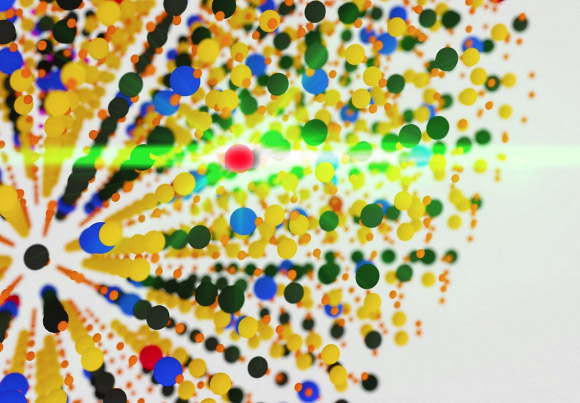
Illustration of the atomic arrangement within a single lanthanide-doped nanocrystal; each lanthanide ion can emit light. Image credit: Andrew Mueller / Columbia Engineering.
“We anticipate that our breakthrough will profoundly transform the sensitivity and dynamic range achievable with optical force measurement devices, instigating immediate disruption across diverse technological domains, from robotics and cellular biophysics to medicine and space exploration,” stated Dr. Jim Schuck, a principal investigator at Columbia University.
The novel nanosensors are now capable of achieving high-resolution, multiscale functionality utilizing a single sensor platform for the first time.
This development is significant as it permits the continuous examination of forces across a wide spectrum, from subcellular levels to entire system dynamics within both engineered and biological constructs. Such applications include the study of developing embryos, migrating cells, battery performance, or intricate nanoelectromechanical systems (NEMS)—highly sensitive devices where the physical displacement of a nanometer-scale structure is modulated by an electronic circuit, or vice versa—all through the deployment of this singular nanosensor, obviating the necessity for a varied array of sensor types.
“What distinguishes these force sensors—beyond their unprecedented capacity for multiscale detection—is their operational reliance on innocuous, biocompatible, and deeply penetrating infrared light,” commented Dr. Natalie Fardian-Melamed, a postdoctoral researcher affiliated with Columbia University.
“This characteristic facilitates in-depth observation of diverse technological and physiological systems, enabling remote monitoring of their operational integrity.”
“By enabling the early identification of anomalies or failures within these systems, these sensors are poised to exert a substantial influence on critical sectors, encompassing human health, energy provision, and environmental sustainability.”
The researchers succeeded in fabricating these nanosensors by harnessing the phenomenon of photon avalanching within nanocrystalline materials.
In the context of photon-avalanching nanoparticles, the absorption of a single photon by the material initiates a cascade of events, culminating in the amplified emission of numerous photons. Essentially, a single photon input results in a multitude of photon outputs.
The optically active constituents within the study’s nanocrystals are atomic ions belonging to the lanthanide series of elements, also recognized as rare-earth elements, which are incorporated into the nanocrystal matrix; for this particular investigation, thulium was the selected lanthanide.
It was observed that the photon avalanching process is exceptionally sensitive to several factors, including the inter-ionic distance between lanthanide atoms.
Capitalizing on this understanding, the researchers subjected some of their photon avalanching nanoparticles (ANPs) to gentle mechanical probing using an atomic force microscopy (AFM) tip. They discovered that the avalanching behavior was profoundly affected by these subtle forces—to an extent far exceeding their initial expectations.
“This discovery occurred quite serendipitously,” Dr. Schuck remarked.
“We had a pre-existing hypothesis regarding the force sensitivity of these nanoparticles, prompting us to measure their emitted light while applying mechanical stimuli.”
“The observed sensitivity proved to be dramatically higher than we had predicted!”
“Initially, we found it difficult to accept the results, suspecting an alternative influence from the probe tip.”
Armed with the knowledge of the ANPs’ remarkable sensitivity, the research team proceeded to design novel nanoparticles engineered to respond to forces in varied ways.
In one innovative design, the nanoparticle exhibits a modulation of its luminescent color directly proportional to the magnitude of the applied force.
In an alternative configuration, nanoparticles were fabricated that do not display photon avalanching under standard ambient conditions. However, upon the application of force, they initiate the avalanching process, revealing an extraordinary sensitivity to mechanical stress.
The team’s current objective is to deploy these force-sensing capabilities within a critical application area where their impact can be substantially realized.
“The imperative of developing advanced force sensors was recently underscored by Ardem Patapoutian, the recipient of the 2021 Nobel Prize, who highlighted the inherent challenges in interrogating environmentally sensitive phenomena within multiscale systems—a characteristic prevalent in the majority of physical and biological processes,” Dr. Schuck elaborated.
“We are enthusiastic contributors to these advancements that are reshaping the paradigm of sensing, enabling the precise and dynamic mapping of critical force and pressure variations in real-world environments that remain inaccessible with current technological capabilities.”
The collective research findings are published today in the esteemed journal Nature.
_____
Natalie Fardian-Melamed et al. 2025. Infrared nanosensors of piconewton to micronewton forces. Nature, in press; doi: 10.1038/s41586-024-08221-2
This article is adapted from a press release disseminated by Columbia University.