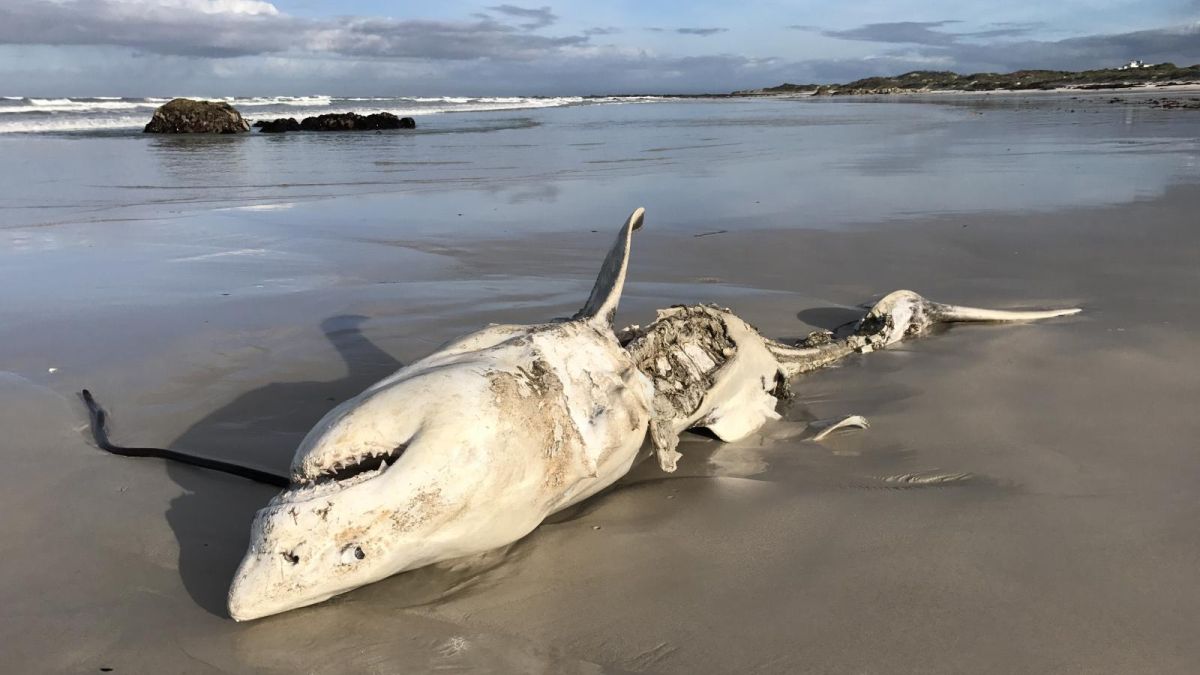
Off the coast of South Africa, in the vicinity of the fishing hamlet of Gansbaai, a pair of orcas have garnered international renown.
Known as Port and Starboard, these killer whales have been repeatedly observed engaging in the predation of one of the ocean’s most formidable inhabitants: the great white shark, Carcharodon carcharias.
The hunting prowess demonstrated by these two marine mammals (Orcinus orca) is so exceptional that some scientific observers have posited that their activities are a direct contributor to the declining numbers of these sharks in an area that once teemed with them.
However, a recent scientific publication presents a compelling counterargument. It suggests that the orcas may not be the principal architects of this ecological shift. Instead, a far more pervasive predator might be responsible for driving these sharks from their traditional territories: humankind.
In recent years, it has become increasingly apparent that killer whales possess sophisticated predatory tactics targeting sharks, including substantial species like whale sharks and great whites.
Through the strategic application of echolocation, orcas effectively create an “ultrasound” image of a shark’s anatomy, precisely targeting the liver—a vital organ replete with lipids crucial for sharks undertaking extensive migrations—and extracting it with remarkable surgical accuracy.
Between 2017 and 2025, spanning an eight-year period, there were eleven documented instances of orca-led predation on white sharks, frequently manifesting as washed-up carcasses. It is widely believed that Port and Starboard are responsible for these events. In 2017, researchers witnessed these two orcas dispatch and disembowel seventeen smaller sevengill sharks in a single day, an event that, while documented, was considered an anomaly.
It remains challenging to ascertain the precise annual mortality rate attributable to Port and Starboard, given that instances of these hunts may not always be recorded by human observers.
Nevertheless, according to research spearheaded by marine biologist Enrico Gennari of the Oceans Research Institute in South Africa, human activities likely surpass the predatory impact of killer whales by a significant margin.
His investigative team and their collaborators have amassed a substantial body of evidence to corroborate estimates of human-induced mortality among the South African white shark population, revealing figures considerably higher than those attributed to known orca predation.
The collective human impact, as determined by the research, involves the removal of an estimated 44 white sharks annually from the coastal waters of South Africa. This is primarily a consequence of the KwaZulu-Natal shark control program and the incidental capture (bycatch) associated with longline shark fisheries.
Historically, investigating this particular aspect of shark population dynamics has presented considerable complexity. In 1991, South Africa pioneered legislation to provide protection for the great white shark. Consequently, a mandate was established to monitor shark populations and implement measures for their conservation.
However, the precise dynamics of these white shark populations have been a subject of ongoing scientific discourse. A 2023 study proposed that rather than declining, the sharks had simply altered their geographical distribution, migrating eastward. The same research group subsequently provided further clarification in 2024, emphasizing that the absence of population growth since the 1991 protective measures nevertheless constitutes a significant cause for concern.
The prevailing narrative of a stable population could potentially diminish the urgency with which governmental bodies approach further conservation initiatives, as cautioned by researchers.
In their commentary piece, Gennari and his colleagues contend that the broader empirical evidence paints a more disquieting picture. They assert that the white shark population is not stable but is, in fact, diminishing. This trend carries more profound implications for the species on a global scale.
“Should the alarming reductions observed in regions historically recognized as the most significant aggregation sites for white sharks globally—occurrences within a span of less than fifteen years—be reflective of the entirety of the white shark population in southern Africa, as we firmly believe to be the case,” the researchers articulate, expressing that “the scenario would be profoundly disconcerting, portending a potential extinction risk that could materialize considerably sooner than current projections indicate.”
The most recent demographic assessment of white shark numbers, utilizing data up to 2011, estimated the population size at approximately 908 individuals. Subsequent analyses that incorporated genetic data, published in 2016, indicated that there are merely 333 mature individuals within a single, interbreeding population along the South African coastline.
No comprehensive census has been conducted since that time, and anecdotal reports suggest a marked decrease in sightings of these creatures in certain locales.
Within False Bay, close to Cape Town, white shark sightings were recorded at a rate of approximately 1.64 per hour between the years 2000 and 2015. This observation rate subsequently plummeted to 0.3 sharks per hour during the period from 2016 to 2020. By 2018, surveys conducted from boats indicated that the presence of these sharks had become virtually non-existent.
Gennari and his colleagues share profound concerns regarding the declining trajectory of the white shark population. Their estimations indicate that the 44 white sharks annually lost due to the demersal shark longline (DSL) fishery, regulated by the South African government, and the KZNSB shark control program, represent approximately 5% to 10% of the estimated population each year.
This level of attrition is inherently unsustainable, and this calculation does not even account for other human-induced mortality factors not encompassed within this specific estimate.
While the actions of Port and Starboard are beyond our capacity to influence, the researchers emphasize that this reality underscores the critical importance of implementing restrictions on human endeavors that endanger this vulnerable shark population.
“Predation by orcas represents a natural ecological process that, regardless of its intensity, falls outside the purview of governmental management control in South Africa. This is analogous to other mortality sources occurring in international waters,” the researchers state.
“Conversely, the ongoing mortality of white sharks stemming from the DSL and KZNSB fisheries, which are subject to governmental regulation, is by itself occurring at levels sufficiently high to impede white shark recovery and is likely contributing to their decline.”
“Although South Africa was a pioneering nation in enacting protections for white sharks,” the research team concludes, “we harbor a significant apprehension that it may very soon also bear the distinction of being the first nation to witness the extirpation of this species.”
The findings of this comprehensive report were officially disseminated in the scientific journal Endangered Species Research.