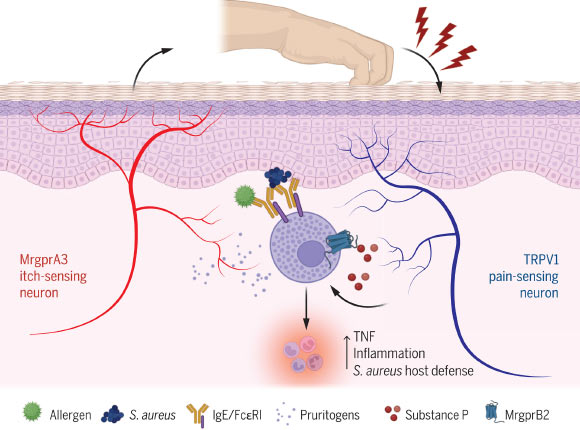

Scratching synergizes with FcεRI mast cell activation to drive allergic skin inflammation. Image credit: Liu et al., doi: 10.1126/science.adn9390.
The act of scratching, a compulsive and ingrained behavioral reaction conserved throughout evolution, is typically evoked by the sensation of discomfort on the skin.
In numerous prevalent dermatological conditions, such as eczema, persistent pruritus is the most prominent manifestation and contributes significantly to patient suffering and reduced quality of life.
It is well-established in clinical observation that scratching in response to itch exacerbates inflammatory skin conditions and plays a detrimental role in the pathogenesis of certain diseases.
Nonetheless, the sensation associated with scratching an itch is frequently perceived as pleasurable and does not typically elicit an avoidance response, indicating a potential host advantage.
“The inherent pleasure derived from scratching suggests a functional benefit that would be necessary for its evolutionary persistence,” stated Professor Daniel Kaplan of the University of Pittsburgh.
“Our research contributes to resolving this apparent contradiction by offering evidence that scratching also confers protection against cutaneous bacterial infections.”
Utilizing a novel genetically engineered mouse model, Professor Kaplan and his research team investigated the impact of disabling the functionality of specific itch-sensing neurons, known as nonpeptidergic 2 (NP2), on the intricate relationship between pruritus, the act of scratching, and subsequent inflammation.
Their investigations revealed that the physical act of scratching triggers pain-sensing neurons, which consequently release substance P (SP). This neurotransmitter then stimulates mast cells, escalating inflammatory responses primarily through the recruitment of neutrophils.
While scratching can indeed intensify conditions like dermatitis, it may paradoxically aid the host’s immune defenses by diminishing the presence of certain bacteria, such as Staphylococcus aureus, during infection episodes.
Furthermore, the mechanical action of scratching can modulate the skin’s microbial ecosystem at the site of injury, potentially averting dysbiotic imbalances. However, chronic afflictions like atopic dermatitis introduce complexities to this phenomenon.
The collective findings postulate that scratching functions as a dual entity: a pathological contributor to inflammation and an adaptive mechanism that enhances the body’s defense against microbial invasion.
“The observation that scratching improves resistance to Staphylococcus aureus implies that, under specific circumstances, it could be advantageous,” Professor Kaplan commented.
“However, the detrimental effects of scratching on skin integrity likely supersede this benefit when pruritus is of a chronic nature.”
These seminal discoveries have been published in the esteemed journal Science.
_____