Physicist Melvin Vopson from the University of Portsmouth offers a fresh perspective on gravity, postulating it not merely as a force of attraction, but as a consequence of the Universe’s inherent drive towards organizational efficiency.
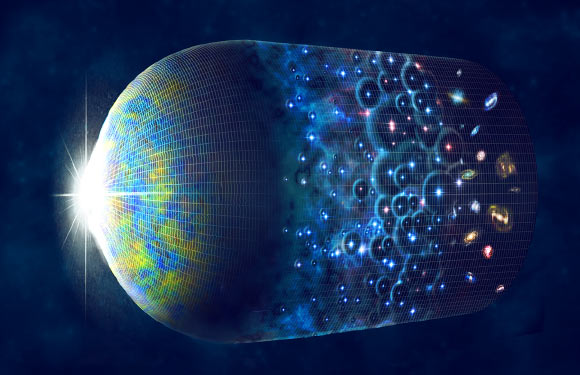
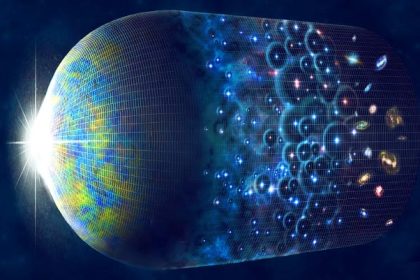
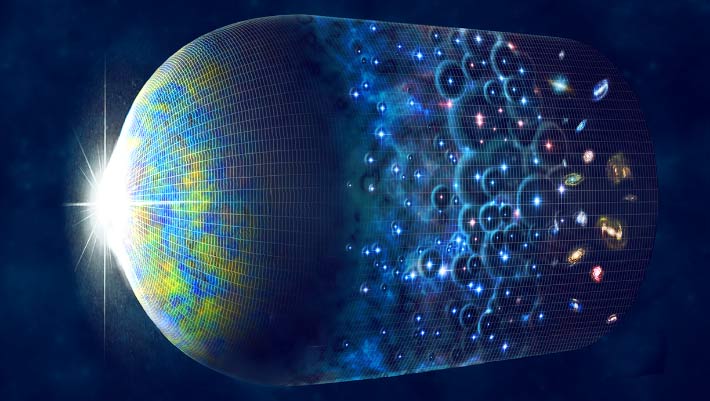
An artist’s depiction illustrates the Universe’s developmental trajectory, commencing with the Big Bang on the left and progressing through the emergence of the Cosmic Microwave Background. The initial stellar formations mark the conclusion of the cosmic dark ages, succeeded by the genesis of galaxies. Image attribution: M. Weiss / Harvard-Smithsonian Center for Astrophysics.
The notion that the cosmos is fundamentally informational in character, akin to a vast computational system, is a concept embraced by several prominent figures.
This line of reasoning originates from information physics, a scientific domain positing that the very fabric of physical reality is constituted by structured information.
In his recent publication, Dr. Vopson unveils findings suggesting that gravity, or the gravitational force, emerges from a computational process inherent to the Universe.
He posits that the phenomenon of gravity may stem from the systematic organization of informational content pertaining to matter within the cosmos.
By applying the second law of information dynamics, he asserts that matter and celestial bodies are drawn together because the Universe endeavors to maintain its informational integrity and compactness.
“The discoveries presented in this investigation align with the hypothesis that the Universe might function as an immense computational entity, or that our perceived reality is a simulated construct,” stated Dr. Vopson.
“Much like computational devices strive to optimize storage and enhance operational efficiency, the Universe may be pursuing similar objectives.”
“This represents an innovative paradigm for understanding gravity—viewing it not simply as a pull, but as a manifestation of the Universe’s pursuit of order.”
Dr. Vopson has previously disseminated research proposing that information possesses mass and that all fundamental particles retain intrinsic informational data, analogous to how DNA encodes information within biological cells, the foundational units of living organisms.
In his most recent paper, he delineates how the “pixelation” of spacetime at the elemental level can function as a data repository. Furthermore, he elaborates on how the information stored within these elemental units dictates the spatial coordinates and inherent properties of matter within a simulated spacetime framework.
Each elemental unit is capable of recording information in a binary format: a digital ‘0’ signifies an empty state, while a digital ‘1’ indicates the presence of matter.
“This operational mechanism is precisely how digital computer games, virtual reality applications, or other sophisticated simulations are architected,” Dr. Vopson remarked.
“When a single unit can contain multiple particles, the system initiates an evolutionary process by repositioning these particles in space, consolidating them into a singular, larger entity within that same unit.”
“This aggregation triggers an attractive force, dictated by the governing rules of the computational system, which mandates the minimization of informational complexity and, consequently, a reduction in computational demands.”
“In simpler terms, it is significantly more computationally efficient to track and calculate the position and momentum of a solitary object than to manage numerous individual objects.”
“Consequently, it appears that gravitational attraction is merely another optimization strategy employed by a computational process whose function is to condense information.”
“This study introduces a novel conceptualization of gravity, supporting the viewpoint that gravitational attraction originates from an intrinsic imperative to decrease information entropy across the Universe.
“The outcomes present marked conceptual and methodological divergences, suggesting that gravity functions as a computational optimization mechanism, wherein matter spontaneously organizes to reduce the complexity of information encoding inherent to spacetime.
“The broader implications of this research extend into fundamental physics, encompassing aspects of black-hole thermodynamics, inquiries into dark matter and dark energy, and potential linkages between gravity and quantum information theory.
“The question of whether the Universe truly constitutes a computational construct remains an unresolved query.”
The paper was released on April 25, 2025, in the scientific journal AIP Advances.
_____
Melvin M. Vopson. 2025. Is gravity evidence of a computational Universe? AIP Advances 15, 045035; doi: 10.1063/5.0264945