An international contingent of physicists, leveraging the capabilities of Lawrence Berkeley National Laboratory’s 88-Inch Cyclotron, has achieved a significant milestone by synthesizing two atoms of livermorium (element symbol Lv). This pioneering feat, accomplished for the first time using a titanium beam, now paves the way for the laboratory to pursue the creation of the next superheavy element, element 120.

To synthesize livermorium, researchers, including Gates and her team, successfully combined isotopes of titanium and plutonium. Image courtesy of Jenny Nuss, Lawrence Berkeley National Laboratory.
The current catalog of known elements encompasses 118 distinct entities, with a mere 90 found naturally on our planet.
Elements surpassing fermium, characterized by their 100 protons, necessitate an artificial creation process involving the fusion of atomic nuclei from two lighter elements; however, not all such combinations yield successful results.
The synthesis of the heaviest elements identified to date has been achieved by merging a specific calcium isotope, calcium-48 (possessing 20 protons and 28 neutrons), with heavier atomic species. This established methodology, however, has proven effective only up to element 118, oganesson.
The stability of atomic nuclei is influenced by certain “magic numbers” of protons and neutrons, which enhance the probability of successful fusion and the subsequent persistence of the resultant compound nucleus.
Nevertheless, advancements beyond this threshold demand the exploration and implementation of novel methodologies.
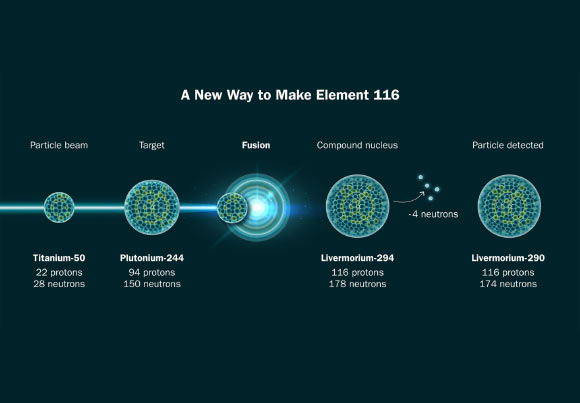
In a series of recent investigations, Dr. Jacklyn Gates, affiliated with Lawrence Berkeley National Laboratory, and her collaborators have reported a groundbreaking advancement. They successfully accelerated a beam composed of titanium-50 (comprising 22 protons and 28 neutrons) within the 88-Inch Cyclotron, inducing a fusion reaction between these titanium nuclei and those of plutonium-244 (which contains 94 protons and 150 neutrons).
Over an experimental duration spanning 22 days, the physicists meticulously managed to produce two atoms of livermorium, a chemical element designated by the symbol Lv and possessing an atomic number of 116.
This experimental outcome unequivocally demonstrates that the synthesis of elements beyond oganesson is indeed achievable at Berkeley Lab.
Nonetheless, the endeavor to create element 120 is anticipated to present a significantly greater challenge, estimated to be 10 to 20 times more arduous than the production of livermorium.
Should this ambitious undertaking prove successful, element 120 would ascend to the status of the most massive known element, thereby unlocking unprecedented avenues for investigating the extreme boundaries of atomic structure and rigorously testing contemporary theories in nuclear physics.
“This particular nuclear reaction had never been experimentally verified before. It was an indispensable prerequisite to confirm its feasibility before we committed to our attempt to synthesize element 120,” stated Dr. Gates.
“The creation of a new element is an exceptionally infrequent occurrence. It is immensely rewarding to be a contributor to this process and to have identified a promising pathway forward.”
“It represented an important initial phase, allowing us to experiment with synthesizing something marginally less complex than a new element, thereby assessing how transitioning from a calcium beam to a titanium beam impacts our production yields of these elements,” commented Dr. Jennifer Pore, also a researcher at Lawrence Berkeley National Laboratory.
“When we are engaged in the pursuit of these exceedingly scarce elements, we are positioned at the very frontier of human comprehension and knowledge, with no inherent guarantee that the fundamental principles of physics will behave precisely as we anticipate.”
“The successful synthesis of element 116 utilizing titanium serves as definitive validation of this production methodology, and we are now equipped to strategize our pursuit of element 120.”
The scientific findings of the research team have been formally documented in a publication featured in the esteemed journal, Physical Review Letters.
_____
J.M. Gates et al. 2025. Toward the Discovery of New Elements: Production of Livermorium (Z=116) with 50Ti. Phys. Rev. Lett 133, 172502; doi: 10.1103/PhysRevLett.133.172502