Geochemical investigations have been undertaken by academics from Tel Aviv University at two smelting sites within the Timna Valley, located in the Southern Arabah region of southern Israel. These sites date back to the 10th century BCE, a period coinciding with the reigns of the Biblical monarchs David and Solomon. The research has determined that environmental contamination stemming from copper production during that era was negligible and confined to specific areas, posing no threat to the local populace, either historically or in contemporary times.

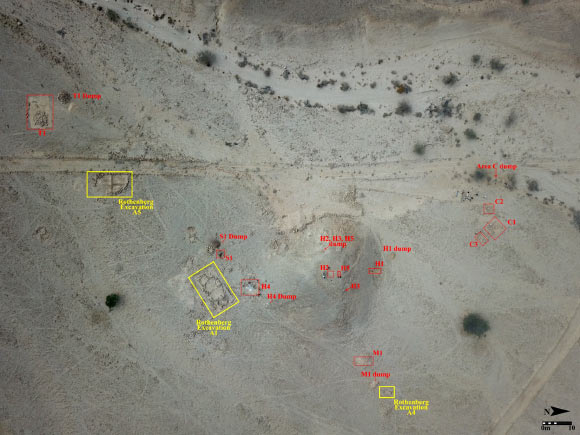
Aerial survey of Site 201, situated north of the central Timna Valley on the western periphery of the Wadi Arabah, Israel. Image attribution: Yagel et al., doi: 10.1038/s41598-024-80939-5.
“We examined two principal copper extraction locations in the Timna Valley: one from the Iron Age, corresponding to the era of King Solomon, and an adjacent site approximately 1,500 years older,” stated Professor Erez Ben-Yosef of Tel Aviv University.
“Our investigation was comprehensive. We collected hundreds of soil specimens from both locations for chemical analysis, thereby generating detailed maps illustrating the distribution of heavy metals in the vicinity.”
“Our findings indicate that contaminant levels at the Timna copper extraction sites are exceptionally low and are restricted to the immediate vicinity of the ancient smelting facilities.”
“For instance, the concentration of lead, which is the principal contaminant associated with metal industries, decreases to below 200 parts per million within a few meters of the furnace.”
“In contrast, the United States Environmental Protection Agency classifies industrial zones as safe for laborers at 1,200 parts per million and residential areas as secure for children at 200 parts per million.”
This recent research challenges a series of academic publications from the 1990s onward that posited widespread pollution attributed to ancient copper extraction activities.
“We have demonstrated that these assertions are unfounded,” Professor Ben-Yosef commented.
“The contamination in Timna is highly localized, and it is probable that only those individuals working directly at the furnace were exposed to inhaled toxic fumes, while areas a short distance away exhibited entirely safe soil conditions.”
“Furthermore, the correlation identified between the spatial distribution of copper and lead concentrations in the soil strongly suggests that these metals are retained within the slag and other industrial byproducts, preventing their dispersion into the soil and consequently mitigating any impact on vegetation or human health.”
“Our findings are consistent with several recent studies conducted in the Wadi Faynan region of Jordan, which also point to very minimal pollution levels.”
“The Timna and Faynan locations are particularly well-suited for this kind of research because they have remained undisturbed by contemporary mining operations, unlike sites such as Cyprus. Additionally, their arid climates prevent the leaching of metals from the soil.”
“In Faynan, scholars from the Hebrew University analyzed 36 sets of human remains from individuals who resided at the mining site during the Iron Age. Only three individuals displayed any evidence of pollution in their dental structures, while the remainder were entirely unaffected. We are now presenting a comparable scenario for Timna.”
In addition to their geochemical survey, the researchers reviewed existing scholarly works, concluding that hypotheses regarding widespread pollution during the pre-Roman era lack substantive empirical support.
“There was a discernible trend in the 1990s that characterized ancient copper production as the inaugural instance of industrial pollution,” noted Dr. Omri Yagel from Tel Aviv University.
“Such declarations, while attention-grabbing and conducive to securing research funding, inaccurately project contemporary environmental concerns onto historical periods.”
“Moreover, the research literature frequently employs the term ‘pollution’ to denote any indication of ancient metallurgical activity. This has fostered a misconception that metal industries were inherently detrimental to human health from their nascent stages, a notion that is demonstrably false.”
“Even during periods when metal production evolved into a large-scale enterprise and became integral to the development of human civilization, it was specifically the lead industry, with its toxic byproducts, that contributed to global pollution, rather than other metals.”
“A study from the 1990s proposed that traces of copper found in ice cores from Greenland had traversed the atmosphere from locations such as Timna.”
“However, this assertion has not been validated by any subsequent investigations.”
“As contemporary researchers confronting formidable environmental challenges, such as climate change, we often find ourselves inclined to seek parallels in historical periods or to assume that environmental degradation has been an inherent consequence of human endeavors since the advent of agriculture.”
“Nevertheless, it is imperative that we exercise caution. While we may identify localized waste materials, such as slag deposits, as ‘pollution,’ we must refrain from conflating this contained residue with widespread regional or global environmental contamination.”
This groundbreaking research is detailed in a publication released on November 29 in the esteemed journal Scientific Reports.
_____
O. Yagel et al. 2024. Pre-Roman copper industry had no polluting impact on the global environment. Sci Rep 14, 29675; doi: 10.1038/s41598-024-80939-5